dollshow

dollshow

AUSTIN DOLL COLLECTORS SOCIETY

The Austin Doll Collectors Society is an organization of antique, vintage, and modern doll collectors, dealers, and artisans. We meet on the second Sunday of each month and our meetings are fun and educational. We begin with refreshments and socializing, and, following our brief business meeting, there is a special doll-related program and "show and tell." The Austin Doll Collectors Society is a nonprofit organization and is a member of the United Federation of Doll Clubs.

Thursday, October 25, 2018

October 13, 2018, Doll Show Special Exhibit

At our October 13, 2018, doll show, club members shared their dolls in a special exhibit that gave a brief tour of doll bodies from the 1800s through contemporary times. While it is the faces of dolls that intrigue and delight collectors, doll bodies, although often hidden under clothing, are as important an element of a doll’s history and appeal. 


Although doll heads have long been made out of papier mache, wood, bisque, and china, the bodies are generally made from another material, such as cloth or kid. Making a doll entirely out of bisque or china would have been expensive to manufacture and ship and result in a doll too heavy and fragile for a child to play with. Also, as the bodies would be covered by clothing, a less expensive body made more economic sense. For families who could not afford to buy an entire doll, shops and general stores often offered shoulder heads, with the body to be sewn at home. The larger doll features an early papier mache shoulder head by Adolph Wislizenus of Germany, circa 1865. It is on a homemade cloth body with stitched joints and separately sewn fingers. Such bodies might seem crude to our modern eyes, but no doubt this doll was beautiful to some little girl long ago, giving her a companion to cuddle and dress.

Her tiny companion is a small exception (literally) to the general rule that doll bodies were not made of bisque or china. Beginning in the 1870s, Germany and France produced small dolls entirely of bisque, often jointed at the shoulders and hips, and for the finer versions, with swivel necks. This example is by the German firm of Simon and Halbig. She, like most of the earlier and finer all-bisque dolls, is peg-strung, meaning that the elastic was pulled through a hole at the top of the arm or leg and pegged into place with a bit of wood. Later, dolls were made with molded loops, making stringing much simpler. By the 1910s, many companies like Hertwig and Company of Germany were using inexpensive and sturdy wire to string their dolls. 


Germany had a long history of producing wooden play dolls, but the seated doll is a rare example made in the United States. In 1858, Joel Ellis established a factory that manufactured a variety of toys from wood, such as doll carriages, sleds, carts, and wagons. Expanding upon his toy business, in 1873 Ellis patented a doll carved from rock maple. However, because of an economic depression, the dolls were produced for only one year. Although the head is stationary, the doll is jointed at the shoulders, elbows, hips and knees with with mortise and tenon joints and has metal hands and feet. 

The standing lovely lady is from the French firm of Jumeau and dates from the 1870s. From the 1860s through the 1880s, most dolls portrayed adult women. The French were renown for their costly fashion dolls with bisque or china heads and wasp-waisted bodies, typically of fine kid. There was an entire industry in Paris dedicated to providing these costly dolls with all the accoutrements of a fine lady of fashion. 


Kid bodies with rivets joints and bisque or composition arms were also used on the later bisque shoulder head child dolls. This example with a pristine kid body is Mold 195 by J.D. Kestner. Her face, with its large eyes, sweet bland expression, and open mouth with tiny teeth is known to collectors as the “dolly face,” a popular style produced by many German and French companies. Note this model has fur eyebrows, patented by Kestner in 1910.
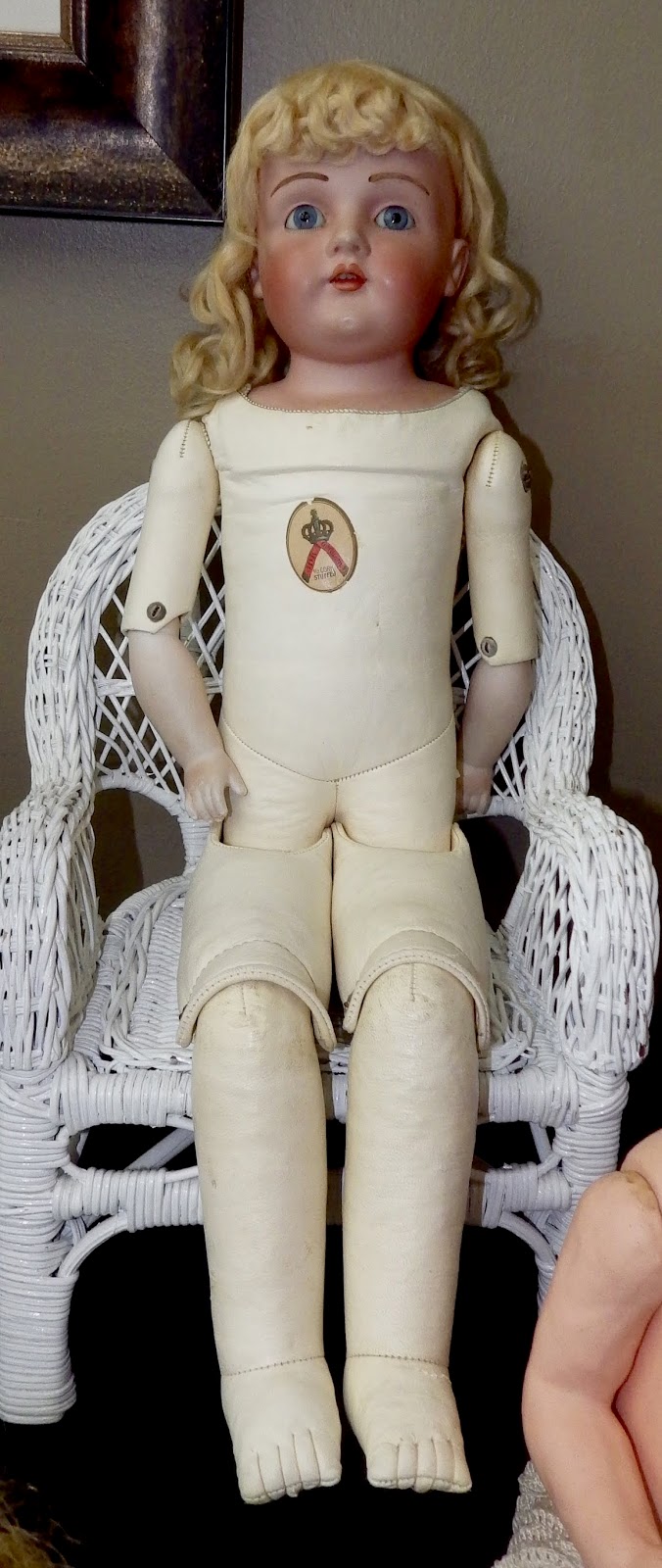

In 1909, the German company of Kämmer and Reinhardt introduced Mold 100 (dubbed by early collectors as the Kaiser Baby). Not only did the bisque head realistically portray that of a infant with a toothless smile and double chin, the composition body was shaped like that of a plump baby with pudgy bent arms and legs. Other companies quickly copied this body for their own line of infants. This example of a bent-limb body is Mold 619 by the German firm of Bahr and Proschild.


German doll artist Käthe Kruse began making dolls for her daughters because she disliked the available commercially-made toys. In 1910, she displayed her dolls in a Berlin department store and they were so popular she began producing them commercially. The early dolls had muslin bodies stuffed with reindeer hair, were jointed at the hips and shoulders, and featured hand painted pressed fabric heads. The bashful boy in the back in his original underwear dates around 1912.

The seated all-wood doll was created by the American company founded by Albert Schoenhut. In 1911, the company introduced the “All-Wood Perfection Art Doll.” The dolls were jointed with a system of internal springs. They had holes in their feet and wore special shoes and socks with matching openings. The holes fit on a stand which allowed the dolls to hold almost any pose. The earliest dolls had character faces, but in order to compete with less expensive bisque and composition dolls., Schoenhut later introduced faces with more doll-like features, as well as toddler and baby dolls, and even a doll with sleeping eyes. However, by 1935 the company declared bankruptcy.

By the 1880s, child and baby dolls had pushed aside their more womanly counterparts, conquering the playroom. However, in the Edwardian period, lady dolls won a brief reprieve with the popularity of the Gibson girl. Both French and German companies produced lady dolls on womanly ball-jointed composition bodies. The elegant Edwardian in the pink silk corset is "La Patricienne" by Edmund Daspres and dates from 1905. Although her body with its narrow waist and subtle bosom was created in France, her bisque head is Mold 1159 by the German firm of Simon and Halbig.  


Beginning in the 1910s, American companies began producing dolls made entirely out of composition or with composition heads and limbs. Lightweight, sturdier, and less costly than bisque dolls, they quickly conquered the American market. Composition could not be washed and the finish could craze or crack as the underlying composition material expanded or contracted due to humidity and temperature. Composition was replaced by hard plastic after WWII. The pretty girl in pigtails is typical of many of the dolls of the era, with a composition head and limbs, but a cloth body, often with a simple mechanism that made the doll squeak “Mama” when tilted. She is unmarked. 

From 1928 through the 1940s, Joseph Kallus, the founder of Cameo Doll Company, created a series of character dolls with segmented wood bodies and composition heads. These included well-know comic characters such as Betty Boop and Popeye, Walt Disney characters such as Mickey Mouse and Jiminy Cricket, and advertising dolls. Others were simply charming children, such as this Joy, introduced in 1932.


This curvaceous beauty heralds the reintroduction of the lady doll. In 1955, Madame Alexander created Cissy, a glamorous fashion doll with a shapely female figure, feet molded for high heels, and a sophisticated wardrobe. Of hard plastic and 20 to 21 inches tall, Cissy is jointed at the neck, shoulders, elbows, hips, and knees, with earlier dolls also having an upper arm joint. She was produced through 1962, with a vinyl version reintroduced in 1966.


The popularity of Cissy encouraged other companies to introduce similar fashion ladies. In 1958, Uneeda Doll Company introduced its own fashion lady doll, Dollikin, here seated in the brown chair.  Advertised as the “Original Doll Mannikin,” her body was jointed in 16 places—neck, shoulders, upper arms, elbows, wrists, waist, hips, knees and ankles—allowing her to assume a wide variety of poses. Produced until 1962, this version has a hard plastic body and a vinyl head. 

 Everything old is new again, as shown by this modern BJD (ball jointed doll) in the white wicker chair. In 1999, the Japanese corporationVolks introduced “Super Dolfie,” a posable ball-jointed resin doll aimed at adult collectors. The popularity of the dolls created an entire industry of BJD dolls, first in Japan, then spreading to Korea and China. Soon companies in the United States and Europe were creating BJDs, as well as many doll artists. Innovations such as interchangeable face plates, eyes wigs, hands, and feet inspired collectors to customize their dolls. This example is Volks Super Dollfie or SD Kira.


 From 1955 through1960s, American Character produced its own multi-jointed hard plastic doll, Toodles, a beautiful baby doll with jointed elbows and knees. She was advertised as being able to pose in 1,000 different positions.


Wednesday, October 10, 2018

October 1, 2018, Meeting

The refreshment table was adorned with ghoulish Halloween goodies. 


Hexe, a scary witch doll produced by Simon and Halbig for Cuno and Otto Dressel, watches over the treats with the assistance of her familiar, a black character cat by Gebruder Heubach.


The program focused on last minute details for our upcoming doll show.  However, afterward several members brought dolls for show and tell.  Member Michele Thelen shared several unusual dolls from her collection.


Sallie Howard and Lisa Fonet discussed the recent Barbie convention and displayed their new dolls.


Monday, October 1, 2018

More on Our Special Drawing

Last week, we told you about a special top secret drawing to be held at our upcoming doll show.  The  clues were "American Girl" and "twice as nice."  Well, at tonight's meeting club members got a preview of just some of the treasures to be included in the drawing.  We can't post a picture, but can assure you it will feature goodies galore.  At the show, there will be hourly reveals of parts of the prize, with the drawing at 3:00 PM.  Any holder of admission ticket is eligible, but you must be present at the time of the drawing to win. 


Wednesday, September 26, 2018

Special Drawing at Our Upcoming Show

Our doll show is just a couple of weeks away.  Last year we had a very special drawing for Nanea, a newly introduced character doll donated by American Girl.  We have another special drawing at our upcoming show, but it is top secret.  Two hints--"American Girl" and "twice as nice." But you have to come to our show to uncover the secret (and be present to win).


Monday, September 17, 2018

More on Our Special Exhibit

As announced previously on our blog,  this year our doll show will feature a special display of dolls entitled, "Doll Bodies, From Bisque to BJD," demonstrating the history of doll bodies over the past two centuries, from early bisque to modern resin ball jointed dolls.  This elegant Edwardian lady will be part of the exhibit, demurely demonstrating her ball-jointed lady body with its curvaceous hourglass shape.  Her fine cotton combination undergarment, stockings, and shoes are original and some talented seamstress created her silk corset.  The doll is "La Patricienne" by the French firm of Edmund Daspres and dates from 1905. Unlike other French companies who tried to disguise the fact they were buying German heads for their French dolls, the La Patricienne heads carry the Simon and Halbig "S&H" mark.  This lovely lady is a petite 15 inches tall.  Her sleeping blue eyes have the remains of mohair eyelashes and her human hair wig is on a French cork pate. 

Wednesday, September 12, 2018

Buddy Lee Revisted

Earlier this blog, as part of the celebration of Labor Day, featured Buddy Lee, who began his career in 1920 as a miniature mannequin for H. D. Lee Company Inc., the maker of Lee Jeans  These charming chubby Buddy Lees belong to member Jenell Howell. They are the 13-inch tall plastic version, first introduced in 1949.  Both Buddy Lees still wear their original Lee Jeans outfits, one dressed as a cowboy and the other as an engineer.


Saturday, September 8, 2018

Labor Day Week; Soldier Boys

Created by cartoonist Percy Crosby, Skippy was a popular comic strip that ran from 1923 to 1945. It focused on the everyday life and adventures of its eponymous hero, a young boy growing up in a city. The strip is considered the archetype and inspiration for many child-centered cartoons, including "Peanuts" by Charles Schulz. There was a novel, a radio show, and a 1931 movie starring Jackie Cooper based on the Skippy comic. Effanbee produced a 14-inch tall composition Skippy doll from 1923 through 1943 based on the comic strip character and serving as the boyfriend to Effanbee's popular Patsy doll. The Skippy doll wore a variety of outfits, including military uniforms. This Skippy belongs to member Sylvia McDonald. She recalls that her brother Larry received Skippy for Christmas in 1941 when Larry was almost one year old. That same Christmas Sylvia received an Ann Shirley doll and she and Larry spent many hours playing together with these dolls, whom they named after school teachers boarding at their home and that of their grandmother. Their mother sewed this military outfit to replace Skippy's missing original clothes and Larry gave Skippy to Sylvia in 1984 as a surprise because Larry wanted his childhood doll to go to “someone special." In 1997, the United States Post Office released a series of 17 stamps portraying "Classic American Dolls," which included Skippy wearing the original of this uniform.


This early aviator belongs to member Elaine Jackson and dates from the WWI era. He is composition and cloth and is stamped "Germany."


This unusual all-bisque doll wears a molded military uniform that appears to be inspired by those worn by the hussars (originally a Hungarian calvary division, but the name and uniform were adopted by light calvary throughout Europe) including the fur-edged pelisse draped over the left shoulder. He is 8 inches tall.


Friday, September 7, 2018

Labor Day Week; French Fisherfolk

Boulogne-sur-Mer on the northern coast of France was a popular tourist destination in the 19th century for both French and English tourists, who flocked there in the summer to enjoy its beautiful beaches and charming countryside. One of its charms were the hardworking fisherfolk in their traditional costumes. Male visitors no doubt especially appreciated the scenery because the fisherwomen were not shy about wading into the surf with skirts tucked up to expose well-toned bare legs! And what better way to remember your seaside sojourn than to bring back a pair of dolls in the famed folk attire? This all-original pair has beautiful bisque shoulder heads attributed to Francois Gauthier, but they have the crude bodies typically found on these souvenir dolls, with terra cotta molded lower limbs and a wire armature body wrapped in cloth. There costumes are nicely detailed, from the man's waterproof hat to the fishing net held by his female companion. While he has molded sturdy boots, her lower legs and feet are bare. Her traditional lace bonnet is known as "le soliel." These fisherfolk can be found with a wide variety of heads, from terra cotta to bisque and china produced both by French and German makers. 


Thursday, September 6, 2018

Labor Day Week; Barbie

No modern doll is as iconic, or had so many careers, as Barbie.  Although she started out as a teenage fashion model in 1969, over the decades she has been everything from an aerobics instructor to a yoga teacher and pretty much everything in between.  These Barbies from the collection of member Gail Simpler are just a sample of three positions in Barbie's extensive employment record.  In 1989, Barbie enlisted in the United States Army as part of the Mattel American Beauties Collection.


However, the following year found her serving in the United States Navy.


In 1994 Barbie traveled to the moon in a special edition created to commemorate the 25th Anniversary of the Apollo 11 moon walk. However, this was not Barbie's first time in the space. In 1965, little girls could dress Barbie in her realistic "Miss Astronaut" outfit, complete with helmet, gloves, and boots, and Ken in his matching "Mr. Astronaut" ensemble. 1985 saw another Astronaut Barbie, this time in a fuchsia and silver suit that seemed more appropriate for a night at the disco than a walk on the moon 


Wednesday, September 5, 2018

Labor Day Week; Peddler Dolls or Notion Nannies

During the Victorian period in England, peddlers and street vendors carrying an array of goods and notions in a basket or displayed on a tray traveled the city streets and rural roads offering bolts of lace and ribbon, sewing articles, costume jewelry, toys, and a wide of small inexpensive goods.  It became a popular pastime for women and girls to dress a small doll as a peddler, typically a woman, and fill her little basket or tray with all sorts of marvelous miniature goods, some ingeniously homemade and others commercially created.  The dolls were made from a wide variety of materials, such as wood, papier mache, china, or bisque and generally wore a cloak, a bonnet, a simple calico dress, and a white apron.  When completed, the peddler doll or "notion nanny" often was displayed in a glass dome.  Creating a notion nanny is still a popular theme for doll artists or a pastime for collectors, as it is a wonderful way to display a collection of miniatures.  This wood peddler doll from the collection of Elaine Jackson was carved by doll artist Helen Bullard.


This is an antique notion nanny with a tray overflowing with tiny trinkets, many homemade from beads, paper, and bits of lace or ribbon.  She typically sits under a hand blown glass dome.  Her character head is papier mache and she has a crude jointed wooden body.


Many of her goods are still labeled with tiny homemade signs, such as this offering of "dressed dolls."


Tuesday, September 4, 2018

Labor Day Week; The Milkmaid

All this week our blog will commemorate Labor Day by featuring dolls in working garb. This miniature milkmaid poses with a metal milk pail in one hand and her wooden milk can in the other. Unlike the milkman, whose job was to deliver the milk, the milkmaid was responsible for milking the cows and preparing cream, butter, and even cheese.   Historically, many large estates had private dairies and employed one or more milkmaids to skillfully run them.  Milkmaids were renown for their buxom figures and smooth rosy complexions, especially noticeable at a time when many people bore extensive scarring marking them as survivors of the dreaded smallpox.  It has been claimed that Edward Jenner, who developed the first vaccine against the scrounge of smallpox, overheard a pretty milkmaid brag about her flawless skin and that she would never suffer from smallpox because she had once contracted cowpox.  Later Jenner would discover that exposure to the far more milder disease of cowpox gave the person immunity to smallpox. Although this story appears to be more fiction than fact, a milkmaid's profession appears to have helped her preserve her complexion.

This 8-inch tall milkmaid is all original and is on a fully jointed composition ball jointed body, even at her wrists.  Under her bonnet, her blond mohair wig is worn in elaborate braids and her bright blue glass eye sleep.  The front of her bodice has been padded to give her the well-fed figure associated with milkmaids and her blooming complexion is flawless.  An old faded label pinned to the back of her apron states "Belgium."  She is incised back of her head "Germany A 12/0 M," indicating that she is by the German maker Armand Marseille.  Her cow companion is Bessy by Steiff, first introduced in 1958, and is made of mohair, felt, and velveteen.

Monday, September 3, 2018

Happy Labor Day; Buddy Lee

Opening our Labor Day week is Buddy Lee, a true working man. He began as a mannequin for H. D. Lee Company Inc., maker of Lee Jeans, in 1920, modeling miniature versions of Lee clothing in stores. The 12.5 inch composition dolls were offered to the public when displays were taken down and later Buddy Lee dolls were retailed by Lee.  Beginning in 1949, Buddy Lee was produced as a 13-inch tall plastic doll.  Although the dolls were discontinued in 1962, Buddy Lee has appeared in Lee advertising and Coca-Cola offered a reproduction Buddy Lee dressed in its uniform in the 1990s. There was no official female version of Buddy Lee; so-called Betty Lee dolls are composition carnival dolls that resemble Buddy Lee and may have been manufactured by the same company that produced Buddy Lee. During his long career, Buddy Lee wore outfits and uniforms representing a wide variety of occupations, including Coca Cola salesman cowboy, gas station attendant, railroad worker, and baseball player. All authentic clothing should carry the Lee tag.

This all-original Buddy Lee dressed as a Phillips gas station attendant belongs to member Sylvia McDonald. He is a childhood doll and was purchased for her at a Phillips 66 gas station run by Bill Balch in New Home, Texas, for $4. 


Thursday, August 30, 2018

Special Exhibit at Our Upcoming Show

This year our doll show will feature a special display of dolls entitled, "Doll Bodies, From Bisque to BJD." The exhibit will show a history of doll bodies over the past two centuries, from early bisque to modern resin ball jointed dolls.  This frisky flapper just one of the dolls that will be on display.  By the German firm of Simon and Halbig, this 13-inch tall lissome lass has a slim flapper body, shapely legs with a ball joint at knees, and feet molded to fit heeled pumps. She is all original, from her bobbed mohair wig to her scandalous silk teddy to her rayon stockings with ribbon garters and high heels.  This lovely little lady is incised on the back of her head “1159 Simon & Halbig S&H 5.” 


Thursday, August 23, 2018

August 6, 2018, Meeting

Members Sallie Howard and Pam Wolf did a program on the recent United Federation of Doll Clubs Convention that took place on July 17th to July 21st in Phoenix, Arizona.  Next year's convention will be in Nashville, Tennessee.   Sallie and Pam shared many of the new dolls they acquired at the convention (thanks to Ann Meier for taking these photographs!).  Pam brought this elegant reproduction French fashion doll made by Becky Hisle. she is 16" tall. The dress she is wearing is made from a kit by Patty Ulrich .


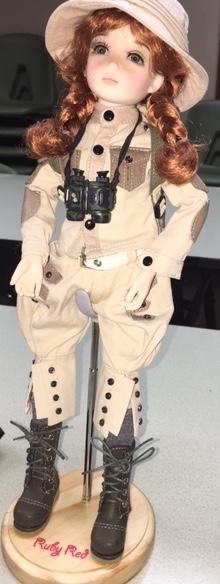
Sallie shared a number of her new dolls. This lass dressed for an expedition is by Ruby Red Galleria and was the convention souvenir doll, fitting into the convention theme, " Passport to Adventure." 


Sallie acquired two versions of that beloved wooden doll known as Hitty.


This little Hitty was a luncheon souvenir.


This little girl is Tibby by artist Judy Porter.  She is 6 inches tall and is a one of a kind creation.


Elaine Jackson brought this sweet vintage cloth doll for show and tell. The doll has a painted face, yarn hair, and stitched fingers. 


Thursday, August 2, 2018

Women Doll Artists: Elena König Scavini


Elena König was born in Turin in 1886. When she was 14 years old she did what so many children dreamed of and ran off to join the circus. She returned home after a few months and later studied art and photography. In 1915, she married Enrico Scavini and moved with him to Italy. After the loss of her first child, Elena began creating dolls, using readily available felt and working with her brother to create special molds. In 1919, the Lenci factory was established. "Lenci" is thought to be an acronym from the Latin motto "Ludus Est Nobis Constanter Industria" (Play is our constant work), although some biographers state that it is also based on Elena’s German nickname.  The company's artistic felt dolls, typically dressed in beautifully tailored outfits of felt and organdy, became very popular and were widely copied by companies throughout Europe.  In 1928, Lenci also began a ceramics factory renowned for its stylized figurines.  The company created everything from small souvenir dolls and mascots to high-end play dolls to decorative boudoir ladies.  This 27-inch tall boudoir lady is unusual as she is lavishly dressed in velvet and silk, heavily adorned with gold embroidery.  She is all original except for her necklaces, rosary and slippers.  Her exquisite and detailed outfit represents the traditional Charro folk costume of Salamanca, Spain.


A close up of her face demonstrates the extraordinary artistry of Lenci dolls.  


A page from the 1930 Lenci catalogue picturing this doll.