At our October 13, 2018, doll show, club members shared their dolls in a special exhibit that gave a brief tour of doll bodies from the 1800s through contemporary times. While it is the faces of dolls that intrigue and delight collectors, doll bodies, although often hidden under clothing, are as important an element of a doll’s history and appeal.


Although doll heads have long been made out of papier mache, wood, bisque, and china, the bodies are generally made from another material, such as cloth or kid. Making a doll entirely out of bisque or china would have been expensive to manufacture and ship and result in a doll too heavy and fragile for a child to play with. Also, as the bodies would be covered by clothing, a less expensive body made more economic sense. For families who could not afford to buy an entire doll, shops and general stores often offered shoulder heads, with the body to be sewn at home. The larger doll features an early papier mache shoulder head by Adolph Wislizenus of Germany, circa 1865. It is on a homemade cloth body with stitched joints and separately sewn fingers. Such bodies might seem crude to our modern eyes, but no doubt this doll was beautiful to some little girl long ago, giving her a companion to cuddle and dress.
Her tiny companion is a small exception (literally) to the general rule that doll bodies were not made of bisque or china. Beginning in the 1870s, Germany and France produced small dolls entirely of bisque, often jointed at the shoulders and hips, and for the finer versions, with swivel necks. This example is by the German firm of Simon and Halbig. She, like most of the earlier and finer all-bisque dolls, is peg-strung, meaning that the elastic was pulled through a hole at the top of the arm or leg and pegged into place with a bit of wood. Later, dolls were made with molded loops, making stringing much simpler. By the 1910s, many companies like Hertwig and Company of Germany were using inexpensive and sturdy wire to string their dolls.

Germany had a long history of producing wooden play dolls, but the seated doll is a rare example made in the United States. In 1858, Joel Ellis established a factory that manufactured a variety of toys from wood, such as doll carriages, sleds, carts, and wagons. Expanding upon his toy business, in 1873 Ellis patented a doll carved from rock maple. However, because of an economic depression, the dolls were produced for only one year. Although the head is stationary, the doll is jointed at the shoulders, elbows, hips and knees with with mortise and tenon joints and has metal hands and feet.
The standing lovely lady is from the French firm of Jumeau and dates from the 1870s. From the 1860s through the 1880s, most dolls portrayed adult women. The French were renown for their costly fashion dolls with bisque or china heads and wasp-waisted bodies, typically of fine kid. There was an entire industry in Paris dedicated to providing these costly dolls with all the accoutrements of a fine lady of fashion.
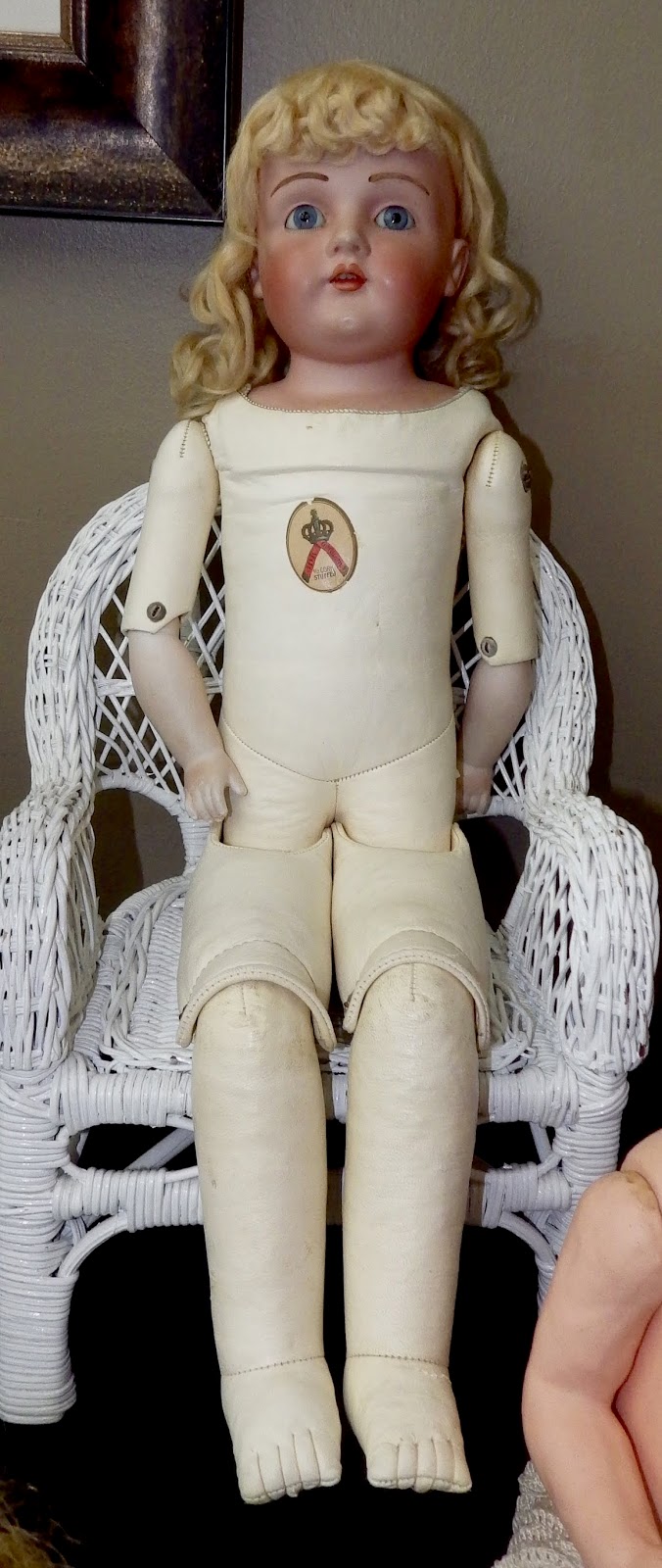
Kid bodies with rivets joints and bisque or composition arms were also used on the later bisque shoulder head child dolls. This example with a pristine kid body is Mold 195 by J.D. Kestner. Her face, with its large eyes, sweet bland expression, and open mouth with tiny teeth is known to collectors as the “dolly face,” a popular style produced by many German and French companies. Note this model has fur eyebrows, patented by Kestner in 1910.
In 1909, the German company of Kämmer and Reinhardt introduced Mold 100 (dubbed by early collectors as the Kaiser Baby). Not only did the bisque head realistically portray that of a infant with a toothless smile and double chin, the composition body was shaped like that of a plump baby with pudgy bent arms and legs. Other companies quickly copied this body for their own line of infants. This example of a bent-limb body is Mold 619 by the German firm of Bahr and Proschild.
German doll artist Käthe Kruse began making dolls for her daughters because she disliked the available commercially-made toys. In 1910, she displayed her dolls in a Berlin department store and they were so popular she began producing them commercially. The early dolls had muslin bodies stuffed with reindeer hair, were jointed at the hips and shoulders, and featured hand painted pressed fabric heads. The bashful boy in the back in his original underwear dates around 1912.
The seated all-wood doll was created by the American company founded by Albert Schoenhut. In 1911, the company introduced the “All-Wood Perfection Art Doll.” The dolls were jointed with a system of internal springs. They had holes in their feet and wore special shoes and socks with matching openings. The holes fit on a stand which allowed the dolls to hold almost any pose. The earliest dolls had character faces, but in order to compete with less expensive bisque and composition dolls., Schoenhut later introduced faces with more doll-like features, as well as toddler and baby dolls, and even a doll with sleeping eyes. However, by 1935 the company declared bankruptcy.
By the 1880s, child and baby dolls had pushed aside their more womanly counterparts, conquering the playroom. However, in the Edwardian period, lady dolls won a brief reprieve with the popularity of the Gibson girl. Both French and German companies produced lady dolls on womanly ball-jointed composition bodies. The elegant Edwardian in the pink silk corset is "La Patricienne" by Edmund Daspres and dates from 1905. Although her body with its narrow waist and subtle bosom was created in France, her bisque head is Mold 1159 by the German firm of Simon and Halbig.

Beginning in the 1910s, American companies began producing dolls made entirely out of composition or with composition heads and limbs. Lightweight, sturdier, and less costly than bisque dolls, they quickly conquered the American market. Composition could not be washed and the finish could craze or crack as the underlying composition material expanded or contracted due to humidity and temperature. Composition was replaced by hard plastic after WWII. The pretty girl in pigtails is typical of many of the dolls of the era, with a composition head and limbs, but a cloth body, often with a simple mechanism that made the doll squeak “Mama” when tilted. She is unmarked.
From 1928 through the 1940s, Joseph Kallus, the founder of Cameo Doll Company, created a series of character dolls with segmented wood bodies and composition heads. These included well-know comic characters such as Betty Boop and Popeye, Walt Disney characters such as Mickey Mouse and Jiminy Cricket, and advertising dolls. Others were simply charming children, such as this Joy, introduced in 1932.
This curvaceous beauty heralds the reintroduction of the lady doll. In 1955, Madame Alexander created Cissy, a glamorous fashion doll with a shapely female figure, feet molded for high heels, and a sophisticated wardrobe. Of hard plastic and 20 to 21 inches tall, Cissy is jointed at the neck, shoulders, elbows, hips, and knees, with earlier dolls also having an upper arm joint. She was produced through 1962, with a vinyl version reintroduced in 1966.
The popularity of Cissy encouraged other companies to introduce similar fashion ladies. In 1958, Uneeda Doll Company introduced its own fashion lady doll, Dollikin, here seated in the brown chair. Advertised as the “Original Doll Mannikin,” her body was jointed in 16 places—neck, shoulders, upper arms, elbows, wrists, waist, hips, knees and ankles—allowing her to assume a wide variety of poses. Produced until 1962, this version has a hard plastic body and a vinyl head.
Everything old is new again, as shown by this modern BJD (ball jointed doll) in the white wicker chair. In 1999, the Japanese corporationVolks introduced “Super Dolfie,” a posable ball-jointed resin doll aimed at adult collectors. The popularity of the dolls created an entire industry of BJD dolls, first in Japan, then spreading to Korea and China. Soon companies in the United States and Europe were creating BJDs, as well as many doll artists. Innovations such as interchangeable face plates, eyes wigs, hands, and feet inspired collectors to customize their dolls. This example is Volks Super Dollfie or SD Kira.
From 1955 through1960s, American Character produced its own multi-jointed hard plastic doll, Toodles, a beautiful baby doll with jointed elbows and knees. She was advertised as being able to pose in 1,000 different positions.