dollshow

dollshow

AUSTIN DOLL COLLECTORS SOCIETY

The Austin Doll Collectors Society is an organization of antique, vintage, and modern doll collectors, dealers, and artisans. We meet on the second Sunday of each month and our meetings are fun and educational. We begin with refreshments and socializing, and, following our brief business meeting, there is a special doll-related program and "show and tell." The Austin Doll Collectors Society is a nonprofit organization and is a member of the United Federation of Doll Clubs.
Showing posts with label Simon and Halbig. Show all posts

Saturday, December 2, 2023

November 12, 2023, Meeting

Member Sharon Weintraub did a program on Black all-bisque dolls. She explained the French and German companies, and later Japanese makers, created Black all-bisque dolls, although in far smaller numbers than white dolls. While sometimes a Black all-bisque doll was made in same mold as a white doll and simply tinted brown, companies also created these dolls with ethnic features. In most cases the dolls were not made expressly for Black children. Many were garbed in ethnic costumes representing French or German colonies or were dressed as servants or entertainers. This example by Simon and Halbig is incised 836 and is a standard mold tinted with a brown complexion. She has bare feet and wears her original bathing costume. The diminutive doll she holds is a French doll known as a Liliputien. Just 2.75 inches high, she  has a swivel neck with a molded loop and has peg-jointed arms and legs. These Les Liliputiens came in a wide variety of costumes; although the white versions generally wore painted light blue boots, the Black dolls were barefoot.


Sharon next discussed the Black all-bisque dolls by the German company Gebruder Kuhnlenz. She said the these dolls have appealing ethnic features with full lips and prominent lower faces. The complexions vary from brown to deep black, the dolls do not have painted lashes, and are barefoot. This pair in their original box wear the costumes of cakewalk dancers.  Inside one of the sections in the box is written in pencil "From Grace to Sadie Newell Christmas 1889." 


Three more dolls by Kuhnlenz. The red and yellow outfit is a copy of an original costume worn by a Black Kuhnlenz doll.


Sharon displayed these examples of Black all-bisque dolls attributed to the German company J.D. Kestner.  The two girl dolls have swivel necks. The one in the red gingham dress has a closed mouth while the one in blue has an open mouth with tiny inset teeth. The standing boy in the molded rompers has loop-jointed arms. All of the dolls have bare feet.


This is a frozen version of the boy in the molded outfit. 


Sharon said that the firm of Hertwig and Company made a wide variety of Black all-bisque dolls. The tallest doll in the "grass" skirt is painted bisque. Next to her is a tiny immobile figure of a Black man in a yellow top hat; he is part of a family of miniature Black figures. Behind him are two cute character dolls in their original matching ribbon outfits. In the back row are two more examples of German Black all-bisque does by unknown German companies. The one in the molded outfit and "straw" hat is wire-jointed. The doll next to him in a molded turban wears his original Middle-Eastern outfit. 


Sharon then shared examples of French Black all-bisque dolls. The one in the red and white outfit is marked on the back of her swivel neck with the "F.G." in a scroll mark of Francois Gauthier. Her all-original outfit may represent one of France's Caribbean colonies. She was made using a typical all-bisque mignonnette doll mold and has molded boots. The two little dolls are more examples of Liliputiens  and wear their original clothing.


Sharon explained that when German goods were embargoed during WWI, Japanese companies entered the bisque doll market, often directly copying German dolls. This example of a Japanese Black all-bisque doll may be early, because the modeling and decoration are of higher quality than is typically found on these Japanese products. The doll has unusual "snow" hair created with bits of ground bisque. 


Member Bette Birdsong brought several examples of Black all-bisque dolls. This tiny bare-foot example is by Simon and Halbig.


These are more typical examples of Japanese dolls. They are often referred to as "Topsy" because of the tiny pigtails inserted into their scalps. Such dolls were often sold in five and dime stores in the United States. Copies of these dolls with extremely black shiny complexions began being produced in China in the 1980s.  


A variety of itty-bitty Black babies ride in a tiny tin car. The one in red is an all-bisque doll and the other two are seated figurines (the one in the back is eating a watermelon slice). These seated figurines are often found attached to miniature cotton bales and were sold as souvenirs throughout the South.


Member Pam Hardy shared this black cloth doll with an embroidered face. It appears to be a commercially produced doll from the 1940s.


Member Jenell Howell brought these two tiny Liliputiens.


She also shared this stunning wooden Schoenhut doll.


Saturday, July 1, 2023

June 11, 2023, Meeting

The theme of the June meeting was "Brides," and member Myrna Loesch provided this beautiful (and delicious) wedding cake for the refreshment table. 


Member Jan Irsfeld did a program on bridal fashion, with dolls from her collection of Madame Alexander Cissys modeling her beautiful hand-tailored bridal gowns. Jan explained that she keeps scrapbooks of pictures and articles from fashion magazines featuring outfits she finds beautiful or intriguing and uses these to inspire her own creations. Some of the dolls were dressed in outfits she had made for a 1987 Las Vegas exhibit of bridal fashions from around the world.


Queen Elizabeth the First of England stated that she could not wed because she was married to England.  Jan accordingly dressed Good Queen Bess as an Elizabethan bride.


This torso gown shows how a bride might have appeared in 1955.


These two dolls appeared in the Las Vegas display. They model bridal fashions from Africa and Japan.


This Cissy represents a French bride in floral lace finery.


The blond bride represents England while the belle with bare shoulders models Jan's interpretation of a 1992 bridal gown.


Two more international brides. The Spanish bride wears a black lace mantilla and a dress adorned with embroidered flowers. Next to her is a bride from Shanghai, who also holds the dress that she will don for the post-wedding reception.


This bride from Mexico is bedecked with bright ribbons.


The bride with the wide-tiered bodice models a version of a gown from 2015. The other Cissy wears a dress in the style of 1957.  Jan hand painted each flower on her wide lace skirt.


A bead-encrusted bridal gown made by Jan.


Members brought many examples of bride dolls to share.


Pam Hardy displayed two porcelain dolls that belong to her daughter. This doll portrays Sarah, the Duchess of York, at her marriage to Prince Andrew.


And this doll represents Princess Diana when she married Prince Charles.


Nancy Countryman brought examples of Madame Alexander brides, including this little Lissette,


and this much larger red-haired Elise.


A Kitty Collier bride by the Tonner Doll Company.


This porcelain doll designed by Suzanne Gibson represents Harriet Rebecca Lane Johnston, who acted as First Lady during the administration of her uncle, President James Buchanan.


Myrna shared this lovely reproduction French fashion doll made by former member Mary McKenzie and dressed by Jan in a bridal gown in the style of the 1870s to 1880s.


She also displayed this composition Madame Alexander Wendy Ann she had won at a recent luncheon with the Fort Worth doll club. The doll dates from the 1940s.


This Madame Alexander Cissette belongs to Sylvia McDonald, who told the club that the doll was given to her daughter in 1969 or 1970.


This Nancy Ann Storybook wedding party is from Sylvia's childhood.  She told the club that in the 1964 they were used as decorations in a relative's wedding and the bride and groom were redressed for that wedding.


Ann Meier displayed this wedding outfit her grandmother had made for her childhood Saucy Walker doll.


Jenell Howell brought this BJD elf adorned in a wedding dress from a Madame Alexander Elise.


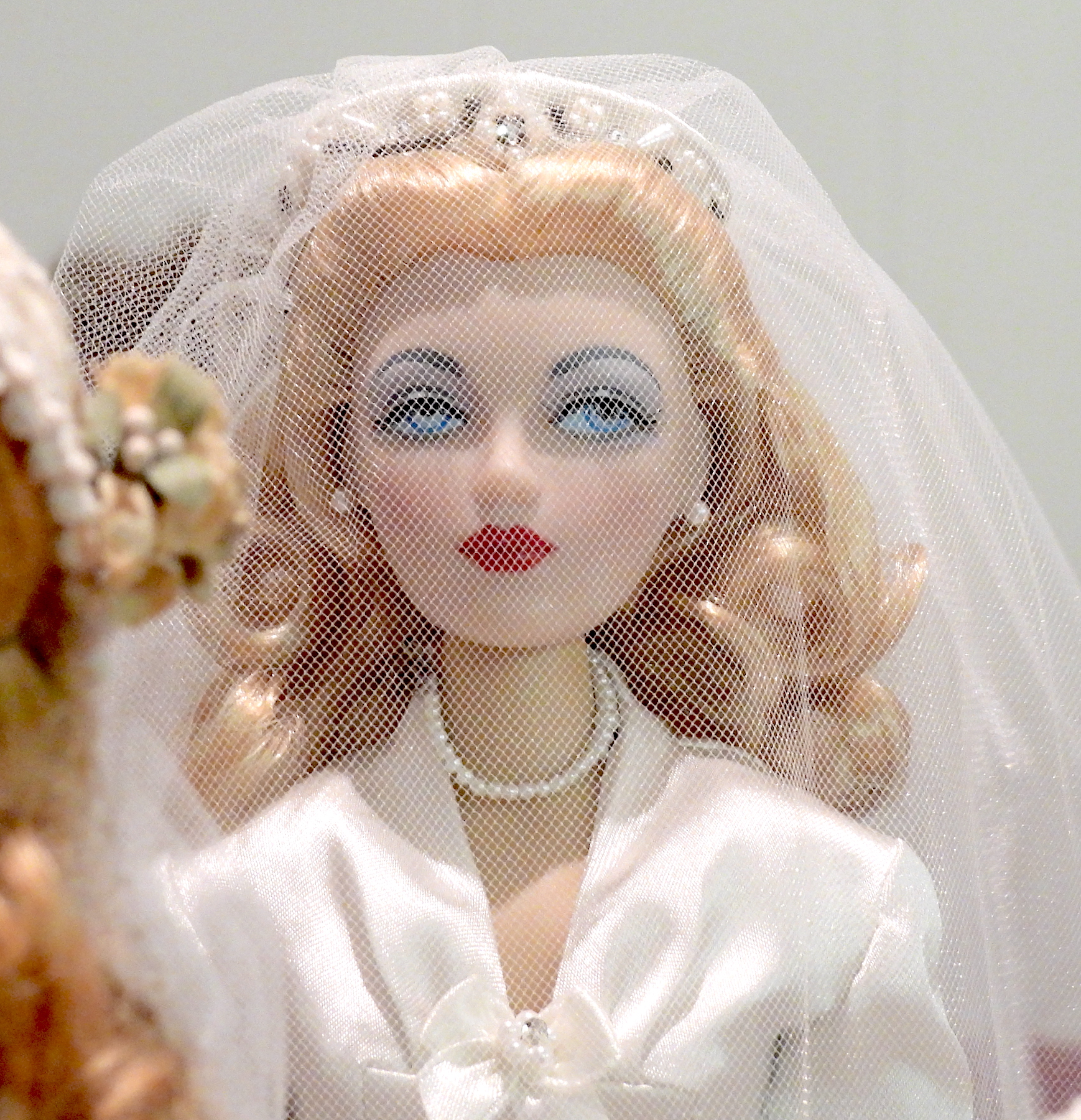
Bette Birdsong shared this Gene doll dressed in bridal finery.


This antique Mold 1469 doll made by Simon and Halbig for Cuno and Otto Dressel wears belongs to Sharon Weintraub. She models a hand-sewn and beaded antique bridal gown from the 1920s.


These diminutive dolls also came from Sharon's collection. The center doll is a pink-tinted frozen Charlotte dressed in an antique lace bridal outfit. Sharon told the club that it was a tradition to dress a small doll in scraps of the bride's gown as a keepsake. The taller bride and groom are wedding cake decorations by Hertwig and Company of Germany. The small pair are also German cake decorations.


Two sets of antique all-bisque German bride and groom dolls in their original boxes. The large pair are from Hertwig while the miniatures in crocheted costumes are by Carl Horn.


Monday, May 8, 2023

April 23, 2023, Meeting

The theme for the April meeting was Easter, spring, or April related dolls. 


Jan Irsfeld brought two of her Madame Alexander Cissy dolls in a trunk that she had created. The doll in white is entitled "The Promise of Spring" and the lovely lady in green is Spring for the Madame Pompadour four seasons series.


Sharon Weintraub brought out a bunch of itty bitty all-bisque bunny dolls. All are by the German firm of Hertwig and Company, except for the largest bunny boy in the brown felt jacket, who was created by Gebruder Heubach.

]

These bunnies are all dressed in their original crocheted clothing. The tallest in only 2.5 inches tall.


Bette Birdsong shared her Gene doll in the "Suddenly Summer" ensemble. Although the title says "summer," the outfit is certainly appropriate for a spring stroll.


Bette also shared this vintage Ginny in a pineapple print dress.


Elaine Jackson brought several dolls, including this wistful wooden doll by Swiss artist Erika Catellani.


This reproduction all-bisque girl in a bunny hat is dressed in an outfit from a mini American Girl Elizabeth.


Elaine also shared a doll she had long wanted and finally found.  This is a composition Patsy-type made by the Averill Manufacturing Company.  Elaine told the club that the doll was sold by various companies under different names. This is "Boots" sold by Horsman and has a twisting waist. The vintage dress is "mommy made." 


Nancy Countryman brought this vintage McGuffey Ana doll by Madame Alexander,


as well as this antique German doll by Armand Marseille.


Jenell Howell shared this charming Crib Crowd doll by Madame Alexander.  She is all original, including her basket, and has a caracal wig. 


Jenell also made this pair of all-bisque bunny dolls, who are reproductions of models by Gebruder Heubach.


Another all-bisque doll shared by Jenell was this reproduction of an antique German "wrestler" made by doll artist Becca Hisle. The doll was the souvenir from the March 18, 2023, luncheon held by the Fort Worth Antique Doll Club to celebrate its 65th anniversary. 


Myrna Loesch brought the doll in the pink floral dress, which she had patiently assembled. She told the club that the head, Mold 1078 by Simon and Halbig, and body were found at a doll show, the dress came from Theriault's, and she made the wig. 

The little girl in the embroidered red dress belongs to Pam Hardy. Pam told the club that both her mother and aunt were doll collectors. The doll, made by Schoenau and Hoffmeister, was one of her mother's first dolls.  


Sylvia McDonald brought this girl in green by doll artist Heidi Plusczok, issued in 2004.