dollshow

dollshow

AUSTIN DOLL COLLECTORS SOCIETY

The Austin Doll Collectors Society is an organization of antique, vintage, and modern doll collectors, dealers, and artisans. We meet on the second Sunday of each month and our meetings are fun and educational. We begin with refreshments and socializing, and, following our brief business meeting, there is a special doll-related program and "show and tell." The Austin Doll Collectors Society is a nonprofit organization and is a member of the United Federation of Doll Clubs.
Showing posts with label bisque. Show all posts

Thursday, August 30, 2018

Special Exhibit at Our Upcoming Show

This year our doll show will feature a special display of dolls entitled, "Doll Bodies, From Bisque to BJD." The exhibit will show a history of doll bodies over the past two centuries, from early bisque to modern resin ball jointed dolls.  This frisky flapper just one of the dolls that will be on display.  By the German firm of Simon and Halbig, this 13-inch tall lissome lass has a slim flapper body, shapely legs with a ball joint at knees, and feet molded to fit heeled pumps. She is all original, from her bobbed mohair wig to her scandalous silk teddy to her rayon stockings with ribbon garters and high heels.  This lovely little lady is incised on the back of her head “1159 Simon & Halbig S&H 5.” 


Wednesday, June 6, 2018

Women Doll Artists; Rose O'Neill


Born in 1874, Rose O'Neill demonstrated her artistic talents early when at the age of 13 she won an newspaper art contest. By the age of 19, she was living in New York City as a professional artist, illustrating books, magazine articles, and advertisements. In the December 1909 issue of Ladies' Home Journal O'Neill's most famous creation appeared, the chubby cheerful Kewpie, whom O'Neill described as "a sort of little round fairy whose one idea is to teach people to be merry and kind at the same time".  Her Kewpie cartoons were a popular hit and in 1912 the German doll company J.D. Kestner began to manufacture her appealing imps in bisque.  Kewpie dolls would later be made in cloth, celluloid, and composition, and O'Neill would expand her cast of Kewpieville characters to include others, such as the toddler Scootles and Doodle Dog, a canine companion to the Kewpies.   O'Neill published and illustrated a number of children's books featuring her Kewpies, but she was much more than the creator of the Kewpie.  She wrote and illustrated novels and books of poetry and continued to produce fine artwork.  After studying with famed French sculptor Auguste Rodin, O'Neill created sculptural works as well.  An ardent advocate for women's rights, O'Neill was active in the suffragist movement, creating cartoons and posters promoting the right of women to vote.  

This trio of bisque Kewpie dolls belongs to member Beverly Evans.  The pudgy pup is Doodle Dog.


This composition Kewpie was the childhood doll of member Sylvia McDonald and is wearing a dress crocheted by Sylvia's grandmother.   Sylvia members her parents struggling (ultimately with success) to restring her beloved doll, using a strip of rubber from an old inner tube from the family car and a bent a coat hanger.


Monday, February 26, 2018

Black History Month; S.F.B.J. Lady

This Black lady doll belongs to member Myna Loesch. This lovely lass is approximately 10 inches tall with a composition body and bisque painted head. She may have been clothed to represent Martinique (her turban is replaced). The maker is Société Française de Fabrication de Bébés et Jouets, known by its initials "S.F.B.J." In 1899 the remaining French doll manufacturers joined together to form S.F.B.J. in an attempt to survive competition by German doll makers.


Wednesday, February 14, 2018

February 5, 2018, Meeting

For our February meeting, the refreshment able was decked out in a festive Mardi Gras theme. 


Member Sharon Weintraub did a program on frozen Charlottes and Charlies. These unjointed bisque and china children are typically frozen into a standing position. Early doll collectors dubbed these dolls "Frozen Charlottes" after the the old American folk ballad called “Fair (or sometimes Young) Charlotte,” which tells the sad tale of a beautiful young woman who foolishly refuses her mother's advice to dress warmly and subsequently freezes to death on a sleigh ride to a Christmas Eve ball. However, these figurines are actually German in origin, where they were called badekinder (bathing children). Produced in Germany beginning in the 1860s, they were offered as children’s playthings and bath toys (some, like the little boy at the top left in yellow and white striped bathing trunks will actually float when placed in water).


The little girl on the left is a bank with a slot on her back for coins.  Not too many seem to have survived, because the only way to reclaim your savings is the literally break the bank!


Although many badekinder are nude, they also can be found in molded clothing. 


Some frozen Charlottes wore wigs.


Frozen Charlottes also appear in novelty items, such as this the badekinder in a bottle.


This early china Charlotte is beautifully dressed an antique bridal gown of silk and net.  Sometimes a doll would be dressed a scraps left over from making the bridal gown to commemorate the happy occasion.


Other members brought Frozen Charlottes to share.  This diminutive doll belongs to Beverly Evans.


This tiny child is a family heirloom belonging to Elaine Jackson.


Sylvia McDonald brought this bisque-headed baby character by the Japanese firm of Morimura for show and tell.  


Saturday, July 22, 2017

July 3, 2017, Meeting

In honor of the upcoming Fourth of July, the refreshments were as American as apple pie. 


Member Beverly Evans gave a program on the history of boy dolls.  In the 1800s there were few male dolls, most simply a doll dressed as a man or boy and often serving as the groom for a bride doll or dressed as a soldier or sailor.  The introduction of character dolls by German manufacturers resulted in dolls modeled to be specifically boys. 


Beverly brought many examples of antique and contemporary boy dolls from her collection.


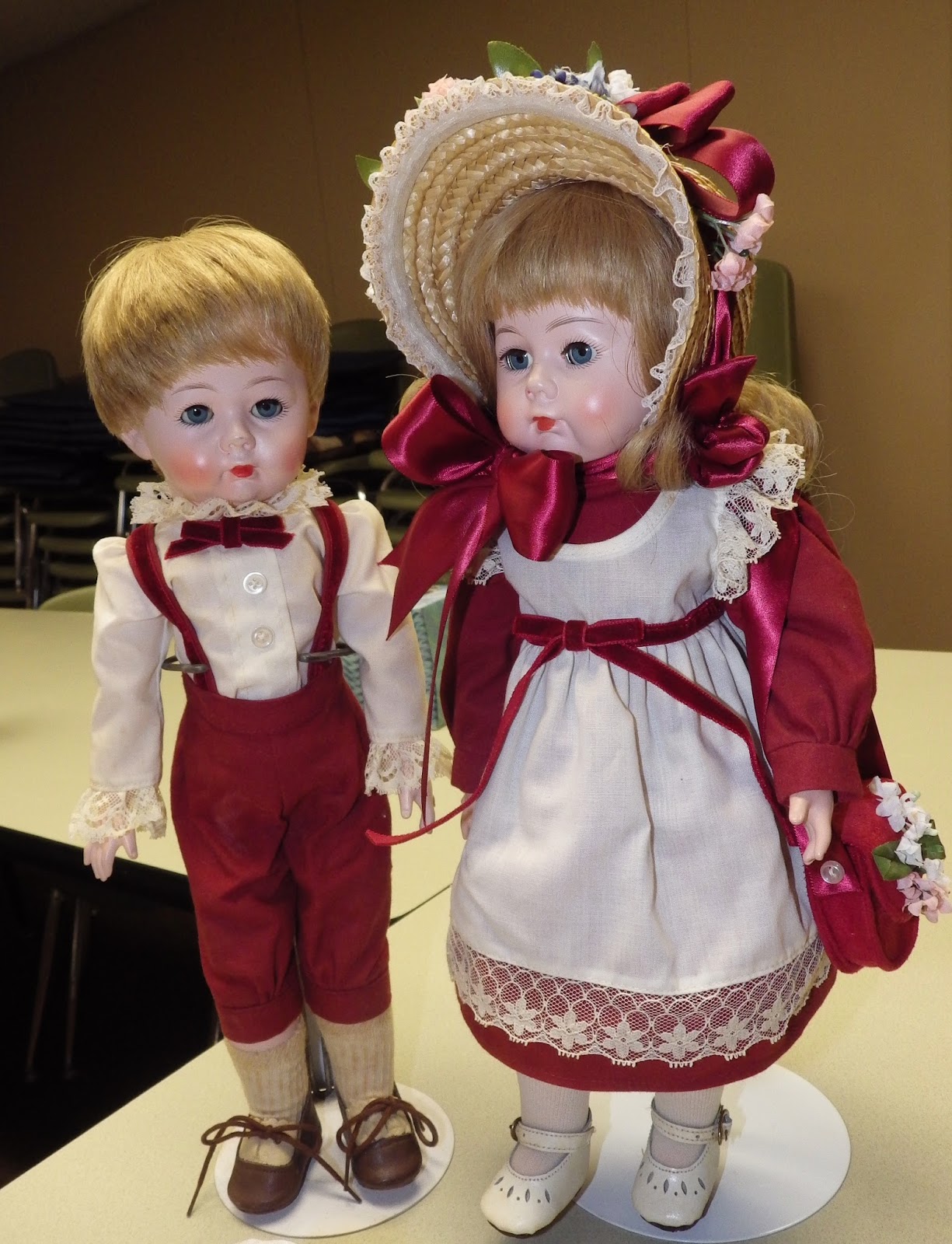
Dolls dressed as brother and sister pairs have long been popular.


Members also brought boy dolls to share.


Brenda Kaye White introduces Logan, the first boy doll created by American Girl.


Sallie Howard displays two boy dolls from Mattel.


Elaine Jackson brought this boy doll by pioneering doll artist Emma Clear.   Clear operated the Humpty Dumpty Doll Clinic in Los Angeles, where she repaired and restored dolls.  Unable to find parts for antique dolls, she began to reproducing her own, and started in the 1930s offering a variety of reproduction bisque and china dolls.  Although Clear is best known for her reproduction dolls, she also created her own character dolls, like this handsome boy.


Myrna Loesch shares Cotton Joe, an early Black character doll by Horsman.


Jennell Howell told us about Buddy Lee, an advertising doll manufactured  for the H. D. Lee Company, the maker of Lee Jeans from the 1920s though the early 1960s.  Buddy Lee dolls came dressed in detailed miniatures of Lee garments representing a variety of occupations.