dollshow

dollshow

AUSTIN DOLL COLLECTORS SOCIETY

The Austin Doll Collectors Society is an organization of antique, vintage, and modern doll collectors, dealers, and artisans. We meet on the second Sunday of each month and our meetings are fun and educational. We begin with refreshments and socializing, and, following our brief business meeting, there is a special doll-related program and "show and tell." The Austin Doll Collectors Society is a nonprofit organization and is a member of the United Federation of Doll Clubs.
Showing posts with label Armand Marseille. Show all posts

Sunday, July 19, 2026

July 12, 2026, Meeting

The theme for the program was "Patriotic Dolls. It would be hard to find a more patriotic outfit than this sparkling red, white, and blue ensemble worn by this doll brought by David Craig. He told the club that the doll is by JAMIEshow USA and that she is wearing an outfit made earlier for the Gene doll line created Mel Odom.


Kathie Tovo shared several examples. This tiny trio of all-bisque dolls by the German firm of Hertwig and Company play vintage American flag party favors.


An antique bisque-headed doll with a composition body is decked out in red white and blue with her original matching box, but Kathie stated that the doll may be in fact be a representation of France.


However, there is no question that this paper cutout represents the all-American Miss Columbia.


Sharon Weintraub displayed this bisque Uncle Sam. He is actually a German naughty novelty known as a squirter; one time he had a rubber bulb on top of his top hat and when he was filled with water and the bulb squeezed, the water came out of the appropriate orifice.


This sweet boy in a sailor suit belongs to Sylvia McDonald. He is a reproduction of a character by Gebruder Heubach and was made by Jenell Howell. His outfit is based on an antique costume and was made by the Gabriella Doll Clothing Company.


She also shared this doll representing Betsy Ross by Madame Alexander.


Also natty in her nautical-themed outfit is this German bisque-headed doll on a ball-jointed body. She is Florodoro by Armand Marseille and belongs to Myrna Loesch.


Jenell shared this all-original doll made by Effanbee and designed by the American doll artist Dewees Cochran. 


Elaine Jackson brought this cloth doll, Miss Columbia. She is modeled after the Columbian cloth dolls manufactured by Emma Adams from 1891 to 1910 and was created by doll artist Connie Tognoli as a souvenir doll for the United Federation of Doll Clubs annual convention in 2000. Her straw hat was purchased by Elaine at a Native American reservation.


Nancy Countryman brought this supersized Barbie doll by Mattel in patriotic apparel.


Thursday, October 26, 2023

October 8, 2023, Meeting

Member Kenneth Reeves did the program on Ginny  and other Vogue dolls. He explained that in 1922 Jennie Adler Graves opened the Ye Olde Vogue Doll Shoppe. She began by dressing dolls imported from Europe and by 1925, Graves had to hire an additional seamstress, as well as home workers. In 1937, she purchased composition Toddles dolls from  from Arranbee Doll Company. Her daughter, Virginia, joined the company in 1942 (she would take over the company from her mother in the 1960s) and in 1945 Vogue Dolls was incorporated. The company moved to hard plastic in 1946. In 1948, Graves introduced an 8-inch hard plastic doll. The doll was so popular that Graves designed her own version, christening her creation "Ginny," after her daughter, Virginia. Ginny originally had painted side-glancing eyes with sleeping eyes introduced in 1950. The early dolls had painted lashes, with molded lashes introduced in 1955. In 1954, "walking" dolls became popular, with the head turning from side to side as the dolls legs were moved. Kenneth said that Vogue focused on doll fashions. 


Kenneth shared these two early Vogue dolls with painted side-glancing eyes. The girl in the bonnet is Little Bo Peep. 


The doll in the striped dress is a bent-knee walker, introduced in 1957. 


Kenneth said that in 1957, Vogue began creating a family for Ginny. Jill (floral gown) was Ginny's big sister. Jan (doll in polka dot dress), was Jill's best friend and made for one year in 1959. 


Jeff was Ginny's big brother.


Vogue brought back Jill in 1962 in vinyl and reintroduced her again in 1965, dressing her in historic eras. The doll in the floral bonnet and blouse and blue skirt is Jill as "Frontier Days."

Kenneth explained that Vogue acquired Arranbee (R & B) and used used the R & B molds for Littlest Angel until Vogue redesigned the doll in 1964. He stated that the girl in the white dress with tiny pink flowers was made by R & B in the mid 1950s. The chubby-cheeked cutie in the pink dress was made by Vogue in 1963, the last year Vogue used the R & B mold.  The redhead at the end of the front row is Li'l Imp made by Vogue in 1959 and 1960, using the R&B Littlest Angel mold. The charming child in bright yellow in the center is the Vogue version of Littlest Angel and the doll in the blue and white print dress and big pink bow is Vogue's Lil' Lovable Imp. Kenneth stated that Vogue reintroduced Littlest Angel in 11-inch and 15-inch sizes (the brunette in the back row in the red and white outfit is 15-inch example). The smaller size was discontinued in 1975 and the 15-inch version in 1980. The curly-headed blond with the character face in the back row is Brikette


Kenneth explained that in 1972 Vogue was sold to Tonka Toy Company and in 1977 Lesney took over the Vogue Ginny name. In the 1980s, R. Dakin & Company bought out the Ginny and Vogue names.

He told the club that Ginny was introduced in the 1970s as an international doll. The doll in green represents Ireland. The baby doll in pink is Ginnette


In 1970s, Kenneth said that Miss Ginny was introduced. This example is pretty in purple.


Members shared their Ginny and Vogue dolls as well. The cowgirl belongs to Elaine Jackson. She was made as a souvenir for a United Federation of Doll Clubs convention. The Ginny in the blue dress with the blond "pixie cut" belongs to member Myrna Loesch.


Myrna also displayed these two hard plastic Jill dolls from 1957-1960 in detailed "mommy-made" outfits.


This little Ginny on roller skates belongs to member Bette Birdsong. . . .


as does the darling doll in the colorful felt dress.


This is a childhood doll of member Elaine McNally. The photograph shows a young Elaine with her doll. 


Member Jenell Howell brought several examples of vintage Vogue dolls. The twins in the front row garbed in blue and white gingham are Toddles.


A Jill babysits two of Jenell's Ginny dolls.


This is Jennie Southern Belle from 1943 to 1944.


This curly haired cutie from the 1950s is from Vogue's Crib Crowd.  The Crib Crowd dolls use the standard Ginny head, but have curved baby legs.


Graves began by creating outfits and trousseaus for imported dolls, like this "Just Me," a googly-eyed character doll by the German maker Armand Marseille. This 9-inch tall example belongs to member Sharon Weintraub.  Although the doll has her original dress, shoes, and socks, they do not carry the "Vogue" tag.


Wednesday, September 22, 2021

September 12, 2021, Meeting


The Austin Doll Collectors Society had its first in-person meeting in over a year, congregating at member Sharon Weintraub's home. Sharon gave a program on Asian character dolls by German and French bisque doll makers. She explained that although the spice trade between Asia and Europe dates back thousands of years, by the 16th century European merchants, often with military support, had seized control of the trade routes, gaining a foothold in the East. The Chinese Qing dynasty losses to Britain and its European allies in the First (1839-42)  and Second Opium Wars (1856-1860) forced China to grant Western companies favorable trade concessions and concede territory to their control. In 1853 American Commodore Mathew Perry sailed into Tokyo harbor, beginning the re-establishment of trade and contact with Japanese, who had closed off their country to most foreigners in 1639. By the 1870s, these trading concessions had expanded into colonial control, with Britain, France, and the Netherlands claiming territories throughout Southeast Asia and the Indian subcontinent. The explosion in magazines and newspapers helped bring images and stories of Asian nations and people to the average European. Schoolchildren learned about their countries' colonies and their peoples. Advances in printing made colorful children’s books widely available and affordable and fanciful stories and characters from the East began to appear in the pages of children’s storybooks. All of the interest in the East inspired both French and German doll companies to create dolls representing Chinese, Japanese, Burmese, and other Asian peoples. In some cases, the dolls were little more than colorful stereotypes while other manufacturers strove for more ethnically correct features and clothing. 

The cheerful Asian infant doll belongs to member Jenell Howell. He is by J.D. Kestner and is on a ball-jointed toddler body, rather than the more typical bent limb baby body. Next to him is Mold 1329 by Simon and Halbig, dressed in an antique outfit of a Manchu noblewoman, including the unusual platform shoes.  

'


Another Asian baby by Kestner, this time in a diminutive all-bisque version. He wears his original, but now fragile, silk outfit. His "slippers" were created by painting the soles of his bare feet black and gluing cord around the edges.


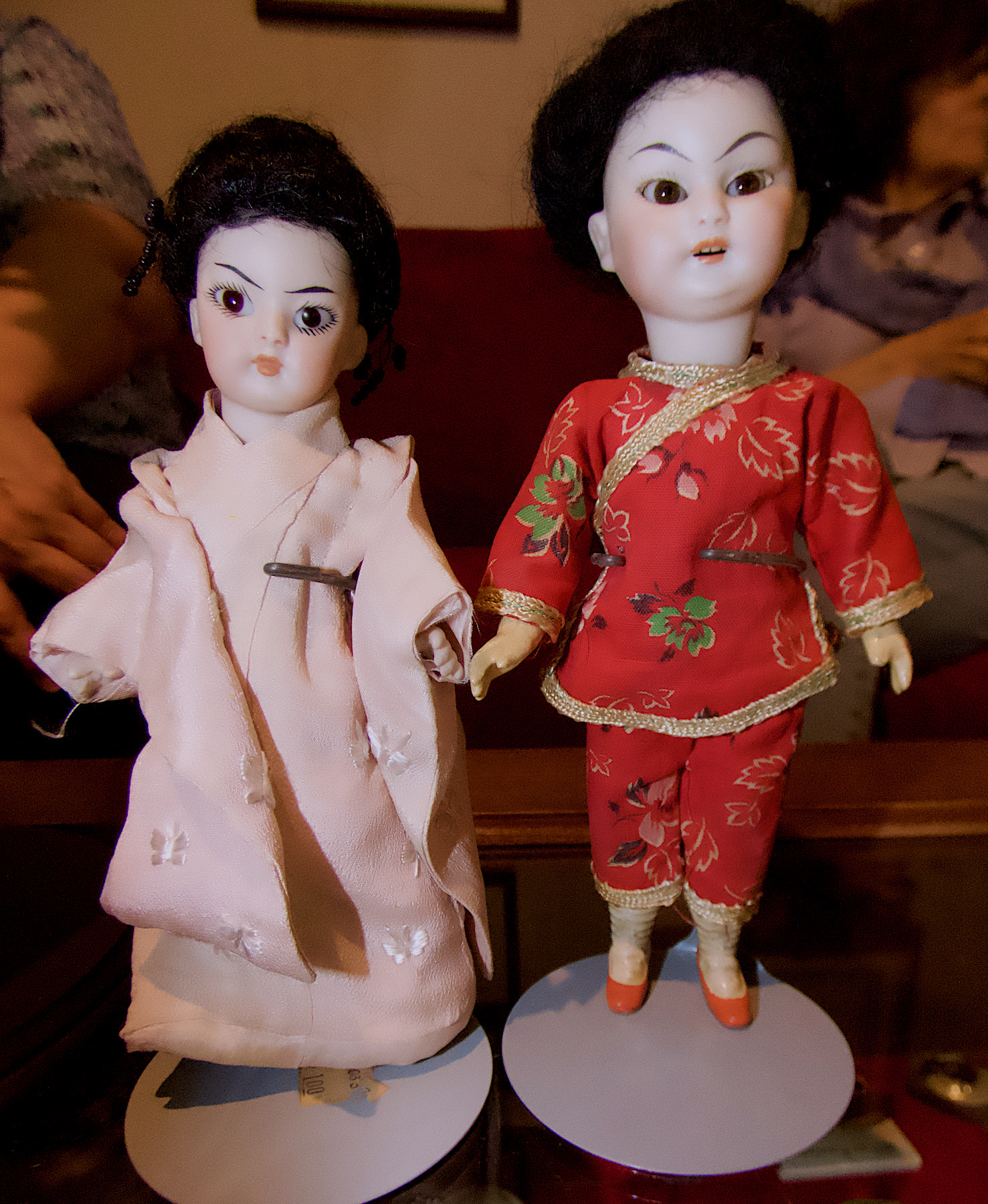
Two more Asian characters by Simon and Halbig. The smaller doll is all-bisque and dressed in an antique embroidered kimono.  She has molded blue slippers with upturned toes.  The other doll is Mold 1129 and is all original.


These 4.5-inch high charming cherubs are Chin-Chin Baby by Gebruder Heubach. Each carries the Heubach square mark faintly incised on the soles of the feet. Made to compete with the popular Kewpie doll, the Chin-Chin Babies came in a variety of headdresses. The girl in the center has her original paper tags.


Another Chin-Chin Baby in a bright orange and blue cap next to a Queue San Baby by Morimura Brothers of Japan.  The two dolls are often confused, as the Queue San is clearly a copy of the Chin-Chin. However the Queue San Baby is larger, with rougher bisque and with less distinct modeling.


All original, this beautiful baby is by Armand Marseille. Incised on the back of the head is the name "Ellar" inside of a six-pointed star. Marseille produced heads for other factories and distributors, but just who "Ellar" is remains a mystery. 


German companies produced a variety of all-bisque Asian dolls. The little lady is the crocheted blue kimono is by Carl Horn and is just 1.75 inches high, including her yarn wig. The minute man in the red cap is by Hertwig and Company. He has a painted dropping mustache and has a little yarn queue inserted in the back of his cap.


French doll makers also produced Asian dolls.  The largest doll is a bit of a mystery. He has a French fashion style shoulder head on a fully jointed twill-covered body with bisque lower arms and lower legs with bare feet. The clothing is old and fragile.  The two tiny dolls are Lilliputiens. Just 2.5 inches tall, these all-bisque dolls were available in a wide variety of costumes, including French regional and historical dress, storybook characters, and ethnic dolls. Like all Lilliputiens, they have swivel necks with a molded loop and painted features.  The pair wear their original costumes and the man has a braided queue inserted into the back of his bald pate.


Elaine Jackson brought her 1950s Kathe Kruse doll to share.


Friday, April 3, 2020

Pretty Petite Patsyette

The club's virtual doll meeting continues with this contribution by member Michele Thelen‎, an  Effanbee Patsyette she recently restored and dressed.  In 1928, the American doll company Effanbee introduced Patsy.  The all-composition doll with her full face with large side-glancing eyes, plump childish body, and slim legs became one of the company's most popular dolls.  The Patsy line grew to encompass an entire family of Patsy dolls from the six-inch tall Wee Patsy to the 30-inch high Patsy Mae.  Patsyette is nine inches tall.


Patsy's endearing cherub-like face was based on the 1922 character doll "Just Me" by the German doll maker, Armand Marseille.  This nine-inch tall Just Me is shown for comparison. She is wearing her original dress, shoes, and socks.


Tuesday, March 24, 2020

Oh Baby!

A second entry in the Austin Doll Collectors Society's virtual doll meeting challenge.  With events and meetings cancelled, social distancing, and many people staying close to home, our members are urged to engage in a virtual meeting by sharing their dolls and doll-related activities on-line.

This bevy of beautiful bisque-headed baby dolls belongs to member Sylvia McDonald.  The first doll on the left is from the Japanese firm of Morimura Brothers.  When German doll exports were interrupted during WWI, the Japanese entered the doll market, often directly copying popular German bisque dolls.  The doll next to him was painted by Rebecca Clay Stewart and has a Real Seeley body.   The next two babies are German.  The one with a cap covering his bald dome head is by Hertel Schwab and the brunette baby is Mold 750 by Armand Marseille.  Sylvia says that the sweater worn by the Armand Marseille doll was made for her childhood dolls by her grandmother and is probably 70 to 75 years old! 


Sunday, November 25, 2018

November 5, 2018, Meeting

A festive fall theme greeted the members. 


Member Beverly Evans did a program on Mold 390 dolls by Armand Marseille. Despite his French-sounding name, Marseille was born to a wealthy Russian family in St. Petersburg in 1856.  His family later settled in Germany. Marseille bought a porcelain factory in 1884 and by 1890 began producing bisque doll heads. He acquired several other small porcelain factories, becoming one of the most prolific doll producers in Germany.  Marseille decided to add a line of affordable play dolls and in the 1890s began production of the Mold 390, a socket head, and Mold 370, the shoulder head version.  These molds were produced in various sizes and quality, and can be found on a wide variety of bodies.   Beverly brought many examples from her collection.  


Mold 370 is the shoulder head version, typically found on a kid body with bisque lower arms.


Other members brought examples to share.  This big ball-jointed girl belongs to Myrna Loesch. . . 


as does this diminutive doll.


Elaine Jackson brought this pretty example in a lacy pinafore.


This all-original Belgium milkmaid is on a fully jointed body and is just 8 inches tall.


Sallie Howard brought these charming child dolls by Miroslava Brodlova of My Meadow Dolls for show and tell.