dollshow

dollshow

AUSTIN DOLL COLLECTORS SOCIETY

The Austin Doll Collectors Society is an organization of antique, vintage, and modern doll collectors, dealers, and artisans. We meet on the second Sunday of each month and our meetings are fun and educational. We begin with refreshments and socializing, and, following our brief business meeting, there is a special doll-related program and "show and tell." The Austin Doll Collectors Society is a nonprofit organization and is a member of the United Federation of Doll Clubs.
Showing posts with label Hitty. Show all posts

Sunday, November 2, 2025

October 12, 2025, Meeting

Jan Irsfeld gave a program on goddesses, celestial, movie, and royal, using examples from her collection of Cissy dolls by Madame Alexander. She explained that Madame Alexander was fascinated by powerful and successful women. Peeking out in the far left corner is a Cissy, dressed by Jan, representing  Hatshepsut, a female pharaoh who reigned in the fifteenth century B.C.E.; she qualifies as a goddess because the pharaohs were considering living deities. The dolls on the table represent more modern goddesses of the silver screen. Starting from the left, the luscious lady in white represents Hollywood, while the others are Madame Alexander's  interpretation of actual actresses; Grace Kelly in icy blue, Vivian Leigh as Scarlett O'Hara, Marilyn Monroe, and Elizabeth Taylor.


Elizabeth Taylor models a hand-beaded gown designed by Jan.


Alexander also created many queens. This is an all-original Queen Elizabeth II.


Elizabeth I is represented by a Cissy dressed in authentic Elizabethan garb by Jan. Next to her is "Royal Reception" by Alexander.


French queen Marie Antoinette in her original bejeweled and embroidered gown by Alexander.


In opera, a "diva" is a celebrated female singer, and the word is derived from the Italian for goddess or divine. This Cissy represents Madame Butterfly from the famous opera by Giacomo Puccini.


However, this sassy swashbuckler is more devilish than divine. . . .


Jan shared two more scintillating Cissy dolls, including this flamboyant flapper. . . 


. . . and her favorite Cissy, reduced nude from an Austin doll shop, whom Jan has since restored and elevated to a goddess.


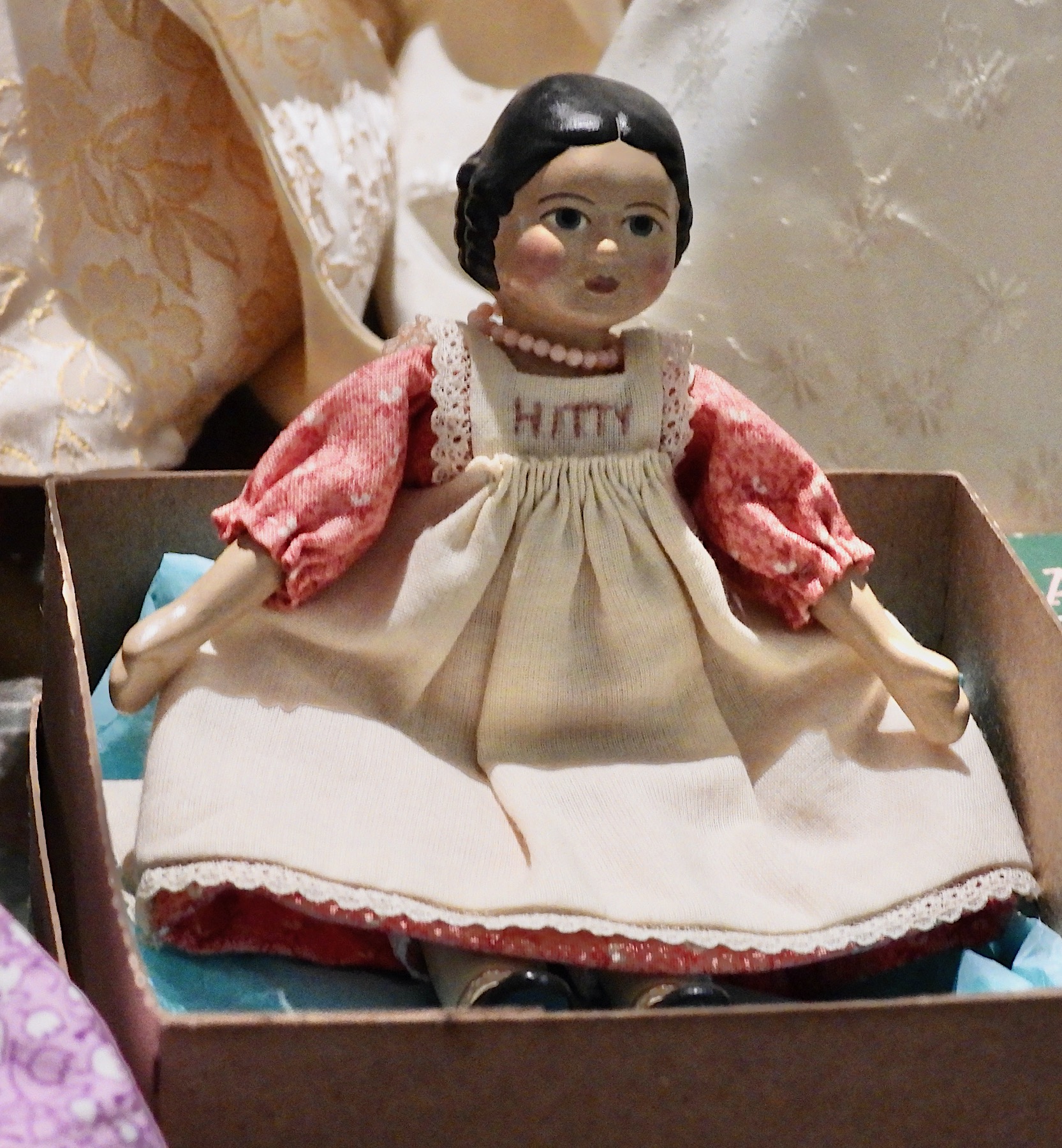
Elaine Jackson shared this wooden Hitty, currently the queen of her Hitty House, carved by member Elaine McNally. 


Jenell Howell brought this goddess of the night, Evangeline Ghastly by Robert Tonner.


David Craig had an earlier example of the eerily beautiful Evangeline. 


Another Tonner doll belonging to David is Ellowyne Wilde, ready for trick or treating in a Halloween outfit made for her by a friend of David's.


Bette Birdsong brought another movie goddess, a Gene doll designed by Mel Odom. In keeping with the season, Jenell shared this Sasha in fall colors.


Sharon Weintraub displayed a trio of little bisque fairies by the German firm of Hertwig and Company, noting that fairies were the subjects the fairy queen and the elfin court.


She also shared this bewitching bisque witch. Witches were thought to worship Hecate. Hecate was originally a Greek goddess, who was the protector of liminal spaces and borders, such as thresholds and doors, and was associated with the night, the moon, and magic. 


Myrna Loesch displayed this doll dress created by the Milwaukee Works Progress Administration (W.P.A.). The W.P.A., which operated from 1939 to 1942, provided work and job training for thousands of unemployed Americans during the Great Depression. While the W.P.A. created large public works such as roads, parks, and schools, it also operated handicraft projects aimed at teaching women skills such as sewing. The Milwaukee W.P.A. handicraft project produced dolls designed to be used as teaching materials in schools, as well as for children in hospitals or as Christmas gifts for children on the relief rolls. This dress was designed to be worn by a cloth doll.






Wednesday, June 18, 2025

June 8, 2025, Meeting

Member Myrna Loesch did a program on dolls made by Michele-ette, a Mexican doll company.

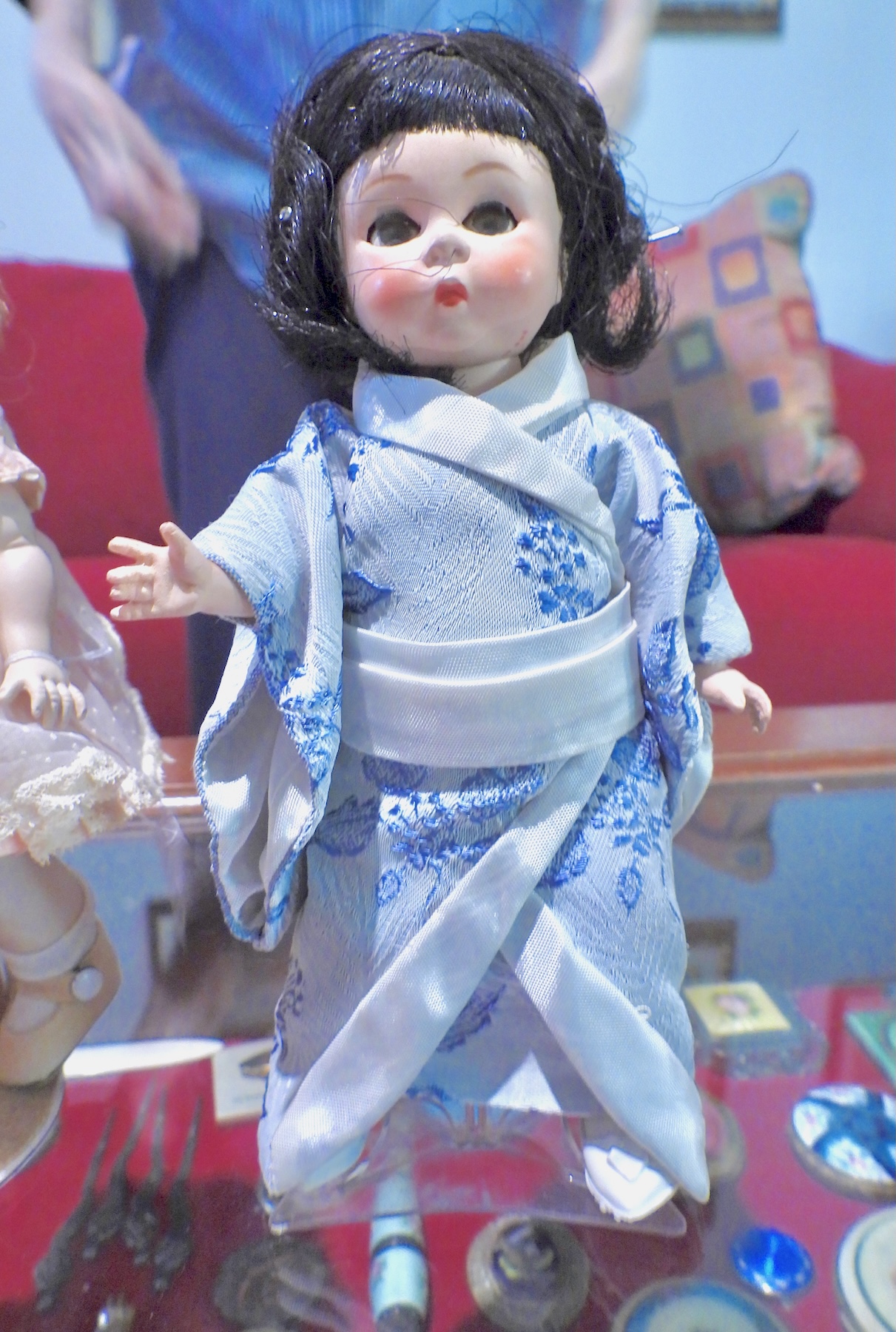
She told the club that she found this doll at an estate sale labeled as by Madame Alexander. Myrna said that although the doll did resemble the eight-inch Alexanderkins/Wendykins, her facial painting, such as the eyebrows, was different, she had a coarse black wig styled with two long pins, and she was unmarked. 


Some time later, Myrna found this doll on eBay, also dressed in a kimono, with the same facial painting, a coarse wig styled with pins, and no mark. 


Shortly afterwards, Myrna acquired these two similar dolls on eBay, but dressed in Mexican outfits. The dolls still carried their original tags, stating "Michele-ette Hecho en Mexico."


Myrna said that a doll collecting friend in San Antonio also had a pair of Michele-ette dolls, a girl in a traditional Mexican outfit and a boy dressed as a matador. She gave Myrna a copy of a newspaper article from the September 19, 1958, edition of the "Arizona Republic" about Mrs. Philip (Michele) Fauerso, the owner of the Michele-ette doll company in Mexico City. According to the article, Fauerso, at the time the owner of the Barbizon modeling agency and its associated schools, was vacationing in Mexico City, but could not find any canned dogfood for her dog. She started making her own dogfood and soon her neighbors were asking whether they could try some for their pets. Fauerso began selling the dogfood and at the end of her vacation sold the company for $10,000. In 1953, Fauerso was again vacationing in Mexico City with her husband and daughter. She told the newspaper that she dreaded returning to the rush of New York City and was looking for an excuse to stay in Mexico. Fauerso and her daughter noted while shopping that all the dolls they saw were ugly. Inspired, Fauerso took a small doll her daughter had brought with her and repainted and redressed it. Using a horse tail she bought at a slaughter house, she braided a new wig for the doll. Fauerso then took the doll to various shop owners and returned with $16,000 worth of orders. She persuaded her husband to stay in Mexico City and started her doll company.

According to the article, the business got off to a rough start with a single sewing machine and three  employees. They had to fulfill the first order for 24 dolls, but were having difficulty assembling the plastic dolls. Fauerso made a quick trip to the United States and returned with 24 plastic dolls, which were repainted, redressed, and re-wigged. In order to meet other order deadlines, Fauerso had her employees  purchase the dolls and used them the fill subsequent orders. This bought the company time to develop its manufacturing techniques. Another problem was with their employees, but over two years the company developed a trustworthy workforce of women. Fauerso told the reporter that hers was the only factory in Mexico with women bosses. The company had grown from a home business to a factory with 150 employees, 35 sewing machines, and ten injection machines. The article reported that over 200,000 Michele-ette dolls, all dressed in hand made fashions, had been produced.

Myrna speculated that the American dolls first used by Michele-ette may have been Alexanderkins/Wendykins and that the company may have later purchased molds from Madame Alexander, which could explain the resemblance between the Michele-ette dolls and the Alexanders. She noted that Fauerso and Alexander were both woman entrepreneurs from New York City and it may have been possible that they knew each other.

Myrna told the club that articles she found on the Internet in 2019 and 2020 reported that the Museo del Juguete MX  (Museum of Toys Mexico) had an exhibit of Michele-ette dolls from the 1970s. She said that it appears that the dolls are no longer being made.

Member Sylvia McDonald shared this example of an American-made hard plastic eight-inch doll, Muffy created by Nancy Ann Storybook Dolls. 


This is a Ginny doll, which started the trend for eight-inch girl dolls. She belongs to member Jenell Howell and is dressed as Davy Crockett, complete with coonskin cap and rifle.


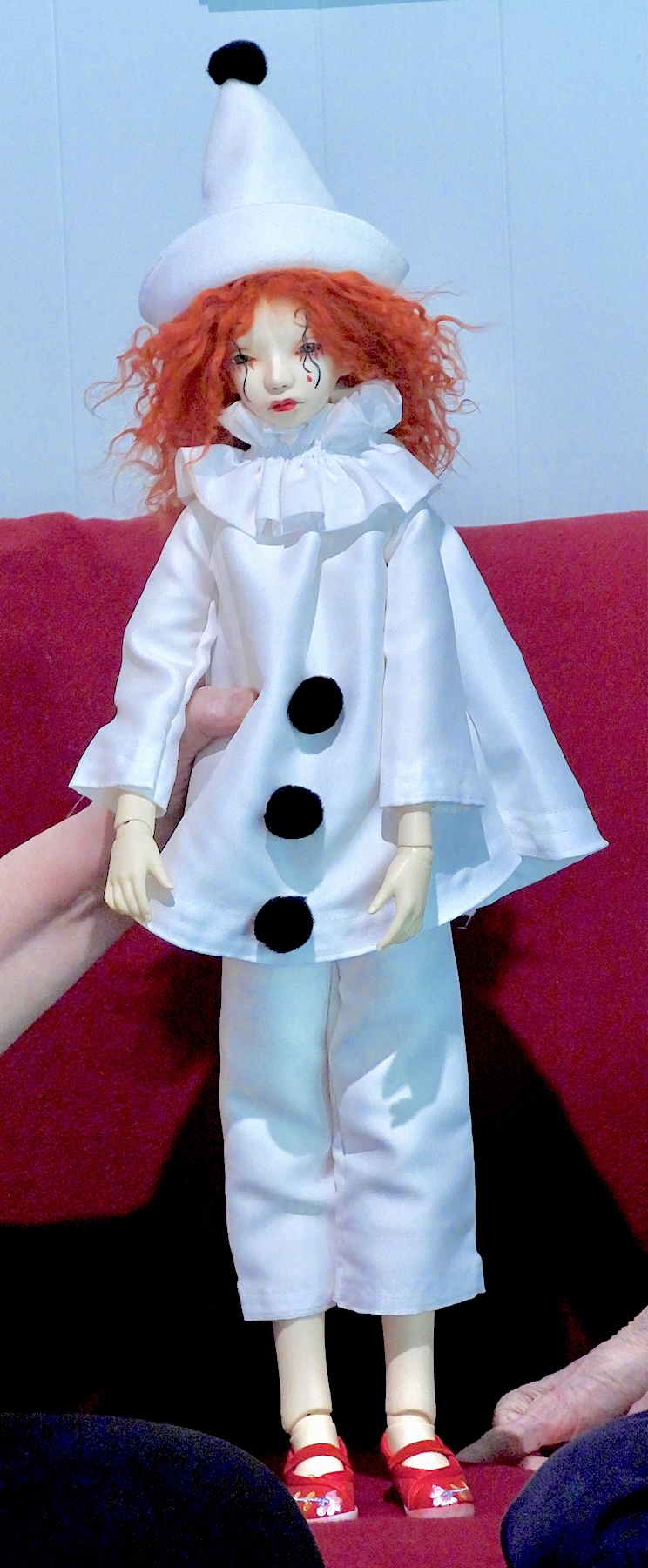
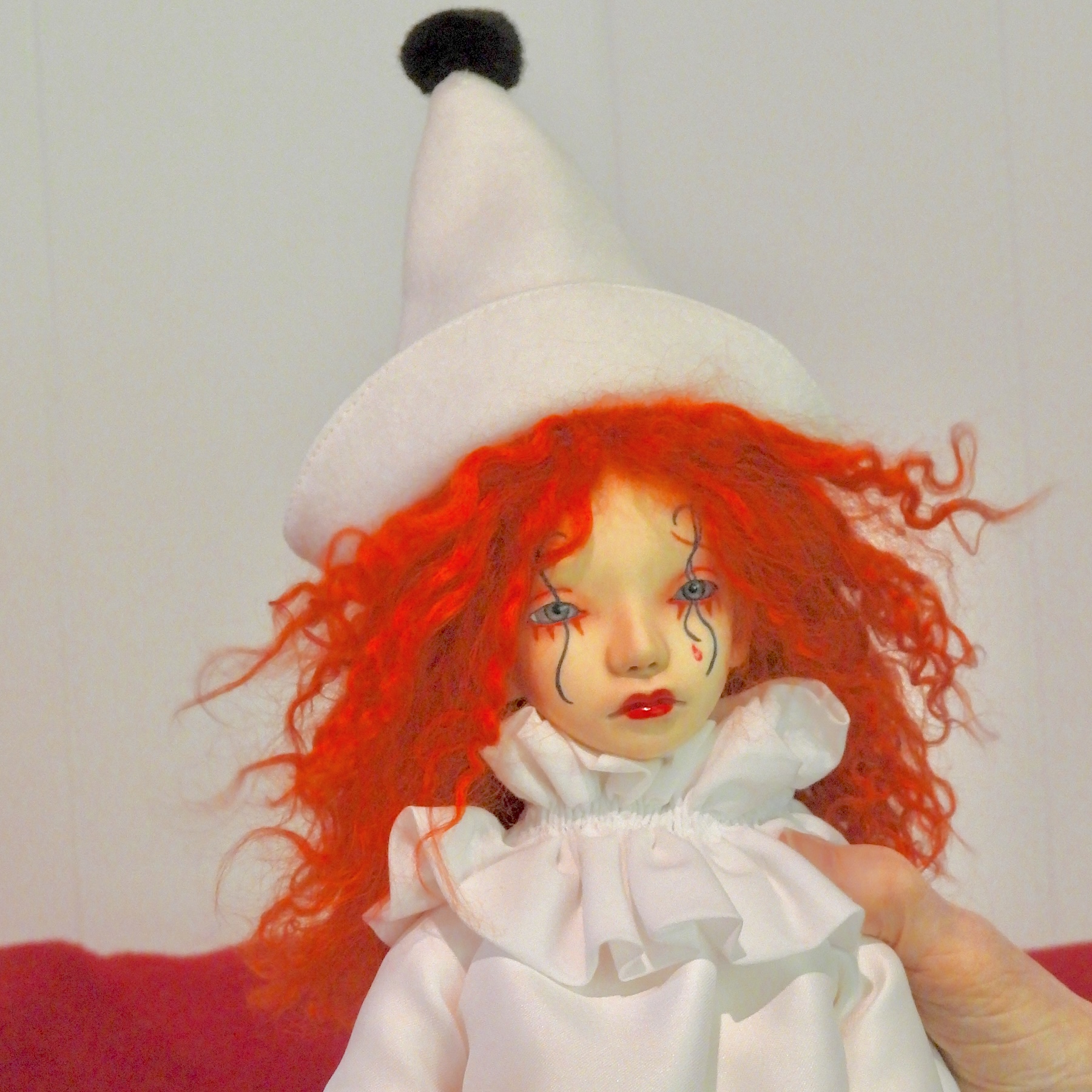
Jenell also shared her newest BJD creation.


Member Elaine Jackson brought this hand-carved wooden Hitty doll by TC Vollum.


Another wooden doll, belonging to member Sharon Weintraub. She is a vintage "peg wooden" or Grodnertal doll dressed as a pearly queen.  Sharon explained that the "pearlies" are charity groups associated with England's working classes. They are famous for their velvet costumes covered in elaborate designs made from mother-of-pearl buttons. The doll's hand-stitched velvet dress and bonnet are covered in small mother-of-pearl buttons and tiny faux pearl beads.


Monday, April 1, 2024

March 10, 2024, Meeting

Members were asked to bring a new doll or a doll that has special meaning for them. Pam Hardy brought this cute porcelain doll by artist Donna Rupert. She told the club that she had bought the doll when her granddaughter was born. Her granddaughter is now 18 years old. 


Jan Irsfeld shared this stunning Cissy. She said that when she first moved to Austin, her doll collection was packed away. Jan visited a local doll shop and found this Cissy. She created the gorgeous hand-beaded gown for her,


Bette Birdsong received this charming child from Jenell Howell as a thank you gift for helping Jenell sort out a doll collection. The vinyl doll is by the Spanish company Famosa and winks when you squeeze her tummy (Bette calls her "Winky").


Jenell brought this Elise by Madame Alexander that she is currently restoring. 


Elaine McNally shared this comic wooden German character. 


She also brought this Hitty doll that she carved and dressed. Elaine said that she tried to make the doll resemble the illustrations in the book. Also, her dolls were recently featured in "Doll Castle News" in an article entitled  "Tiny Texas Treasures." 


Sylvia McDonald brought this doll by German artist Elisabeth Pongratz. The wooden doll is hand-carved  and has spring joints that allow her to pose without a stand. Her wig is real hair and her dress is crocheted by hand.


Myrna Loesch rescued this early composition baby doll from an estate sale. She said that it reminded her of a childhood doll.


She also brought this very well loved carved-hair Schoenhut, which dates from 1912 to 1918.


Myrna told the club that this antique papier mache head doll has special meaning for her because the doll was given in 1883 by a grandfather to his granddaughter with the last name of Bader. Myrna said that Bader was also her grandmother's name. 


Sharon Weintraub brought two dolls she recently added to her collection. This bisque-headed clown doll was purchased at a local antiques mall. It is by the French company Jules Steiner and appears to be all-original.


She also has shared this unusual Black German all-bisque doll.


Elaine Jackson brought this collection of carved wooden dolls created by Austin artist Nancy Grobe, who was once a member of our club. Nancy eventually had to give up carving because of arthritis and became a skilled painter.


Monday, June 20, 2022

All Kitted Out

Following up on the Hitty program at out last club meeting, Member Gail Simpler shares her Hitty doll, which came from the American Kit Company by Robert Raikes. The kit included a 6.5 inch tall wooden Hitty doll, a storage bag with her name stitched on it, fabric, and patterns for making her a dress.


Wednesday, June 15, 2022

June 13, 2022, Meeting

Elaine Jackson and Elaine McNally did a joint program on Hitty and her friends. Hitty is the wooden doll heroine of Rachel Field's 1929 children's novel, Hitty, Her First Hundred Years. In the book, the eponymous Hitty (short for Mehitabel), a simple wooden doll carved by a peddler in the 1820s, narrates her adventures over her century of existence. Jackson explained that Fields was friends with illustrator Dorothy Lathrop and sometime in the 1920s, while strolling together in New York City they saw a small time-worn wooden doll in an antique shop window. All the shop owner could tell them about the doll was that she was at least 100 years old. Neither woman could afford the doll by herself, so they pooled their resources and purchased her jointly. Inspired by the diminutive doll, they created a history for Hitty, written by Fields and illustrated by Lathrop. The book was a success and was awarded the John Newbery Medal of Excellence in 1930. Elaine brought several examples of Hitty, which is still in print. 


The book's charming historical tale has inspired generations of doll artists to carve their own versions of Hitty based on the book's illustrations, as well as Hitty-type dolls referred to as Hitty friends. 


This an early all-wood Hitty was carved by Helen Bullard, one of the founders of the National Institute of American Doll Artists. Jackson explained that because of copyright issues, Bullard called her doll "Holly." People began to wonder what had happened to the original Hitty and Jackson stated that in the 1980s Hitty was discovered in the Stockbridge Library in Massachusetts, where she had been donated by a relative of Lathrop. The original Hitty now resides in a climate-controlled case donated by the Friends of Hitty.


The copyright has since expired and artists now may call their creations "Hitty." Michael Langton persuaded the Stockbridge to permit him to measure the original Hitty and he created Hitty replicas both in wood and resin. This doll, belonging to Elaine McNally, is actually a perfume bottle created by Langton.


Jackson displayed a wide variety of Hitty dolls in wood and resin, showing each artist's own unique interpretation of the beloved doll. 


This doll by Sara Cole is made of resin. Using resin allows an artist to make multiple editions of a doll.


This Hitty by Janet Cordell was a wooden shoulderhead on a cloth body.


Many of Jackson's Hitty dolls are souvenirs from Hitty conventions. This doll by Constance Hardt was the souvenir for a San Antonio convention called "Hitty at the Alamo."


Like many Hitty fans, Jackson has a "Hitty House" to display her Hitty dolls and friends. Jackson explained that Hitty is too large for a standard dollhouse and that her late husband built her a house suitable to Hitty's dimensions. This vintage handmade bed and chair are just the right size for many of Jackson's Hitty dolls. The bed was cleverly created out of an old wooden cigar box with clothespin posts and sewing spool legs.


Another wooden doll from Jackson's collection, this one representing "Miss Unity," the mascot of the United Federation of Doll Clubs. The doll was created by Judy Brown, who has also carved Hitty dolls.


Elaine McNally then displayed her wonderful whimsical dolls inspired by Hitty.


She showed the club the tools she uses to carve her creations.

McNally explained that she may start with a block of wood. . . 

or use a commercially-made blank.

This Hitty holds a wooden whale. In the book, Hitty sails on a whaling ship.

A Hitty-inspired Alice in Wonderland cradling the Cheshire cat. McNally said that she enjoys creating miniature dolls holding an even smaller doll or other object.


This doll is an experiment by McNally to create a fully-jointed wooden doll.


McNally also makes little cloth versions of the rare Izannah Walker dolls, created in the 1840s through the 1880s. 


Another version of Alice and the Cheshire cat.


This is McNally's tiny version of an Edith Flack Ackley doll. A writer and doll artist, in the 1930s Ackley published a book entitled Dolls to Make for Fun and Profit, which included patterns for dolls and their clothing. Many dolls were made using her patterns in the 1930s and 40s.


Guest Joey Gomez shared two of his Hitty dolls. This version is by Gail Wilson.


And this one is by Robert Raikes.


Myrna Loesche brought this little wooden girl carved by Austin artist Nancy Grobe, who was once a member of our club. Nancy eventually had to give up carving because of arthritis and became a skilled painter.


In honor of the Platinum Jubilee celebrating Queen Elizabeth's 75 years on the throne, members shared dolls representing English royalty. The Madame Alexander Cissy dolls and Cissette dolls belong to Myrna and date from the 1950s.


Although these dolls' costumes closely resemble the outfit worn by Queen Elizabeth II at her 1953 coronation, Alexander only referred to them as "Queen" dolls. This doll is all original except for the replacement crown created by Myrna.


This bisque-headed doll represents an earlier English queen, Queen Victoria. She is 9.5 inches tall and is all original. Her round paper tag reads "Fabrication Jumeau Paris Made in France" on one side and written in ink on back of label is "Victoria I Reine d Angleterre Cirque 1860." The head is incised "221 2/0." She is part of the "Femmes Célèbres" ("Great Ladies") series produced by Société Française de Bébé and Jouets (S.F.B.J.) in the 1940s. In 1899, a number of French doll makers, including Jumeau, joined in this alliance in an attempt to ward off German competition. S.F.B.J. (later under the name UNIS) produced dolls until the 1950s and continued to use the Jumeau name for some of its dolls.