dollshow

dollshow

AUSTIN DOLL COLLECTORS SOCIETY

The Austin Doll Collectors Society is an organization of antique, vintage, and modern doll collectors, dealers, and artisans. We meet on the second Sunday of each month and our meetings are fun and educational. We begin with refreshments and socializing, and, following our brief business meeting, there is a special doll-related program and "show and tell." The Austin Doll Collectors Society is a nonprofit organization and is a member of the United Federation of Doll Clubs.
Showing posts with label Jumeau. Show all posts

Saturday, January 28, 2023

January 8, 2023, Meeting

Member Sharon Weintraub did a program on "Weird, Wacky, and Ugly Dolls." She explained that while we tend to think of dolls as beautiful, with phrases such as "dolly face" or "she's a real doll," doll companies also created dolls that many would consider odd or ugly.  She shared a number of examples from her collection. This automaton is by Leopold Lambert and entitled "Bébé et Polichinelle." Made in the 1890s, when the automaton is wound, the little girl lifts and lowers her broken polichinelle doll as she turns her head and raises her left hand to "wipe" tears from her eyes. The character head, with squinting eyes and wide-open wailing mouth, is Mold 211 by Jumeau. 


This wicked witch, complete with many molded warts, is "Hexe," created for Cuno Otto and Dressel by Simon and Halbig as part of Dressel’s portrait doll series from 1898 through 1903. Other dolls in this series include the Farmer, Rip Van Winkle, and Uncle Sam, as well as historical figures from the period, such as Admiral George Dewey and Admiral William Thomas Sampson.


Another witch doll, with a hooked nose, wrinkled face, and painted fangs, made by the German firm of Hertwig and Company. She is dressed in her original outfit. Hertwig also offered this doll as part of a set, with two all-bisque children representing Hansel and Gretel. The little china boy is front of her is a mysterious oddity. He is molded into his chair and when a metal lever is moved in the back of the chair, he jiggles his head and arms.


This peddler doll with her basket full of tiny antique items has a German papier mache head of the type made from the 1870s through the 1890s. The head represents an elderly woman with a large hooked nose, a wide grin exposing two teeth, and wire eyeglasses. Such heads were also used for characters such as witches and Mother Goose.


The taller monkey is of early composition covered with brown mohair and his smaller companion is an all-bisque monkey. Although unmarked, Sharon stated that they were no doubt of German origin


This early all-bisque doll is two toys in one, as his hat is also a whistle.


Another unusual male all-bisque doll, this man appears to be dressed as a character from the traditional commedia dell'arte. His hands are pierced, there are loops on each foot, and another hole in the brim of his hat, suggesting that he could be strung as a simple marionette. Sharon thinks that he may have been intended to be part of a child's toy theatre.


This pair of unusual early bisque nodders features a naughty boy in a dunce cap sticking out his tongue at his primly dressed sister.


The popularity of Rose O'Neill's Kewpie doll introduced in 1913 sent German companies scrambling to create their own Kewpie-inspired dolls to try to cash in on the Kewp craze. This well-fed trio are "Happifats" dolls designed by Kate Jordan and produced by George Borgfeldt in Germany from 1913 to 1921. They were produced in three sizes of all-bisque dolls as well as a version with a composition head. Happifats were also produced in Japan and companies like Shackman made reproductions as well. The German dolls have the finest bisque and decoration and often carry a stamped “C” for “copyrighted” on the sole of one foot. 


 The little horned imp was no doubt another German company's creative answer to the rather angelic Kewpies. He has cloven hoof feet and even a tiny goat tail. The other doll is HEbee SHEbee designed by Charles Twelvetrees, a prominent illustrator of the 1920s who specialized in drawings of cute children, often with humorous captions. E.I Horsman introduced HEbee SHEbee in 1925 both in bisque and composition. The boy and girl dolls are identical, except that SHEbee has pink shoes and while HEbee wears blue ones. 


These grinning or grimacing girls were designed by Jeanne I. Orsini in 1920. The all-bisque dolls were made in Germany and distributed by George Borgfeldt. The unusual right hand with the extended pointing finger is unique to these dolls.


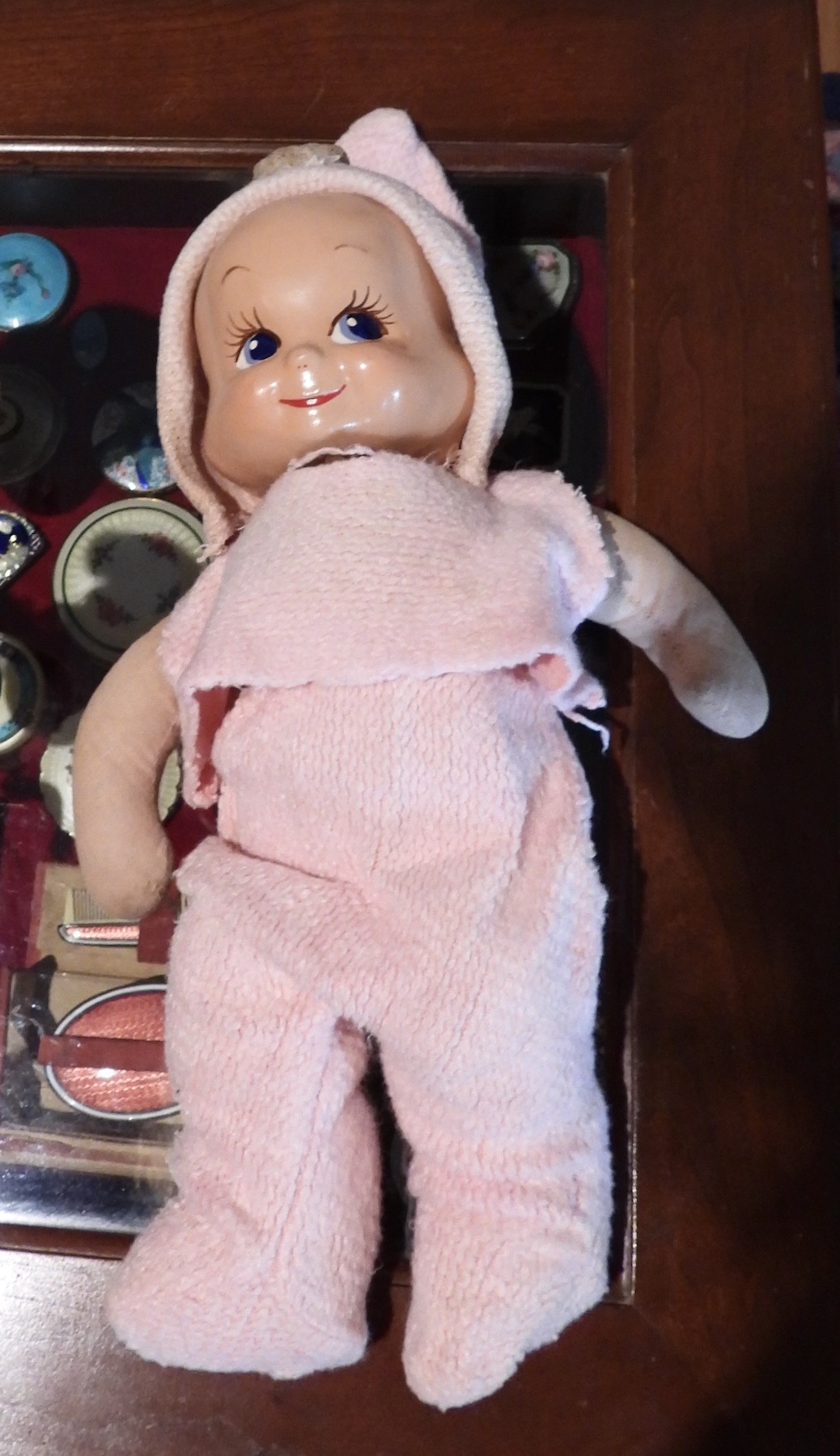
Jenell Howell shared her recent find, a Trudy doll with three faces. Trudy was introduced in 1946 by the Three-in-One-Doll Corporation and was designed by Elsie Gilbert. She has a composition head and a cloth body.

Elaine McNally brought this German doll dressed in its original Shaker costume.  Founded in the 1740s in England, the United Society of Believers in Christ's Second was a Christian sect that became known as the "Shaking Quakers" because of the dances and movements they made during worship services. A number of Shaker settlements were established in the United States beginning in the 1780s. The Shakers were known not only for their unique dress, but also for their fine arts and crafts. Shaker woman and girls dressed dolls in traditional Shaker costumes to sell to the public as souvenirs. 


Inspired by her find, Elaine created her own version of Shaker dolls. The larger doll she calls "Sister Flora." The dolls are cloth with paper clay faces. 


Elaine Jackson brought this trio of dolls created by Jane C. Furbee (1891 -1978). Little is known about this doll artist other than she started making and dressing dolls in the 1940s. The two taller dolls are wood and cloth and the one in the violet dress has a cloth tag stating that she is a "JanFer Woodee Doll."  The little girl is carved completely from wood and dates from 1970.


Kenneth Reeves shared this picture of his three R & B (Arranbee) Littlest Angels. He stated that the girl in the white dress with tiny pink flowers was made by R & B in the mid 1950s. The redhead in the center is Li'l Imp made by Vogue in 1959 and 1960 using the old R & B molds. The one in pink on the right was made by Vogue in 1963, again using the old R & B molds. He said that 1963 was the last year of production of Littlest Angel using the old R & B molds.




Wednesday, September 28, 2022

September 11, 2022, Meeting

Loading

In memory of Queen Elizabeth II, this month's theme was queens. 


Member Sharon Weintraub displayed two doll heads, one of fine bisque and the other of carved wood. Both heads had the hair tucked into a snood, with a scarf draped over on side of the head and a plume on the other.  She explained that this style of head is known to collectors as Empress Eugenie. Empress Eugenie was the consort of Napoleon III, who reigned as the emperor of France from 1852 until 1870. Sharon stated that there is no evidence the head is actually a portrait of the empress, but that this is just a name given this type of head by early doll collectors. The wooden head was found in an antiques market in Barcelona, Spain, and is expertly carved. 


She also shared this French fashion doll by Francois Gaultier on a jointed wooden body. The doll is dressed in an old beautifully tailored and hand sewn outfit, including layers of undergarments. Pinned to the back of her slip is a yellowed note declaring in French "Margueritte of France, Sister of Francis the 1st." This would indicate that the doll represents Margaret of Valois, who became Queen of Navarre upon her marriage to Henry III of Navarre in 1572 and then rose to Queen of France at her husband's 1589 accession to the latter throne as Henry IV. Sharon pointed out that the doll should be more properly dressed in Elizabethan garb rather than a romanticized outfit of the Middle Ages.


Sharon displayed this 9.5-inch tall bisque-headed doll representing Queen Victoria. The doll is part  of the "Femmes Célèbres" ("Great Ladies") series produced by Société Française de Bébé and Jouets (S.F.B.J.) in the 1940s. Her round paper tag reads "Fabrication Jumeau Paris Made in France" on one side and written in ink on back of label is "Victoria I Reine d Angleterre Cirque 1860." 


Member Sylvia McDonald brought this 1992 Madame Alexander doll dressed in a coronation outfit, complete with crown and velvet robe


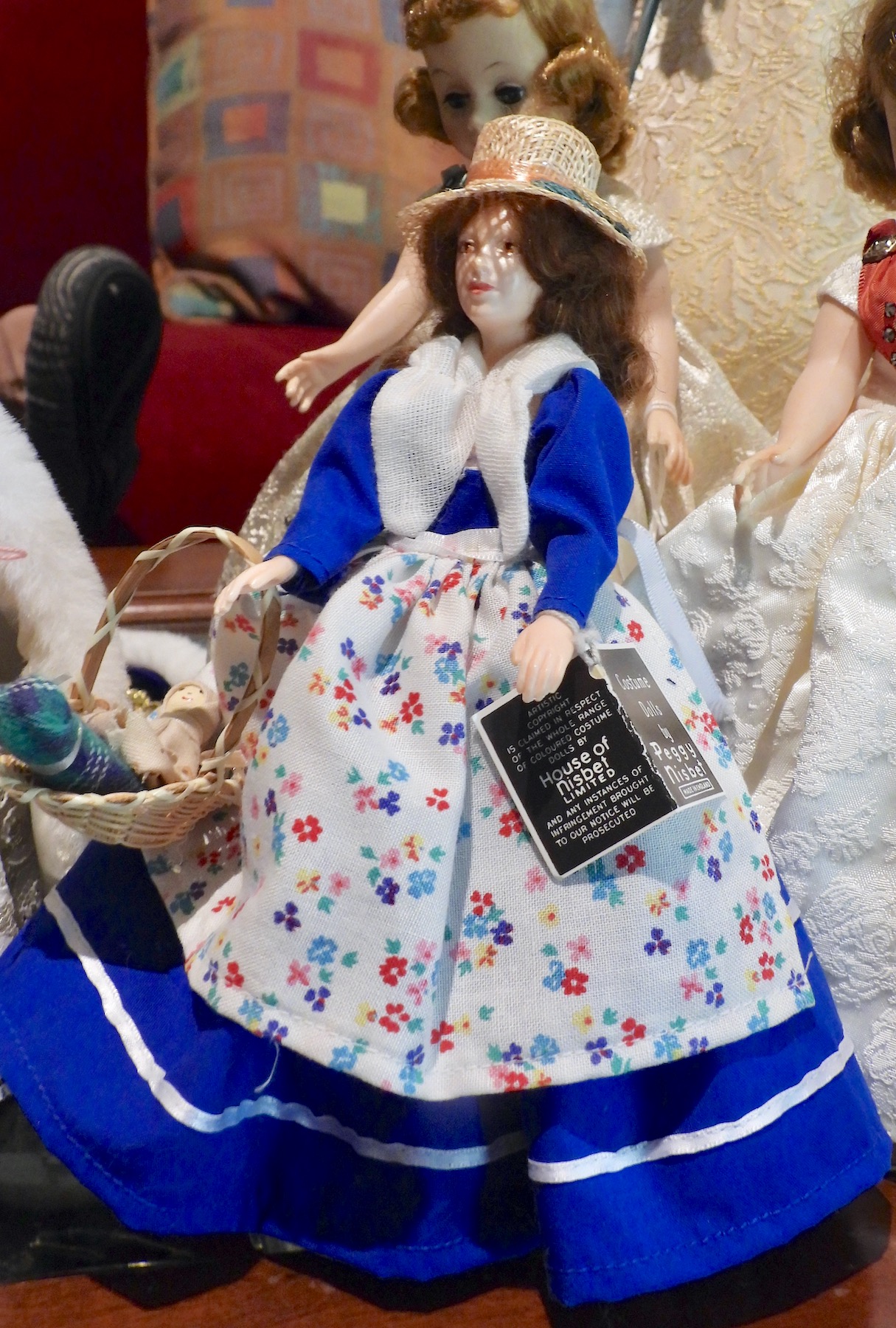
On one side of the doll are dolls in elaborate uniforms by English doll artist Peggy Nesbitt.  The older man represents a yeoman warder, who guards the Tower of London and the crown jewels displayed therein. The other man represents a palace guard wearing his signature "bearskin" helmet. The actual helmets are made of Canadian bear skins and were originally intended to make soldiers look taller and more intimidating in battle. 


A doll peddler, also by Nesbitt, admires the pomp and circumstance.


Member Myrna Loesch brought this collection of Madame Alexander Cissy and Cissette dolls in coronation gowns. The lovely lady in the purple robe dates from 1955. Myrna pointed out the doll's "ruby" and "diamond" bracelets, explaining that the jeweled cuffs worn by Queen Elizabeth during her coronation were a symbol of her sovereignty. The other Cissy dates from 1957 and wears a replacement crown made by Myrna. The purple robe, large golden crown, and specter belong to Member Jan Irsfeld and were made by Alexander to commemorate the 20th anniversary of Elizabeth's coronation.


The Cissette in the golden floral dress is from 1958. The doll with the red sash dates from 1972-73.


Member Elaine Jackson shared this book, first published in 1950, written by Marion Crawford, who was the governess to Princess Elizabeth and her sister, Margaret.


Member Elaine McNally displayed some of her latest wood and cloth creations.


Guest Pam Hardy brought this artist doll to share. She purchased it on a tour of Germany. The doll has a handwritten paper tag that says "matrosen mädchen," or "sailor girl."


Wednesday, June 15, 2022

June 13, 2022, Meeting

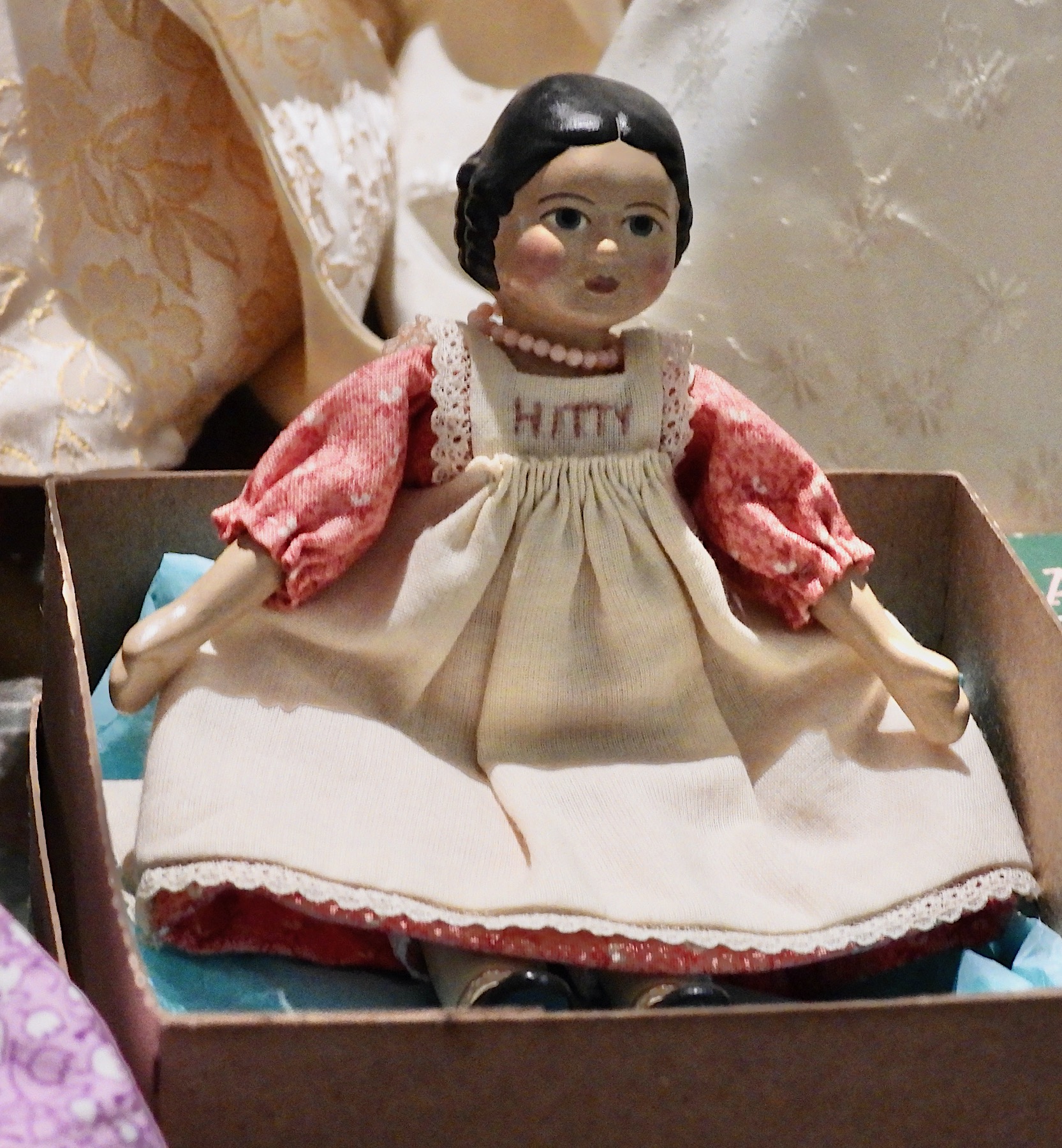
Elaine Jackson and Elaine McNally did a joint program on Hitty and her friends. Hitty is the wooden doll heroine of Rachel Field's 1929 children's novel, Hitty, Her First Hundred Years. In the book, the eponymous Hitty (short for Mehitabel), a simple wooden doll carved by a peddler in the 1820s, narrates her adventures over her century of existence. Jackson explained that Fields was friends with illustrator Dorothy Lathrop and sometime in the 1920s, while strolling together in New York City they saw a small time-worn wooden doll in an antique shop window. All the shop owner could tell them about the doll was that she was at least 100 years old. Neither woman could afford the doll by herself, so they pooled their resources and purchased her jointly. Inspired by the diminutive doll, they created a history for Hitty, written by Fields and illustrated by Lathrop. The book was a success and was awarded the John Newbery Medal of Excellence in 1930. Elaine brought several examples of Hitty, which is still in print. 


The book's charming historical tale has inspired generations of doll artists to carve their own versions of Hitty based on the book's illustrations, as well as Hitty-type dolls referred to as Hitty friends. 


This an early all-wood Hitty was carved by Helen Bullard, one of the founders of the National Institute of American Doll Artists. Jackson explained that because of copyright issues, Bullard called her doll "Holly." People began to wonder what had happened to the original Hitty and Jackson stated that in the 1980s Hitty was discovered in the Stockbridge Library in Massachusetts, where she had been donated by a relative of Lathrop. The original Hitty now resides in a climate-controlled case donated by the Friends of Hitty.


The copyright has since expired and artists now may call their creations "Hitty." Michael Langton persuaded the Stockbridge to permit him to measure the original Hitty and he created Hitty replicas both in wood and resin. This doll, belonging to Elaine McNally, is actually a perfume bottle created by Langton.


Jackson displayed a wide variety of Hitty dolls in wood and resin, showing each artist's own unique interpretation of the beloved doll. 


This doll by Sara Cole is made of resin. Using resin allows an artist to make multiple editions of a doll.


This Hitty by Janet Cordell was a wooden shoulderhead on a cloth body.


Many of Jackson's Hitty dolls are souvenirs from Hitty conventions. This doll by Constance Hardt was the souvenir for a San Antonio convention called "Hitty at the Alamo."


Like many Hitty fans, Jackson has a "Hitty House" to display her Hitty dolls and friends. Jackson explained that Hitty is too large for a standard dollhouse and that her late husband built her a house suitable to Hitty's dimensions. This vintage handmade bed and chair are just the right size for many of Jackson's Hitty dolls. The bed was cleverly created out of an old wooden cigar box with clothespin posts and sewing spool legs.


Another wooden doll from Jackson's collection, this one representing "Miss Unity," the mascot of the United Federation of Doll Clubs. The doll was created by Judy Brown, who has also carved Hitty dolls.


Elaine McNally then displayed her wonderful whimsical dolls inspired by Hitty.


She showed the club the tools she uses to carve her creations.

McNally explained that she may start with a block of wood. . . 

or use a commercially-made blank.

This Hitty holds a wooden whale. In the book, Hitty sails on a whaling ship.

A Hitty-inspired Alice in Wonderland cradling the Cheshire cat. McNally said that she enjoys creating miniature dolls holding an even smaller doll or other object.


This doll is an experiment by McNally to create a fully-jointed wooden doll.


McNally also makes little cloth versions of the rare Izannah Walker dolls, created in the 1840s through the 1880s. 


Another version of Alice and the Cheshire cat.


This is McNally's tiny version of an Edith Flack Ackley doll. A writer and doll artist, in the 1930s Ackley published a book entitled Dolls to Make for Fun and Profit, which included patterns for dolls and their clothing. Many dolls were made using her patterns in the 1930s and 40s.


Guest Joey Gomez shared two of his Hitty dolls. This version is by Gail Wilson.


And this one is by Robert Raikes.


Myrna Loesche brought this little wooden girl carved by Austin artist Nancy Grobe, who was once a member of our club. Nancy eventually had to give up carving because of arthritis and became a skilled painter.


In honor of the Platinum Jubilee celebrating Queen Elizabeth's 75 years on the throne, members shared dolls representing English royalty. The Madame Alexander Cissy dolls and Cissette dolls belong to Myrna and date from the 1950s.


Although these dolls' costumes closely resemble the outfit worn by Queen Elizabeth II at her 1953 coronation, Alexander only referred to them as "Queen" dolls. This doll is all original except for the replacement crown created by Myrna.


This bisque-headed doll represents an earlier English queen, Queen Victoria. She is 9.5 inches tall and is all original. Her round paper tag reads "Fabrication Jumeau Paris Made in France" on one side and written in ink on back of label is "Victoria I Reine d Angleterre Cirque 1860." The head is incised "221 2/0." She is part of the "Femmes Célèbres" ("Great Ladies") series produced by Société Française de Bébé and Jouets (S.F.B.J.) in the 1940s. In 1899, a number of French doll makers, including Jumeau, joined in this alliance in an attempt to ward off German competition. S.F.B.J. (later under the name UNIS) produced dolls until the 1950s and continued to use the Jumeau name for some of its dolls.