
dollshow

dollshow

AUSTIN DOLL COLLECTORS SOCIETY

The Austin Doll Collectors Society is an organization of antique, vintage, and modern doll collectors, dealers, and artisans. We meet on the second Sunday of each month and our meetings are fun and educational. We begin with refreshments and socializing, and, following our brief business meeting, there is a special doll-related program and "show and tell." The Austin Doll Collectors Society is a nonprofit organization and is a member of the United Federation of Doll Clubs.
Showing posts with label Lenci. Show all posts

Sunday, February 26, 2023

February 12, 2023, Meeting

 Member Elaine Jackson did a program on Norah Welling dolls. Elaine told the club that Wellings was born in England in 1893. She attended school until she was 14-years old, staying home to help her mother care for her father. Wellings took art courses by correspondence with the London School of Art and in 1919 took her art certificates and applied to the Chad Valley Company. She was hired as one of the company's chief doll designers. In 1926, Wellings left the company over a dispute with management. It was reported that she took and destroyed her designs so that Chad Valley could no longer use them.

Her brother Leonard helped Wellings set up the Norah Wellings Company, renting her space in the family's plastering firm. In 1929, Welling's company purchased an abandoned church and Leonard began working with his sister full-time; Elaine said that the company employed many of Wellings' family and friends. By 1930, the company had opened a showroom and office in London. In addition to dolls, the company also made animals, pajama and handkerchief cases, and tea cozies. After Leonard died in 1959,  Wellings decided to retire, closing the factory and destroying all designs, tools, and unfinished dolls. She died in 1975.


Elaine explained how to identify Wellings dolls. Some carried a round paper tag.  Other dolls have a stitched fabric label around the wrist or on the sole of the foot reading "Made in England by Norah Wellings." The faces are molded and hand painted, either on felt or, for the smaller later dolls, stockinette. Elaine said that the dolls never had composition or plastic faces. The ears are two layers of fabric, stitched around the edge.


This doll with a beautifully pieced felt dress is the model called Norene, produced from 1930 to 1959. She represents a Dutch girl. The red-haired girl in the center of the first picture is Norette, a series produced from 1934 through 1934 as child dolls. She does not have her original clothes. 


This doll possibly represents a Dutch boy.


Wellings made a variety of character or novelty dolls, such as this Native American man. The dolls had stitched jointing and the clothes were sewn on the dolls as an integral part of the design. The admiral doll in the first picture, holding a British flag, is another example. The most common Wellings character doll is  a sailor; the dolls were sold to cruise lines to stock as souvenirs and often carry the name of the ship or line on the hat band.


This style of doll is referred to as "Old English." 


This doll is from a line called "Tiny Tot." Produced in the 1950s, the doll has a stockinette face and cotton limbs. The admiral doll stands behind her just to her right.


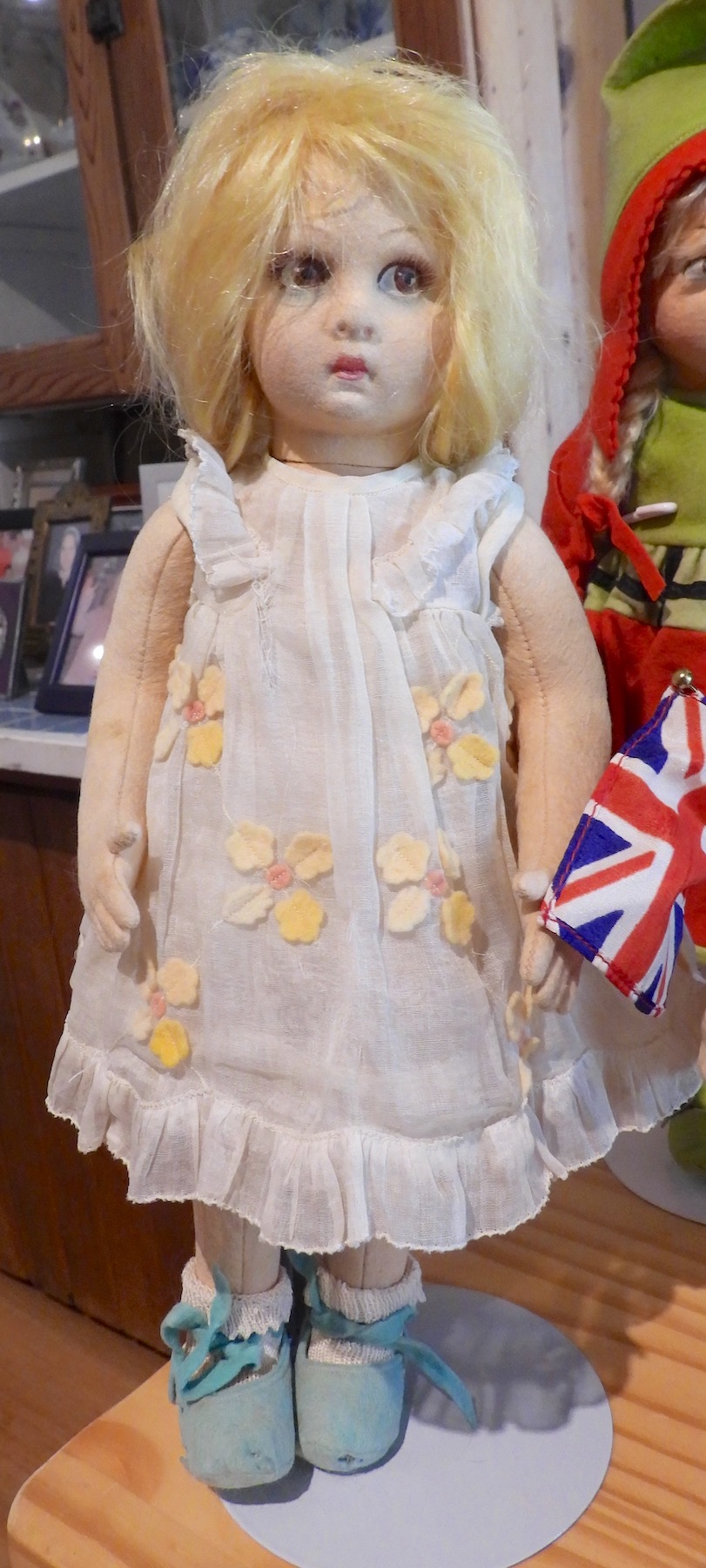
Member Jenell Howell brought this felt doll by the Italian firm of Lenci to compare with the Wellings felt dolls.

Member Nancy Countryman brought four dolls.  Three of the dolls are by Madame Alexander; the two dolls in the front are Cissettes (the one in the gown is Cinderella), and largest doll is from the Little Women series with a Maggie face. The fourth doll in the red and black outfit is an unmarked composition girl.


Member Elaine McNally shared this charming wax over composition antique doll.


Guest Kenneth Reeves displayed two cloth dolls by the Canadian company of Bamboletta. He said that the  Waldorf-style dolls are handmade of natural materials. 


Member Pam Hardy told the club that this doll had been brought from Europe by a relative. She said that the doll stayed in such good condition because the children were not allowed to play with her. The label on the doll's skirt identifies her as being made by the Italian firm of Magis.


Tuesday, May 26, 2020

Boudoir Belles

This lovely lady belongs to member Michele Thelen.  She is known as a boudoir doll. This gorgeous gal has a composition head and was probably made in the United States.  Her colorful ruffled gown is original and her composition complexion is in excellent condition.


These elongated long-limbed lasses were not made as children's playthings, but for fashionable women to display in their bedrooms and salons, hence the name "boudoir dolls." The boudoir doll was grew out of the art doll movement of the 1910s. Artist Stefania Lazarka moved from her native Poland to Paris prior to WWI. The coming of the war stranded many Polish citizens in France, leaving some without any source of income. Lazarka created the Ateliers Artistiques Polonais, hiring Polish artists to handcraft artistic cloth dolls, with the proceeds going to support their community.  Fashion designer Paul Poiret saw some of the dolls on exhibit and soon his fashion salon was producing similar dolls for his atelier.  He had his models stroll down the runways with with cloth dolls dressed in miniatures of his most recent creations draped over their arms.  Soon boudoir dolls became the "must have" fashion accessory of the season.  Not only did they adorn boudoirs and sofas, women carried them around as mascots and upper-scale night clubs even offered them to their female patrons.  Some dolls doubled as lingerie bags or purses, but the vast majority were purely decorative.  Soon boudoir dolls were being produced not only in Paris, but throughout Europe and the United States.  The dolls were produced in a wide variety of materials, with heads of silk, felt, muslin, or composition.  They varied in size, some a petite 14 inches or so while others stretched to 30 inches or more. Throughout the 1920s and 30s the dolls' dresses became more creative, not reflecting fashion as much as some designer's imagination.  The dolls ranged from expensive artistic creations to inexpensive gaudily-gowned ladies offered as carnival prizes.   By the 1940s the fad had faded.

This example is a petite 14-inches long and has a papier mache head that is stamped Made in Germany. She wears her original clown costume and is "puffing" a little wooden cigarette.  These dolls with a cigarette dangling insouciantly from their rouged lips are known to collectors as "smokers" and are highly sought after.  Sadly, so sought after that some less-honest dealers are cutting holes in the face of more ordinary boudoir ladies and adding often oversized cigarettes.


A close up of her face shows her very daring and detailed eye makeup.


This serene señorita is the creation of Lenci, founded by Elena König in Italy and renown for its artistic felt dolls.  She is 27 inches tall and lavishly dressed in the traditional Charro folk costume of Salamanca, Spain.  She is all original except for her necklaces, rosary and slippers.


The doll as pictured in the 1930 Lenci catalogue.


This boudoir doll head from the German firm of Hermann Steiner is very unusual, not only because she is made from bisque, but also because she is a "living eye" doll.  “Living eyes” were advertised by Steiner in 1926, and consisted of a loose glass disk iris under clear dome; when the doll is tilted, the iris slides back and forth. Most living eye dolls by Steiner  are child-like googlies.  She is incised on back of the neck with an intertwined H and S over Germany 395 0.


Thursday, August 2, 2018

Women Doll Artists: Elena König Scavini


Elena König was born in Turin in 1886. When she was 14 years old she did what so many children dreamed of and ran off to join the circus. She returned home after a few months and later studied art and photography. In 1915, she married Enrico Scavini and moved with him to Italy. After the loss of her first child, Elena began creating dolls, using readily available felt and working with her brother to create special molds. In 1919, the Lenci factory was established. "Lenci" is thought to be an acronym from the Latin motto "Ludus Est Nobis Constanter Industria" (Play is our constant work), although some biographers state that it is also based on Elena’s German nickname.  The company's artistic felt dolls, typically dressed in beautifully tailored outfits of felt and organdy, became very popular and were widely copied by companies throughout Europe.  In 1928, Lenci also began a ceramics factory renowned for its stylized figurines.  The company created everything from small souvenir dolls and mascots to high-end play dolls to decorative boudoir ladies.  This 27-inch tall boudoir lady is unusual as she is lavishly dressed in velvet and silk, heavily adorned with gold embroidery.  She is all original except for her necklaces, rosary and slippers.  Her exquisite and detailed outfit represents the traditional Charro folk costume of Salamanca, Spain.


A close up of her face demonstrates the extraordinary artistry of Lenci dolls.  


A page from the 1930 Lenci catalogue picturing this doll.