dollshow

dollshow

AUSTIN DOLL COLLECTORS SOCIETY

The Austin Doll Collectors Society is an organization of antique, vintage, and modern doll collectors, dealers, and artisans. We meet on the second Sunday of each month and our meetings are fun and educational. We begin with refreshments and socializing, and, following our brief business meeting, there is a special doll-related program and "show and tell." The Austin Doll Collectors Society is a nonprofit organization and is a member of the United Federation of Doll Clubs.

Monday, April 3, 2023

March 12, 2023, Meeting

In honor of the upcoming Saint Patrick's Day, members were asked to bring Irish dolls or dolls dressed in green. Jenell Howell brought this little German boy in his original outfit. He was made by Porzellanfabrik Rauenstein.


This little doll in an Irish outfit is by Madame Alexander. Myrna Loesch told this club that this is one of the last dolls she received as a child. This doll has bent knees and was made between 1963 to 1972. 


She also brought these Madame Alexanders in outfits Myrna said represented the six flags that have flown over Texas.


Sharon Weintraub shared some Japanese dolls in honor of another March holiday. She explained that March 3rd is the Japanese holiday of Hinamatsuri, also called Doll's Day or Girls' Day. It is traditional in Japanese homes to set up a display of tiered platforms with dolls representing court figures from the Heian era (794-1185 AD). The dolls, called hina-ningyō, include an emperor and empress, always seated on the top tier, with court ladies, musicians, and ministers, and attendants displayed on descending tiers, along with miniature lacquer furniture and other accessories. The kneeling doll in the front is a hina-ningyō representing an attending court lady and the lacquer chest behind her is typical of the furniture used in the Hinamatsuri display. The little doll in green next to her represents a boy and has a head of carved ivory. Behind him is Mausu-san, a doll Sharon created using a vintage Japanese doll that had lost its head and a taxidermied mouse. In the back are two ichimatsu dolls, traditional Japanese play dolls, but these two are unusual. The little girl has a head of bisque instead of the tradition gofun finish (a mix of glue and ground oyster shells) and the doll next to her represents an adult woman, although typically ichimatsu represent young children.


Guest Mary Jordon shared a fashion doll by the Tonner Doll Company that she had redressed in an outfit inspired by the popular "Outlander" book and television series, as well as two Neo-Blythe dolls.


Elaine Jackson brought this doll created by Jay of Dublin, dressed in the traditional outfit of Sligo County Doll. These dolls were made from the 1930s through the 1960s and came in detailed costumes of the different regions in Ireland. She has a painted plaster face and wire armature body.


Another doll from Elaine, a cloth girl dressed in green. She is an early example from the Deans Rag Book Doll Company.


New member Kenneth Reeves brought a number of examples of dolls in Irish costumes. The two small dolls in the front are also by Jay of Dublin.  The little girl in the green dress and white cap is a Ginny by Vogue Doll Company and the doll next to her in the red head scarf is "Irish Colleen" by Peggy Nesbit.  


More dolls displayed by Kenneth. The three dolls with the ceramic faces and painted features are by Si-Og, a company that handcrafts the dolls in Ireland using local materials. Kenneth explained that Si-Og means "little people." The red-haired girl in green is Adora Irish Belle by Marie Osmond.


Elaine McNally brought these tiny tots clad in green. The doll in the front was hand-carved and dressed by Elaine and the other doll is a needle-sculpted and painted creation by doll artist Dianne Dengel.


More creations by the talented Elaine, three cloth dolls inspired by antique Izannah Walker dolls.


Pam Hardy shared these two dolls in shamrock print dresses. She told the club that the dolls were given to her and her sister when they were children by an aunt who collected dolls. Pam said that she played with her doll, so that it looks a bit "loved."


Sylvia McDonald brought this Effanbee vinyl doll dressed in green as Goldilocks. Sylvia received this doll from her brother.


Skilled seamstress Jan Irsfeld shared this reproduction doll she had dressed.


Nancy Countryman brought several dolls gowned in green. This is Scarlet O'Hara by Madame Alexander. Nancy added the hat in honor of Saint Patrick's Day.


Two other dolls from Madame Alexander are the little girl in the Irish outfit and "Little Lambkin Wendy." The doll in the back is another Goldilocks from Effanbee.


Sunday, February 26, 2023

February 12, 2023, Meeting

 Member Elaine Jackson did a program on Norah Welling dolls. Elaine told the club that Wellings was born in England in 1893. She attended school until she was 14-years old, staying home to help her mother care for her father. Wellings took art courses by correspondence with the London School of Art and in 1919 took her art certificates and applied to the Chad Valley Company. She was hired as one of the company's chief doll designers. In 1926, Wellings left the company over a dispute with management. It was reported that she took and destroyed her designs so that Chad Valley could no longer use them.

Her brother Leonard helped Wellings set up the Norah Wellings Company, renting her space in the family's plastering firm. In 1929, Welling's company purchased an abandoned church and Leonard began working with his sister full-time; Elaine said that the company employed many of Wellings' family and friends. By 1930, the company had opened a showroom and office in London. In addition to dolls, the company also made animals, pajama and handkerchief cases, and tea cozies. After Leonard died in 1959,  Wellings decided to retire, closing the factory and destroying all designs, tools, and unfinished dolls. She died in 1975.


Elaine explained how to identify Wellings dolls. Some carried a round paper tag.  Other dolls have a stitched fabric label around the wrist or on the sole of the foot reading "Made in England by Norah Wellings." The faces are molded and hand painted, either on felt or, for the smaller later dolls, stockinette. Elaine said that the dolls never had composition or plastic faces. The ears are two layers of fabric, stitched around the edge.


This doll with a beautifully pieced felt dress is the model called Norene, produced from 1930 to 1959. She represents a Dutch girl. The red-haired girl in the center of the first picture is Norette, a series produced from 1934 through 1934 as child dolls. She does not have her original clothes. 


This doll possibly represents a Dutch boy.


Wellings made a variety of character or novelty dolls, such as this Native American man. The dolls had stitched jointing and the clothes were sewn on the dolls as an integral part of the design. The admiral doll in the first picture, holding a British flag, is another example. The most common Wellings character doll is  a sailor; the dolls were sold to cruise lines to stock as souvenirs and often carry the name of the ship or line on the hat band.


This style of doll is referred to as "Old English." 


This doll is from a line called "Tiny Tot." Produced in the 1950s, the doll has a stockinette face and cotton limbs. The admiral doll stands behind her just to her right.


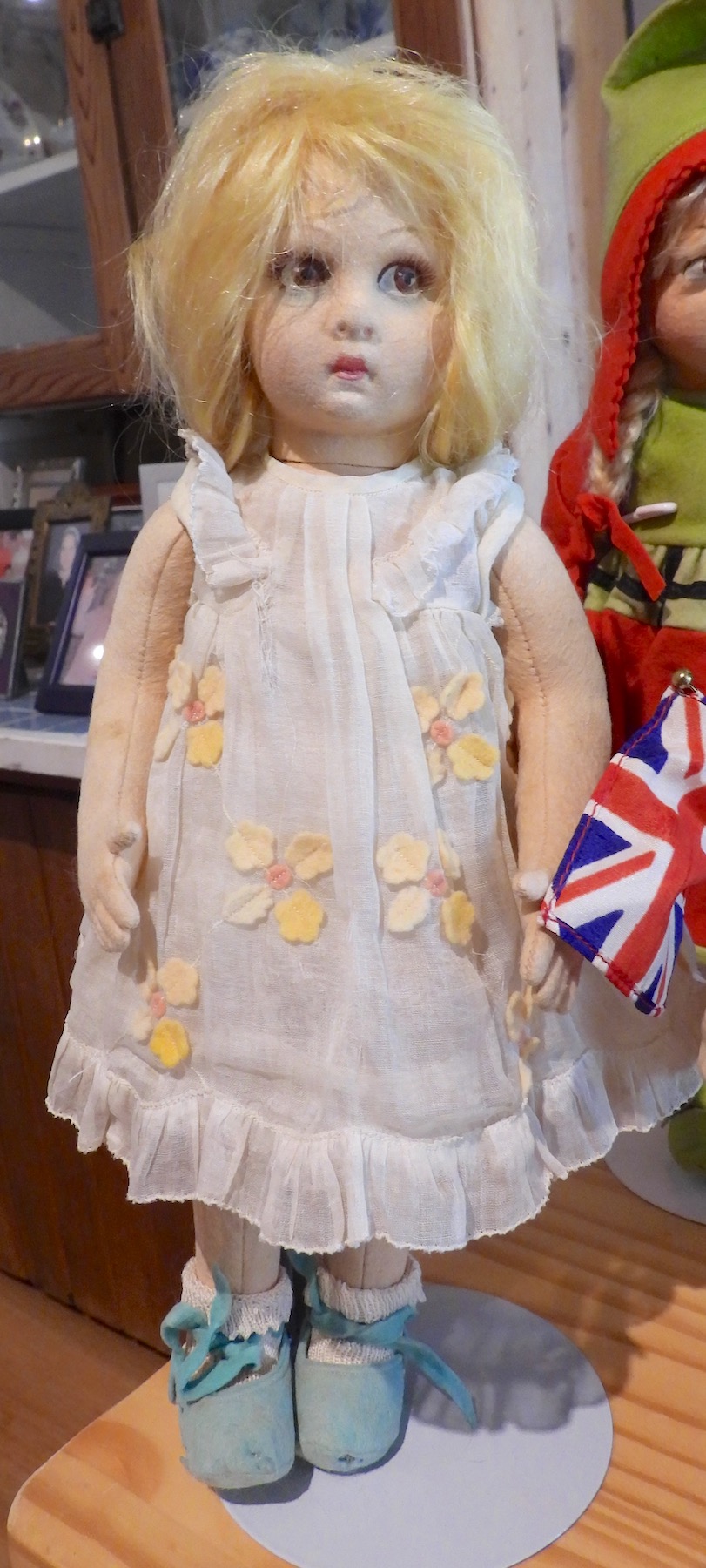
Member Jenell Howell brought this felt doll by the Italian firm of Lenci to compare with the Wellings felt dolls.


Member Nancy Countryman brought four dolls.  Three of the dolls are by Madame Alexander; the two dolls in the front are Cissettes (the one in the gown is Cinderella), and largest doll is from the Little Women series with a Maggie face. The fourth doll in the red and black outfit is an unmarked composition girl.


Member Elaine McNally shared this charming wax over composition antique doll.


Guest Kenneth Reeves displayed two cloth dolls by the Canadian company of Bamboletta. He said that the  Waldorf-style dolls are handmade of natural materials. 


Member Pam Hardy told the club that this doll had been brought from Europe by a relative. She said that the doll stayed in such good condition because the children were not allowed to play with her. The label on the doll's skirt identifies her as being made by the Italian firm of Magis.


Saturday, January 28, 2023

January 8, 2023, Meeting

Member Sharon Weintraub did a program on "Weird, Wacky, and Ugly Dolls." She explained that while we tend to think of dolls as beautiful, with phrases such as "dolly face" or "she's a real doll," doll companies also created dolls that many would consider odd or ugly.  She shared a number of examples from her collection. This automaton is by Leopold Lambert and entitled "Bébé et Polichinelle." Made in the 1890s, when the automaton is wound, the little girl lifts and lowers her broken polichinelle doll as she turns her head and raises her left hand to "wipe" tears from her eyes. The character head, with squinting eyes and wide-open wailing mouth, is Mold 211 by Jumeau. 


This wicked witch, complete with many molded warts, is "Hexe," created for Cuno Otto and Dressel by Simon and Halbig as part of Dressel’s portrait doll series from 1898 through 1903. Other dolls in this series include the Farmer, Rip Van Winkle, and Uncle Sam, as well as historical figures from the period, such as Admiral George Dewey and Admiral William Thomas Sampson.


Another witch doll, with a hooked nose, wrinkled face, and painted fangs, made by the German firm of Hertwig and Company. She is dressed in her original outfit. Hertwig also offered this doll as part of a set, with two all-bisque children representing Hansel and Gretel. The little china boy is front of her is a mysterious oddity. He is molded into his chair and when a metal lever is moved in the back of the chair, he jiggles his head and arms.


This peddler doll with her basket full of tiny antique items has a German papier mache head of the type made from the 1870s through the 1890s. The head represents an elderly woman with a large hooked nose, a wide grin exposing two teeth, and wire eyeglasses. Such heads were also used for characters such as witches and Mother Goose.


The taller monkey is of early composition covered with brown mohair and his smaller companion is an all-bisque monkey. Although unmarked, Sharon stated that they were no doubt of German origin


This early all-bisque doll is two toys in one, as his hat is also a whistle.


Another unusual male all-bisque doll, this man appears to be dressed as a character from the traditional commedia dell'arte. His hands are pierced, there are loops on each foot, and another hole in the brim of his hat, suggesting that he could be strung as a simple marionette. Sharon thinks that he may have been intended to be part of a child's toy theatre.


This pair of unusual early bisque nodders features a naughty boy in a dunce cap sticking out his tongue at his primly dressed sister.


The popularity of Rose O'Neill's Kewpie doll introduced in 1913 sent German companies scrambling to create their own Kewpie-inspired dolls to try to cash in on the Kewp craze. This well-fed trio are "Happifats" dolls designed by Kate Jordan and produced by George Borgfeldt in Germany from 1913 to 1921. They were produced in three sizes of all-bisque dolls as well as a version with a composition head. Happifats were also produced in Japan and companies like Shackman made reproductions as well. The German dolls have the finest bisque and decoration and often carry a stamped “C” for “copyrighted” on the sole of one foot. 


 The little horned imp was no doubt another German company's creative answer to the rather angelic Kewpies. He has cloven hoof feet and even a tiny goat tail. The other doll is HEbee SHEbee designed by Charles Twelvetrees, a prominent illustrator of the 1920s who specialized in drawings of cute children, often with humorous captions. E.I Horsman introduced HEbee SHEbee in 1925 both in bisque and composition. The boy and girl dolls are identical, except that SHEbee has pink shoes and while HEbee wears blue ones. 


These grinning or grimacing girls were designed by Jeanne I. Orsini in 1920. The all-bisque dolls were made in Germany and distributed by George Borgfeldt. The unusual right hand with the extended pointing finger is unique to these dolls.


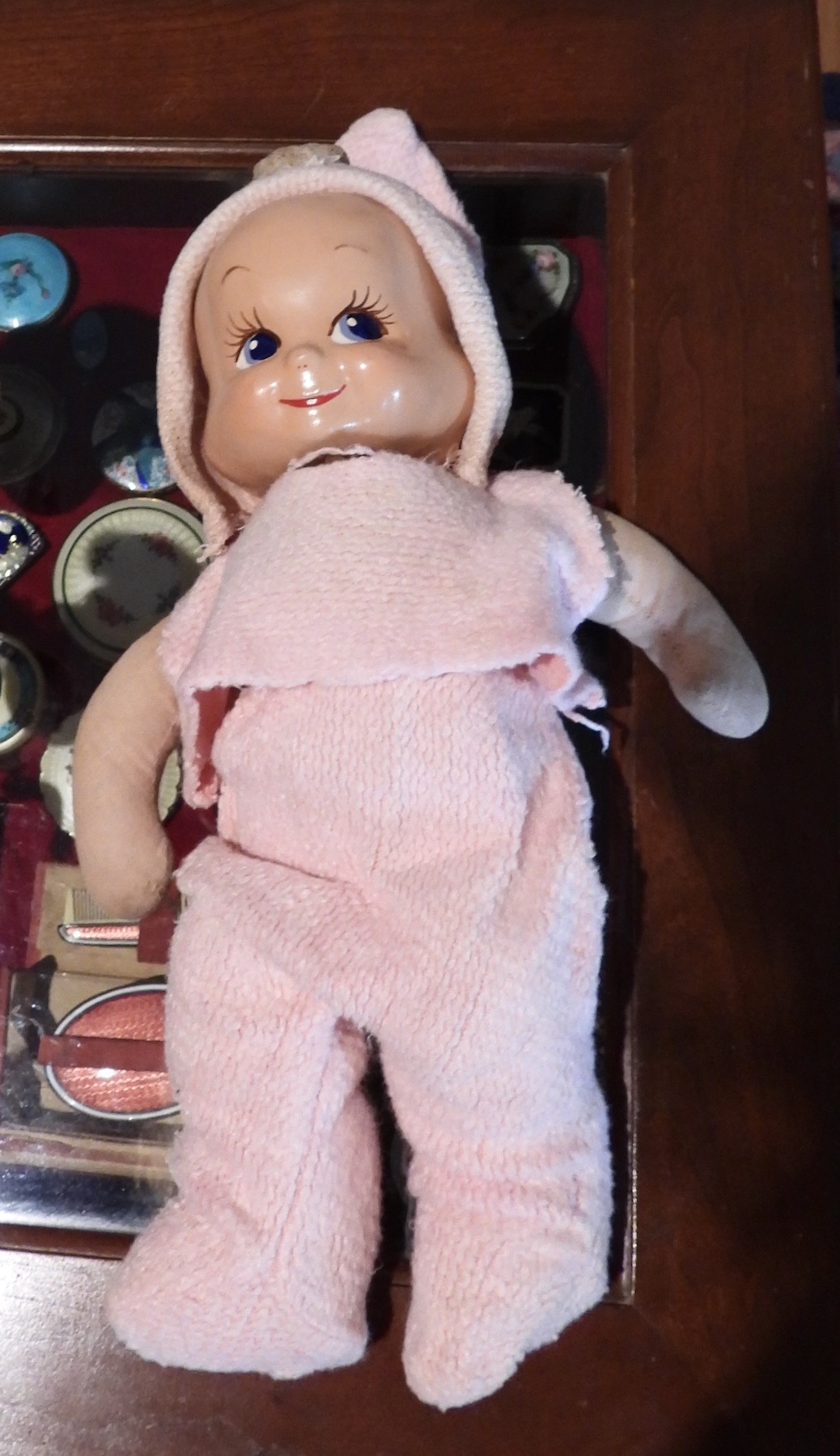
Jenell Howell shared her recent find, a Trudy doll with three faces. Trudy was introduced in 1946 by the Three-in-One-Doll Corporation and was designed by Elsie Gilbert. She has a composition head and a cloth body.


Elaine McNally brought this German doll dressed in its original Shaker costume.  Founded in the 1740s in England, the United Society of Believers in Christ's Second was a Christian sect that became known as the "Shaking Quakers" because of the dances and movements they made during worship services. A number of Shaker settlements were established in the United States beginning in the 1780s. The Shakers were known not only for their unique dress, but also for their fine arts and crafts. Shaker woman and girls dressed dolls in traditional Shaker costumes to sell to the public as souvenirs. 


Inspired by her find, Elaine created her own version of Shaker dolls. The larger doll she calls "Sister Flora." The dolls are cloth with paper clay faces. 


Elaine Jackson brought this trio of dolls created by Jane C. Furbee (1891 -1978). Little is known about this doll artist other than she started making and dressing dolls in the 1940s. The two taller dolls are wood and cloth and the one in the violet dress has a cloth tag stating that she is a "JanFer Woodee Doll."  The little girl is carved completely from wood and dates from 1970.


Kenneth Reeves shared this picture of his three R & B (Arranbee) Littlest Angels. He stated that the girl in the white dress with tiny pink flowers was made by R & B in the mid 1950s. The redhead in the center is Li'l Imp made by Vogue in 1959 and 1960 using the old R & B molds. The one in pink on the right was made by Vogue in 1963, again using the old R & B molds. He said that 1963 was the last year of production of Littlest Angel using the old R & B molds.


Monday, January 2, 2023

Holiday Party, December 11, 2022

The club celebrated its annual holiday party at the beautiful home of member Jan Irsfeld, all decked out for the holidays.


Members shared not only a delicious pot luck lunch but dolls with links to the season. Sylvia McDonald brought this "Precious Moments" doll. She is from the series "Garden of Friends" and represents December.


Myrna Loesch set up this endearing tableau of two Alexander-kins dolls by Madame Alexander celebrating the holiday of Chanukah. 


Both dolls are from the international series and represent Israel. The earlier doll from the 1960s wears earrings as well as a Star of David necklace.


The later version has only the necklace.


Jenell Howell brought this delightful wooden Santa, beautifully hand carved by the husband of former member Ann Campbell.


Sharon Weintraub brought this crocheted miniature snowman she attributed to the German company of Carol Horn.


Also by Horn are these diminutive dolls, each only about 1.5 inches high. The bearded dolls at the ends Sharon said could represent either gnomes or the traditional Father Christmas and they each have a tiny metal lantern hanging by their sides.


Sharon also shared this all-bisque Kewpie doll in its original Christmas crepe paper costume.


Nancy Countryman brought these two well-loved dolls from her childhood.


Jam Irsfeld displayed this outstanding Cissy representing representing Madame 
Pompadour in the court of King Louis XV of France. Jan created the doll's lavish and ornate winter outfit.


Under her lush cloak, Madame's gown is elaborately adorned with intricate hand beading. Jan said it took her a year and a half to complete the dress.


Another creation by Jan is her interpretation of a Cissy trunk and trousseau once offered by FAO Schwarz.  Jan made the trunk out of wooden boxes.