
dollshow

dollshow

AUSTIN DOLL COLLECTORS SOCIETY

The Austin Doll Collectors Society is an organization of antique, vintage, and modern doll collectors, dealers, and artisans. We meet on the second Sunday of each month and our meetings are fun and educational. We begin with refreshments and socializing, and, following our brief business meeting, there is a special doll-related program and "show and tell." The Austin Doll Collectors Society is a nonprofit organization and is a member of the United Federation of Doll Clubs.
Showing posts with label Arranbee. Show all posts

Monday, January 19, 2026

January 11, 2026, Meeting

Pam Hardy gave a program on baby dolls. She told the club that she has loved baby dolls since she was four years old. Pam displayed her "last" doll, a Babeside Reborn Baby that was her Christmas present.


Another baby from her collection is this bisque-head Bye-Lo baby, designed by American artist Grace Storey Putnam in the 1920s. Pam said that she had long wanted a Bye-lo baby, but was waiting for one in excellent condition with its original button. She finally found this beautiful babe.


Pam Hardy brought this porcelain doll by artist Donna Rupert. . . 


. . . as well as this vinyl doll by Effanbee named Lisa.


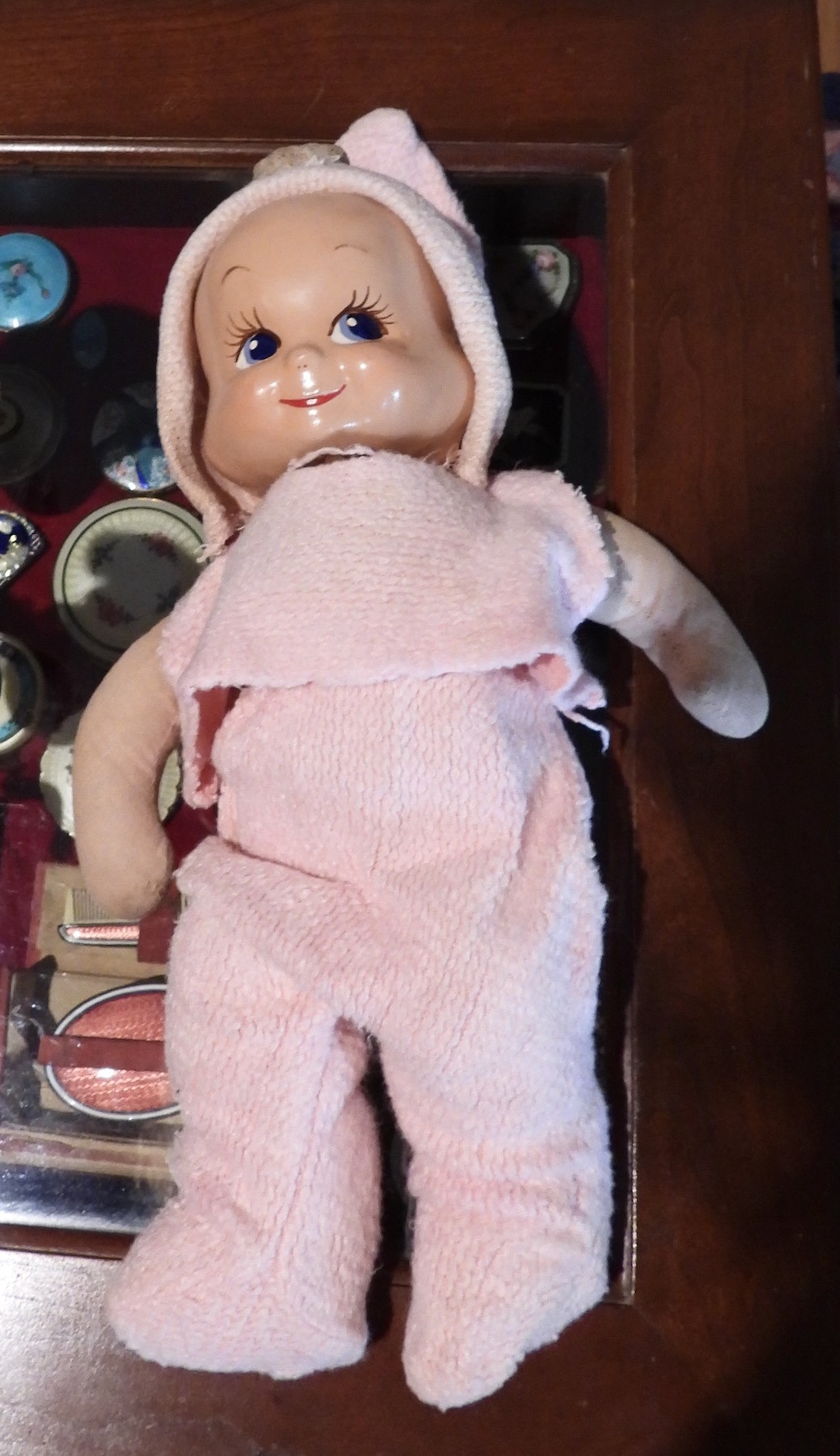
This composition baby was a gift to Pam. It is believed to have been made by Arranbee.


Another early doll from Pam's collection, this all bisque baby is by the German firm of Hertwig and Company and has its original clothing.


Kenneth Reeves brought this composition "Mama" doll (so named because the sound box in her cloth body once said "Mama" when the doll was moved) and a Baby Ginny in a bright bathing suit.


His doll in the yellow outfit is also a Ginny while the tot in purple is an unmarked drink and wet doll. The boy in the white jacket was made by Italo Cremona. Kenneth told the club that he bought this doll because it resembled one that his brother had received as a child.


Elaine Jackson shared a trio of all-wooden Schoenhut dolls. She told the club that Harry Schoenhut had designed the baby head in 1911 and the company used this head until it went out of business in 1935. This doll is a walking model.


The doll in white wears a dress made by Elaine's mother in the 1940s. The boy has an open mouth with metal teeth and sleep eyes. Elaine told the club that this was an attempt by Schoenhut to compete with popular composition dolls and was among the last of the dolls produced by the company.


Sharon Weintraub display this bevy of all-bisque babies. The largest doll is by J.D. Kestner. It has the plump bent limb body first introduced by Kammer and Reinhardt in 1909. On its lap is an all-original Bye-lo Baby. Sharon told the club that the Bye-lo was so poplar that it was called the "million dollar baby" and was made in a wide variety of sizes, including little all-bisque dolls like this one. The happy toddler in pink is "Bonnie Babe" designed by artist Georgene Averill in the 1920s.


These two bisque-headed babies on composition bodies are also from Sharon's collection. The smiling Black doll is by the German company of Heubach Kopplesdorf and was marketed as "South Seas Baby." The other doll is "Hanna" by Schoenau & Hoffmeister. Both wear their original outfits with "grass" skirts..


Myrna Loesch brought two vintage drink and wet babies by Madame Alexander, This is Baby Wendykins.


Also pretty in pink is the 1957 Little Genuis.


This trio of adorable infants were Myrna's childhood dolls. They are by American Character.  This is Tiny Tears from 1959 to 1960.


This doll is another Tiny Tears,  from 1963 to 1964.


Myrna told the club that this doll is from the Toodles line. 


She also shared this all-original Teenie Toodles by the same company.


David Craig shared this fully-articulated doll by Ruby Red Galleria. 


Sylvia McDonald brought this doll that she received when she was seven years old. The doll has a "magic skin" body made of latex that was advertised as feeling like real skin, but Sylvia noted that this material darkened and deteriorated over the years. She made this doll a body suit to try to preserve it.


Sylvia brought a batch of babies. The brunette in the back is Thumbkin by Effanbee. The babe in the bonnet is an unmarked composition copy of the famous Madame Alexander Dionne Quintuplet doll and the bisque-headed baby in the sweater is mold number 750 was made by the German company of Armand Marseille.


Also shared by Sylvia is the composition baby in the print dress; it has tin sleeping eyes and is circa 1919. In front is Baby Thumbelina by the Ideal Doll Company.


Ann Meier displayed this porcelain-headed baby. The head turns, displaying different faces.


This big German bisque-headed baby brought by Better Birdsong has quite a background story. Bette told the club that when she was in college she traveled by plane to Paris with her mother and sister. There she bought this doll in an antique shop and it flew home with her on her lap. Her doll collection was at her parent's home when the house caught fire, but this baby survived, although her composition body was covered with soot and her hair had been singed.


Nancy Countryman could not recall where she got this baby doll, but has had it since 1977.


Nancy also brought this selection of doll fashions, still in their original packaging.




Saturday, January 28, 2023

January 8, 2023, Meeting

Member Sharon Weintraub did a program on "Weird, Wacky, and Ugly Dolls." She explained that while we tend to think of dolls as beautiful, with phrases such as "dolly face" or "she's a real doll," doll companies also created dolls that many would consider odd or ugly.  She shared a number of examples from her collection. This automaton is by Leopold Lambert and entitled "Bébé et Polichinelle." Made in the 1890s, when the automaton is wound, the little girl lifts and lowers her broken polichinelle doll as she turns her head and raises her left hand to "wipe" tears from her eyes. The character head, with squinting eyes and wide-open wailing mouth, is Mold 211 by Jumeau. 


This wicked witch, complete with many molded warts, is "Hexe," created for Cuno Otto and Dressel by Simon and Halbig as part of Dressel’s portrait doll series from 1898 through 1903. Other dolls in this series include the Farmer, Rip Van Winkle, and Uncle Sam, as well as historical figures from the period, such as Admiral George Dewey and Admiral William Thomas Sampson.


Another witch doll, with a hooked nose, wrinkled face, and painted fangs, made by the German firm of Hertwig and Company. She is dressed in her original outfit. Hertwig also offered this doll as part of a set, with two all-bisque children representing Hansel and Gretel. The little china boy is front of her is a mysterious oddity. He is molded into his chair and when a metal lever is moved in the back of the chair, he jiggles his head and arms.


This peddler doll with her basket full of tiny antique items has a German papier mache head of the type made from the 1870s through the 1890s. The head represents an elderly woman with a large hooked nose, a wide grin exposing two teeth, and wire eyeglasses. Such heads were also used for characters such as witches and Mother Goose.


The taller monkey is of early composition covered with brown mohair and his smaller companion is an all-bisque monkey. Although unmarked, Sharon stated that they were no doubt of German origin


This early all-bisque doll is two toys in one, as his hat is also a whistle.


Another unusual male all-bisque doll, this man appears to be dressed as a character from the traditional commedia dell'arte. His hands are pierced, there are loops on each foot, and another hole in the brim of his hat, suggesting that he could be strung as a simple marionette. Sharon thinks that he may have been intended to be part of a child's toy theatre.


This pair of unusual early bisque nodders features a naughty boy in a dunce cap sticking out his tongue at his primly dressed sister.


The popularity of Rose O'Neill's Kewpie doll introduced in 1913 sent German companies scrambling to create their own Kewpie-inspired dolls to try to cash in on the Kewp craze. This well-fed trio are "Happifats" dolls designed by Kate Jordan and produced by George Borgfeldt in Germany from 1913 to 1921. They were produced in three sizes of all-bisque dolls as well as a version with a composition head. Happifats were also produced in Japan and companies like Shackman made reproductions as well. The German dolls have the finest bisque and decoration and often carry a stamped “C” for “copyrighted” on the sole of one foot. 


 The little horned imp was no doubt another German company's creative answer to the rather angelic Kewpies. He has cloven hoof feet and even a tiny goat tail. The other doll is HEbee SHEbee designed by Charles Twelvetrees, a prominent illustrator of the 1920s who specialized in drawings of cute children, often with humorous captions. E.I Horsman introduced HEbee SHEbee in 1925 both in bisque and composition. The boy and girl dolls are identical, except that SHEbee has pink shoes and while HEbee wears blue ones. 


These grinning or grimacing girls were designed by Jeanne I. Orsini in 1920. The all-bisque dolls were made in Germany and distributed by George Borgfeldt. The unusual right hand with the extended pointing finger is unique to these dolls.


Jenell Howell shared her recent find, a Trudy doll with three faces. Trudy was introduced in 1946 by the Three-in-One-Doll Corporation and was designed by Elsie Gilbert. She has a composition head and a cloth body.


Elaine McNally brought this German doll dressed in its original Shaker costume.  Founded in the 1740s in England, the United Society of Believers in Christ's Second was a Christian sect that became known as the "Shaking Quakers" because of the dances and movements they made during worship services. A number of Shaker settlements were established in the United States beginning in the 1780s. The Shakers were known not only for their unique dress, but also for their fine arts and crafts. Shaker woman and girls dressed dolls in traditional Shaker costumes to sell to the public as souvenirs. 


Inspired by her find, Elaine created her own version of Shaker dolls. The larger doll she calls "Sister Flora." The dolls are cloth with paper clay faces. 


Elaine Jackson brought this trio of dolls created by Jane C. Furbee (1891 -1978). Little is known about this doll artist other than she started making and dressing dolls in the 1940s. The two taller dolls are wood and cloth and the one in the violet dress has a cloth tag stating that she is a "JanFer Woodee Doll."  The little girl is carved completely from wood and dates from 1970.


Kenneth Reeves shared this picture of his three R & B (Arranbee) Littlest Angels. He stated that the girl in the white dress with tiny pink flowers was made by R & B in the mid 1950s. The redhead in the center is Li'l Imp made by Vogue in 1959 and 1960 using the old R & B molds. The one in pink on the right was made by Vogue in 1963, again using the old R & B molds. He said that 1963 was the last year of production of Littlest Angel using the old R & B molds.


Sunday, October 30, 2022

October 9, 2022, Meeting

Member Jenell Howell did a program on Arranbee dolls, which she referred to as a mystery company. She explained that very few collectors are familiar with the company and that many of its dolls were not marked and can be difficult to identify. When the dolls are marked, she said that they may be branded "Arranbee,” “R&B,” or with the doll’s name. 


Jenell stated that the company was founded in 1919 by Bill Rothstein and Berman, hence the name Arranbee. By the 1930s, Rothstein was the sole owner. The company’s motto was “The dolls that sell on sight.”  The company started by importing dolls from Germany. Its most popular import was “Dream Baby’ by Armand Marseille, such as this tiny example, as well as Simon and Halbig dolls. Jenell said that sometimes the Arranbee name appears on these dolls. Arranbee also sold doll hospital supplies and doll parts. 


Around 1925 the company began manufacturing composition dolls, both under its own name and for other companies. It sold a “mama doll” named Nannette. Jenell noted that Arranbee often reused names like “Dream Baby” and “Nannette” for other dolls in its line. The company was known for quality dolls at reasonable prices. Ruby Hopf, the sister of George Averill, designed clothing for the the company’s doll line. In 1927, Arranbee formed a partnership with Vogue. This little doll in blue is an example of this partnership. 


This cute 9-inch tall cowgirl belongs to member Elaine Jackson and is an example of the company’s storybook series. 


Jenell told the club that Arranbee created the Nancy doll to compete with the ever-popular Patsy doll. The doll was made in a wide variety of sizes with painted eyes, sleep eyes, molded hair, or wigged. This example belongs to member Elaine McNally and is marked “Nancy. 


Another example of Nancy with molded hair, belonging to member Nancy Countryman. The doll is marked “Arranbee. 


Debuteen was another popular doll offered by Arranbee. This example belongs to member Myrna Loesch. Jenell stated that the doll may have been made by Vogue for Arranbee. 


Jenell shared several variations of hard plastic Nancy Lee or Nannette. She said that these dolls have pointed chins and lips painted with the right side very slightly higher than the left. Several of the dolls have floss wigs.


The ice skater has a walker mechanism. Her striped dress is
not original.


This adorable redhead is Littlest Angel, which Jenell noted is similar to “Wee Imp” by Vogue. She said that Arranbee introduced the small bent-knee toddler doll. 


Jenell stated that Rothstein died in 1957 and the following year the company was bought out by Vogue. Vogue kept Arranbee as a separate company for three years, then merged the two companies. Jenell noted that Arranbee clothing uses lots of bias tape and square snaps, and that a fichu is often part of the outfit. 

Member Sylvia McDonald brought one of her childhood dolls, this charming child in her original outfit. The doll has been purchased for her in 1946 or 1947 from White’s Auto Store and put away for her as a Christmas present. However, Sylvia came across the doll before the holiday and that is how she learned that Santa was in fact her father! 


New member Pam Hardy shared this beautiful Toni doll in its original box. She said that it was given to her by a neighbor who learned that she collected dolls. The doll belonged to the neighbor’s daughter, who had never played with it. 


Jan Irsfeld displayed this Dollikin, which she said replaced one she had in childhood. Jan also created her striking outfit.