dollshow

dollshow

AUSTIN DOLL COLLECTORS SOCIETY

The Austin Doll Collectors Society is an organization of antique, vintage, and modern doll collectors, dealers, and artisans. We meet on the second Sunday of each month and our meetings are fun and educational. We begin with refreshments and socializing, and, following our brief business meeting, there is a special doll-related program and "show and tell." The Austin Doll Collectors Society is a nonprofit organization and is a member of the United Federation of Doll Clubs.
Showing posts with label Bamboletta. Show all posts

Saturday, July 27, 2024

July 14, 2024, Meeting

Elaine Jackson did a program on Black cloth dolls. She used as a reference the catalog for “No Longer Hidden,” an exhibit at the Harvard Historical Society museum in 2007. The dolls were from the collection of Pat Hatch and the exhibit and book were by Robin Campbell. 

Elaine noted that Black dolls have never been common. She explained that two factors made the development of Black cloth dolls possible, the production by cotton mills that made cotton fabric widely available and the invention of the sewing machine, which started to become commonplace in houses by the 1870s and made sewing clothing at home more convenient and affordable. Elaine said that subsequently bags of rags and fabric scraps became more common and could be used for everything from cleaning, creating rag rugs, to sewing cloth dolls. She explained that there few commercially made Black dolls, so many cloth Black dolls were made at home.  Elaine stated that Black cloth dolls can be broken down into three eras. The earliest dolls, 1870 to 1890, were one-of-a-kind creations and beautifully made. These dolls are well proportioned and dressed, and often have applied ears and noses, as well as inset eyes. They were stuffed with bran, hay, or horsehair. During the second period, 1890 to 1910, as the dolls because popular and as more people made them, the quality began to decline. Shoe button eyes were often used at this time. Finally in the third period, the dolls became simpler and cruder with less individuality. They were stuffed with lighter material, such as cotton. Patterns became available in magazines. In the 1930s through 1950s, there were patterns for making “Mammy” dolls using bottles or jars or as toaster covers. 

Elaine said that late in the first period to early in the second period, Julia Beecher created the Beecher babies, which had black stockinette faces with needle-sculpted features and eyes of black beads with the whites made from shell. This doll is an artist's interpretation of a Beecher baby.


Elaine told the club that this doll is probably one of the oldest in her collection. At one point she wore a bandana to cover her head.


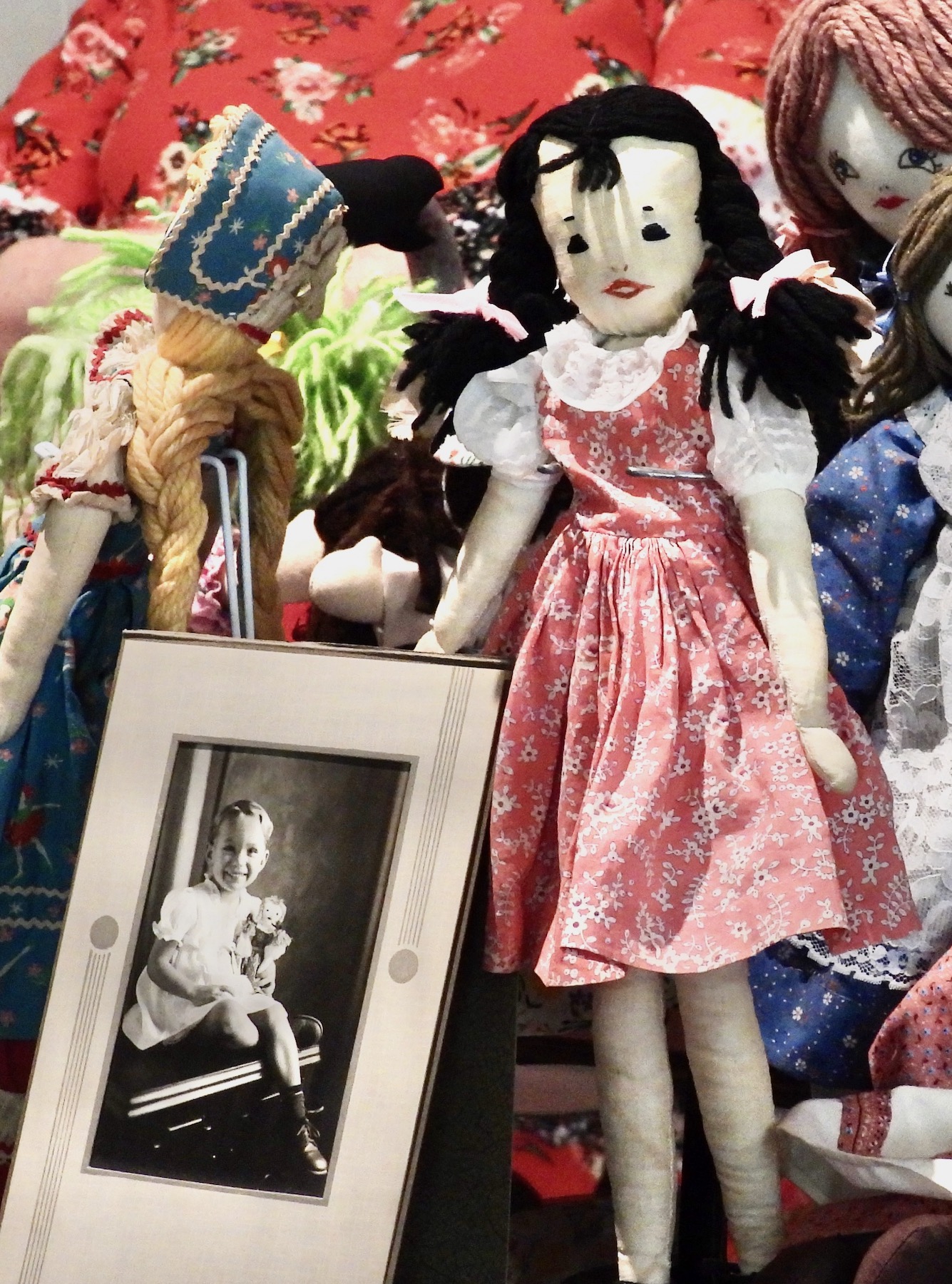
This sweet set of sisters is from the 1920s or so. The blue dress and pinafore are original. The other doll has a pink replacement dress and a headdress made from a child's handkerchief.


This simple cloth doll was made as a craft project by students at Berea College in Kentucky. Elaine said that the college was founded in the 1850s as an integrated institution and that the students farmed and made crafts to pay their tuition. She stated that the school still has a craft store. This doll was created in the 1980s, but is based on an older pattern.


This is an example of a bottle doll. Magazines printed patterns for such dolls from the 1930s through the 1950s.


Her skirt hides a vintage bottle for rubbing alcohol.
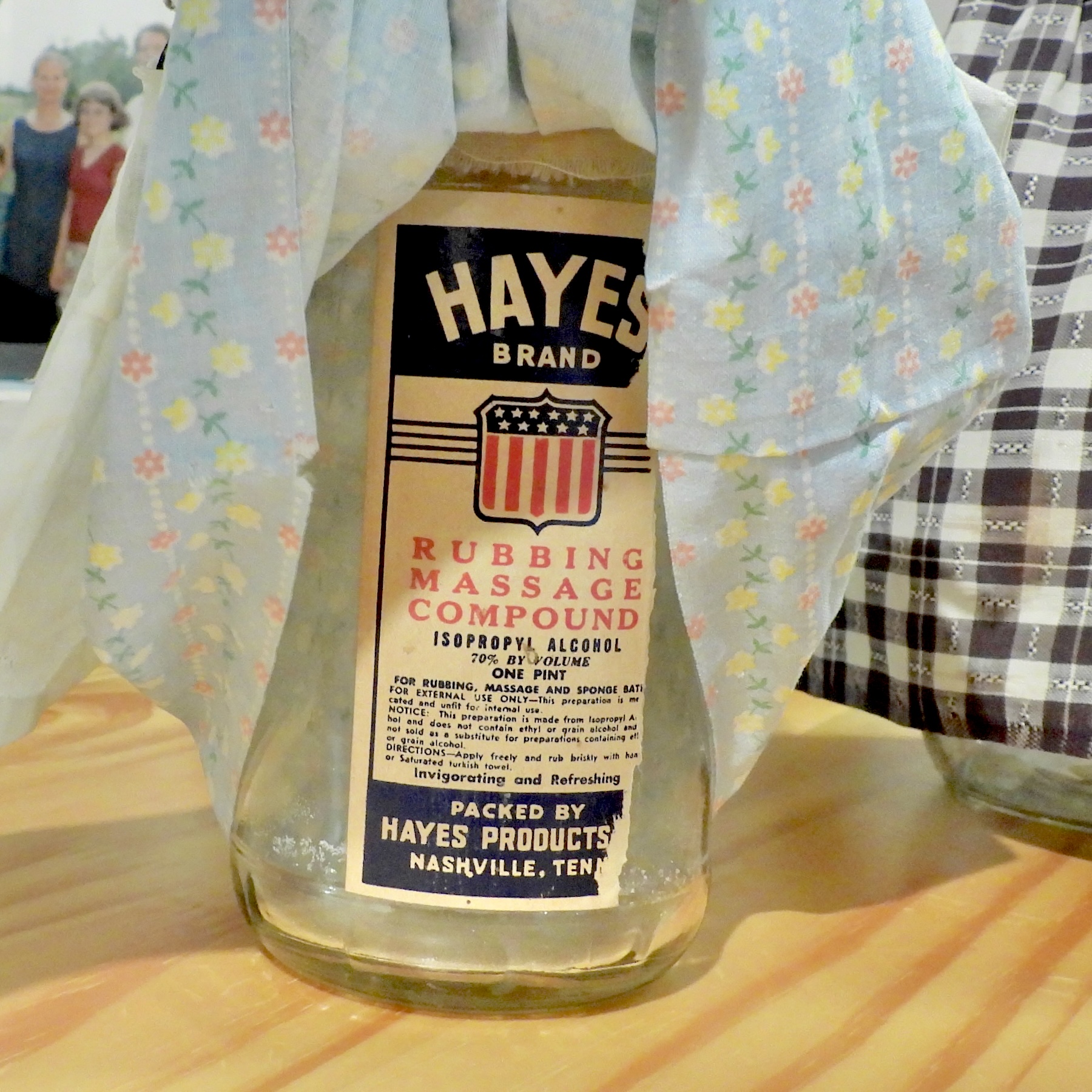

Another bottle doll from Elaine's collection.


This little girl is made from a later pattern which formed a face with seam down each cheek. She was sold as a souvenir for New Orleans,


Elaine said that this doll was a gift from a friend. The doll was commercially created as a decorative item in the 1970s and resembles Beloved Belindy, a character from the Raggedly Ann book series, 


This is Heather Matilda Miranda McGee, a homemade rag doll Elaine found in an antique shop in the 1980s. She is wearing a baby dress from the 1930s.


This cloth doll is a souvenir from the Caribbean. In the 1950s, such handcrafted creations were replaced by plastic dolls.


Member Bette Birdsong shared this doll she found in an antique shop in the 1960s. She said the doll probably dates from the 1930s.


Member Sharon Weintraub displayed a cloth topsy-turvy doll patented by the American firm of Albert Bruckner in 1901, with a Black doll on one side and a white doll on the other. This felt doll was commercially made in Italy by one of the competitors to the famous Lenci factory, such as Magis or Eros.


Member Pam Hardy shared this rag doll from the 1920s.


This cloth and wood black bunny belongs to member Sylvia McDonald.


Member Jan Irsfeld shared this character doll of mathematician Katherine Johnson made by Mattel.


Member Kenneth Reeves displayed this cute cloth doll by the Canadian company of Bamboletta. He said that the Waldorf-style doll was custom made for his niece from natural materials. 


Member Myrna Loesch shared her new book on Cissy dolls created by Madame Alexander.


Member Jenell Howell displayed two dolls she acquired at the recent BJD convention in Austin. This doll is a one-of-a-kind 3D printed creation.

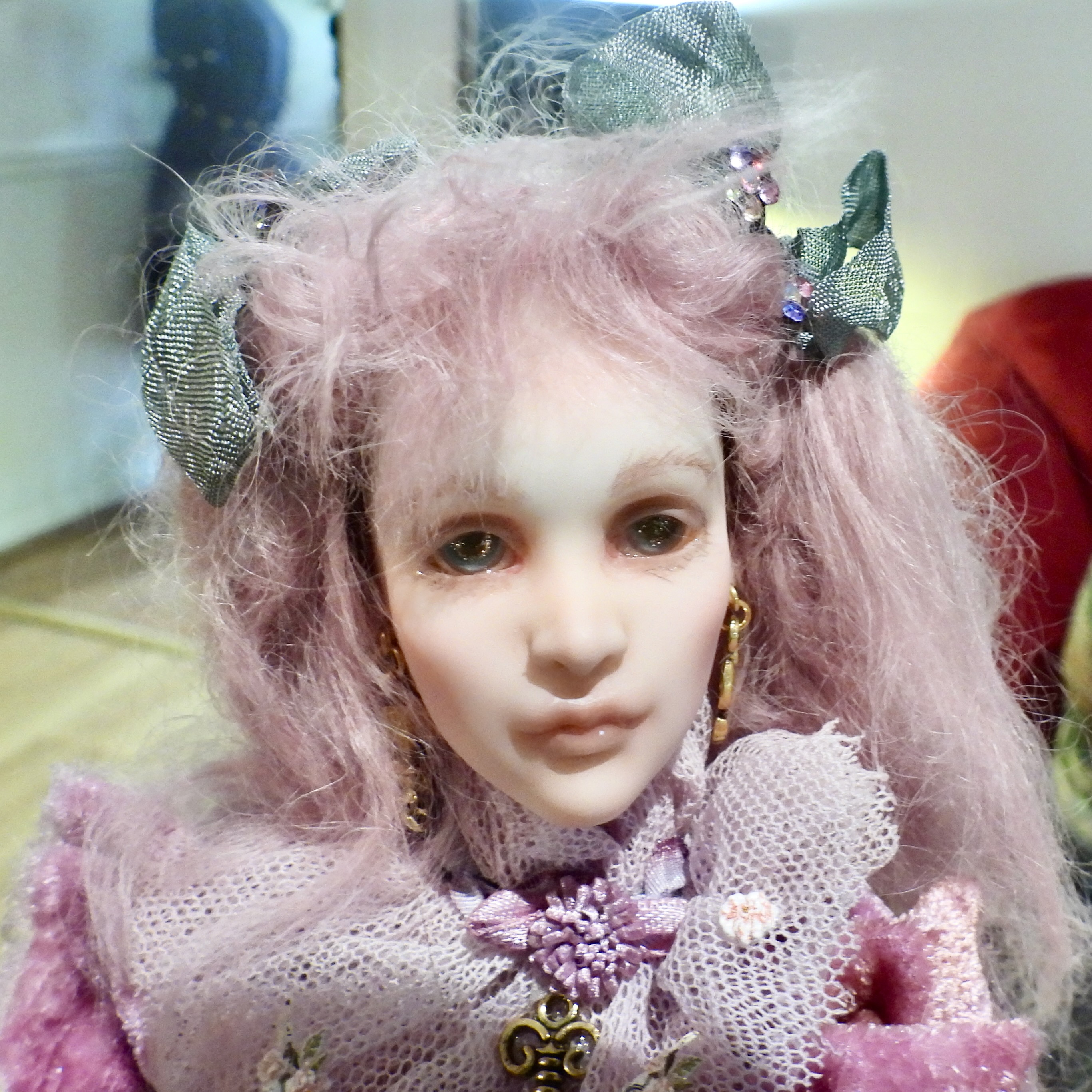

This wistful child is by artist Rose Bbflockling.


Saturday, September 30, 2023

September 10, 2023, Meeting

 Member Elaine Jackson did a program on Edith Flack Ackley, an author and doll artist. Elaine noted that cloth dolls were often the first dolls given to children. She said that from the 1920s through the 1940s, many stay-at-home mothers began making and selling cloth dolls. This was a thriving industry, but many of these dolls were later discarded after they became worn or dirty from play. During this era, Ackley published books with patterns and instructions for making puppets and dolls. Elaine noted that in 1939, "Woman's Home Companion" magazine published doll patterns and other women's magazines followed suit, as well as offering kits.

Elaine told the club that Ackley was born in 1887 and grew up in an artistic family. Her father owned a paint store and both her mother and sister wrote children's books. Ackley's first husband, Floyd Ackley, was a jewelry designer. Their daughter, Telka, was born in 1918. After Floyd died, Ackley needed a way to support herself and Telka. She had been making marionettes and putting on puppet shows for years, so in 1929 she published her first book, Marionettes. The book included patterns for making cloth puppets in a pocket in the back of the book, as well as plays. Ackley in the 1930s also made marionettes for store displays. In 1938, she published her second book, Dolls to Make for Fun and Profit, and the following year she published A Doll Shop of Your Own. Ackley also created paper dolls and greeting cards, as well as making and selling her own dolls. She created an estimated 3,500 over her career, but except for some very rare examples carrying a ribbon with her name, Ackley's dolls are not marked. Telka became and artist and illustrator, painting still life images that included her mother's dolls, and these paintings were used for creating greeting cards. Ackley died in 1970. 

This is an example of a marionette made from an Ackley pattern.

Elaine described some of the characteristics of a doll made using an Ackley pattern. The dolls had side seams and a flat face with embroidered eyes made with horizontal stitches and no nose. The toes of the feet pointed down unless they were stitched up and there were no fingers. The dolls were stuffed through the top of the head and Ackley recommended placing a stick or nail inside the head and neck to keep the head from flopping. The clothes were typically stitched closed, as Ackley did not mention buttons or snaps. Because these dolls were handmade by many different people, there are a lot of charming variations.


This cowboy was created by a woman in Austin.


Elaine found this little Native American doll at member Jenell Howell's house, where it was being used as a cat toy!


Ackley issued a pattern for this clown doll.


This is a version made by Elaine. The circus-print fabric for his outfit is from a 1940s crib pad.


This doll was made by dolly artist Lucy Geist in New York, who used Ackley patterns to create her own dolls. 


Member Sylvia McDonald displayed dolls made by her and her family members. 


This doll was made by her great-aunt.


Jenell shared this cloth doll from the 1940s. She has an expressive face and stitched fingers.


Member Kenneth Reeves displayed this cute cloth doll by the Canadian company of Bamboletta. He said that the Waldorf-style dolls is handmade of natural materials. 


Myrna Loesch brought this cloth doll by doll artist Susan Fosnot that was made as a souvenir doll for the 2014 United Federation of Doll Clubs convention.


Member Nancy Countryman shared a wide variety of cloth dolls from her collection, including two original Cabbage Patch dolls, Bevo, the University of Texas longhorn mascot, and


Miss Piggy of Muppets fame


Sunday, February 26, 2023

February 12, 2023, Meeting

 Member Elaine Jackson did a program on Norah Welling dolls. Elaine told the club that Wellings was born in England in 1893. She attended school until she was 14-years old, staying home to help her mother care for her father. Wellings took art courses by correspondence with the London School of Art and in 1919 took her art certificates and applied to the Chad Valley Company. She was hired as one of the company's chief doll designers. In 1926, Wellings left the company over a dispute with management. It was reported that she took and destroyed her designs so that Chad Valley could no longer use them.

Her brother Leonard helped Wellings set up the Norah Wellings Company, renting her space in the family's plastering firm. In 1929, Welling's company purchased an abandoned church and Leonard began working with his sister full-time; Elaine said that the company employed many of Wellings' family and friends. By 1930, the company had opened a showroom and office in London. In addition to dolls, the company also made animals, pajama and handkerchief cases, and tea cozies. After Leonard died in 1959,  Wellings decided to retire, closing the factory and destroying all designs, tools, and unfinished dolls. She died in 1975.


Elaine explained how to identify Wellings dolls. Some carried a round paper tag.  Other dolls have a stitched fabric label around the wrist or on the sole of the foot reading "Made in England by Norah Wellings." The faces are molded and hand painted, either on felt or, for the smaller later dolls, stockinette. Elaine said that the dolls never had composition or plastic faces. The ears are two layers of fabric, stitched around the edge.


This doll with a beautifully pieced felt dress is the model called Norene, produced from 1930 to 1959. She represents a Dutch girl. The red-haired girl in the center of the first picture is Norette, a series produced from 1934 through 1934 as child dolls. She does not have her original clothes. 


This doll possibly represents a Dutch boy.


Wellings made a variety of character or novelty dolls, such as this Native American man. The dolls had stitched jointing and the clothes were sewn on the dolls as an integral part of the design. The admiral doll in the first picture, holding a British flag, is another example. The most common Wellings character doll is  a sailor; the dolls were sold to cruise lines to stock as souvenirs and often carry the name of the ship or line on the hat band.


This style of doll is referred to as "Old English." 


This doll is from a line called "Tiny Tot." Produced in the 1950s, the doll has a stockinette face and cotton limbs. The admiral doll stands behind her just to her right.


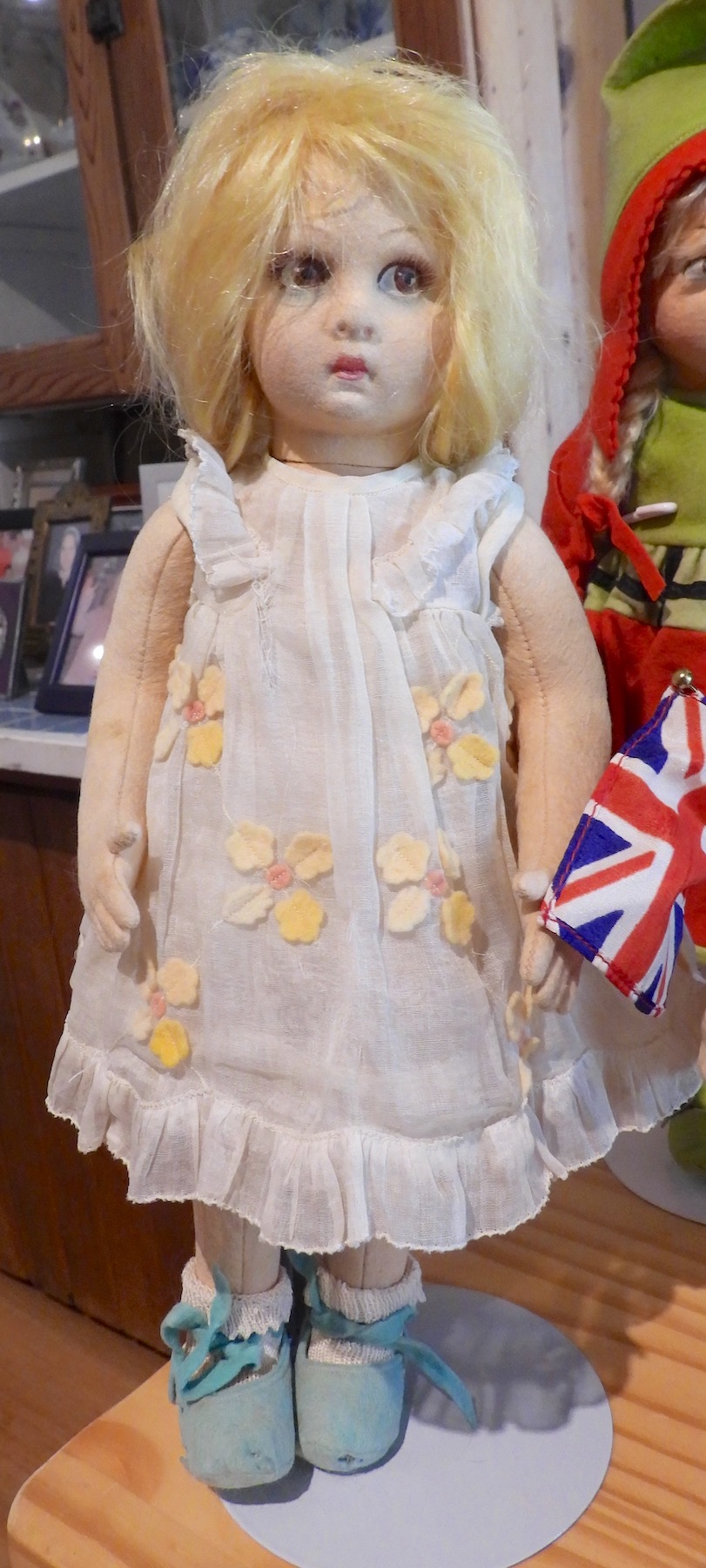
Member Jenell Howell brought this felt doll by the Italian firm of Lenci to compare with the Wellings felt dolls.


Member Nancy Countryman brought four dolls.  Three of the dolls are by Madame Alexander; the two dolls in the front are Cissettes (the one in the gown is Cinderella), and largest doll is from the Little Women series with a Maggie face. The fourth doll in the red and black outfit is an unmarked composition girl.


Member Elaine McNally shared this charming wax over composition antique doll.


Guest Kenneth Reeves displayed two cloth dolls by the Canadian company of Bamboletta. He said that the  Waldorf-style dolls are handmade of natural materials. 


Member Pam Hardy told the club that this doll had been brought from Europe by a relative. She said that the doll stayed in such good condition because the children were not allowed to play with her. The label on the doll's skirt identifies her as being made by the Italian firm of Magis.