
dollshow

dollshow

AUSTIN DOLL COLLECTORS SOCIETY

The Austin Doll Collectors Society is an organization of antique, vintage, and modern doll collectors, dealers, and artisans. We meet on the second Sunday of each month and our meetings are fun and educational. We begin with refreshments and socializing, and, following our brief business meeting, there is a special doll-related program and "show and tell." The Austin Doll Collectors Society is a nonprofit organization and is a member of the United Federation of Doll Clubs.
Showing posts with label ichimatsu. Show all posts

Monday, July 31, 2023

July 9, 2023, Meeting

Member Elaine McNally did a program on so-called Motschmann or taufling dolls. She explained that although they are called different names by collectors and come in a variety of materials and styles, what the dolls have in common are a solid chest and pelvis connected by fabric, often covering a squeaker or voice box, and cloth inserts at the shoulders and thighs, giving the dolls the floppiness of an infant. Some dolls may also have swivel necks and jointed wrists and ankles. Elaine said that these dolls were inspired by a type of Japanese play doll called ichimatsu, which has the same "floating" limbs. In 1853, American Commodore Mathew Perry sailed into Tokyo harbor to re-establish  trade and contact with Japanese, who had closed off their country to most foreigners. Among the artifacts brought back by Perry were Japanese dolls. German companies began manufacturing dolls with similar bodies in papier mache, sometimes with a wax coating, and china. The dolls often resembled babies with round bald heads, sometimes with little tufts of hair painted by their ears, hence the name "taufling," meaning a very young infant. However, dolls also were made with hairstyles or features associated with older children. Christoph Motschmann patented a voice box that was used in many of these dolls; an early collector seeing the Motschmann name on one such doll mistakenly thought Motchmann had made the doll, when in fact he had simply designed the voice box. The tallest standing doll is an antique, while the two other standing dolls are creations by Elaine.


This doll with molded hair was a gift to Elaine from a friend. It is papier mache with a wax coating.

'

The tallest doll with a curly mohair wig has a voice box operated by a pull string and clearly cries "Papa." Standing in front of this doll is a traditional Japanese ichimatsu doll. The little doll next to her is wax over papier mache and wears her original clothing. 


Member Sharon Weintraub displayed these two Japanese ichimatsu dolls. The lady doll is unusual because most ichmatsu resemble young boys or girls and the child doll has a bisque head, rather than the traditional head with a complexion made of gofun, a smooth white coating made from crushed oyster shells. 


Sharon also shared this scarce china version with inset glass eyes. Although unmarked, the head resembles the rare glass-eyed china head dolls made by the German company of Kloster Veilsdorf. This poor little guy is waiting to be restored, but the squeak box in his torso still works. 


Member Elaine Jackson brought this example with sleeping eyes. She has a squeaker, but lacks floating hands or feet.

Member Pam Harding displayed this beautiful Bye-lo baby. She said that she had wanted one for a long time. 


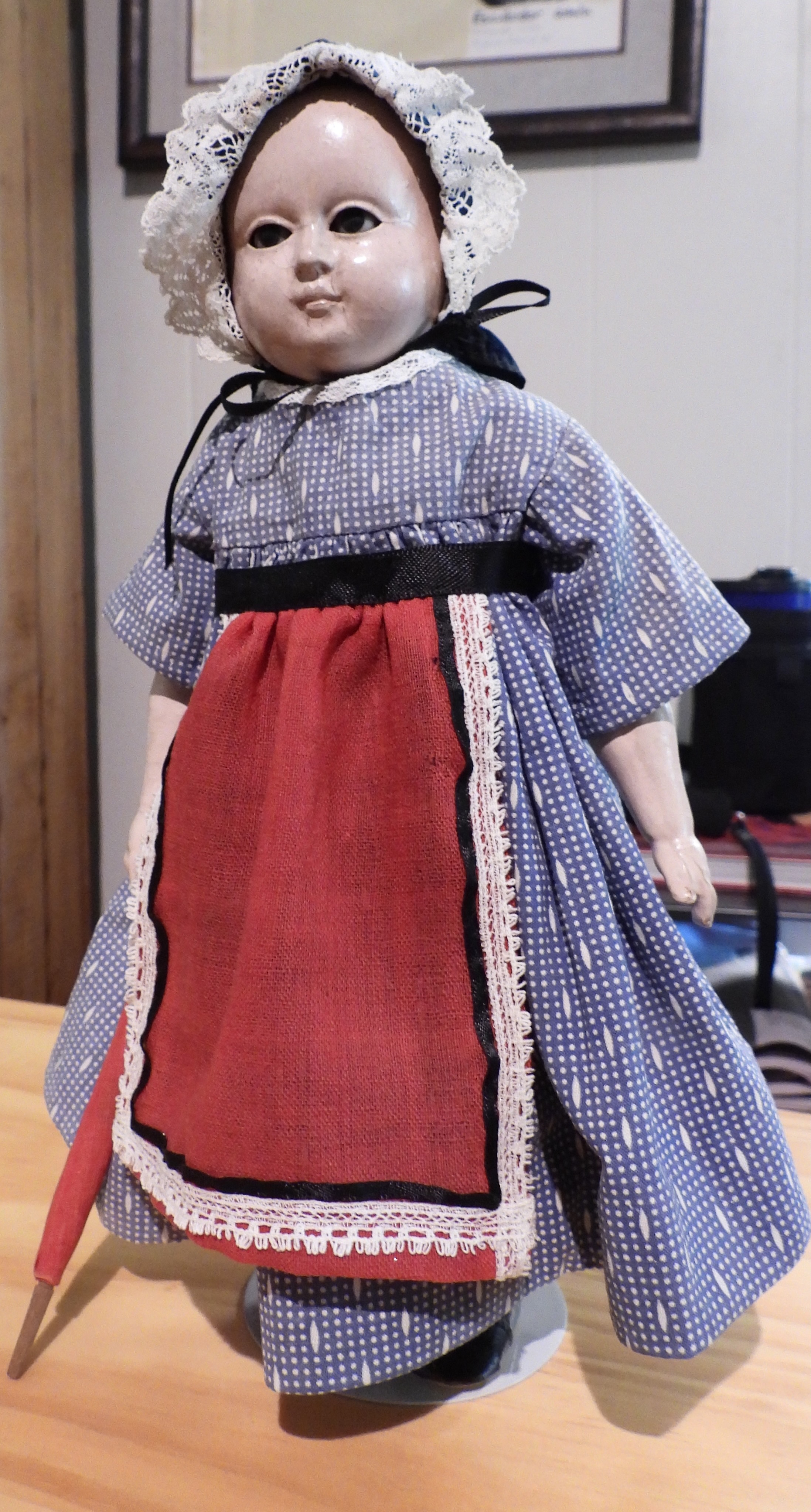
She also shared this stockinette doll with large painted eyes made in 1976. The doll is supposed to represent Betsy Ross.


Member Jan Irsfeld told the club how she found, restored, and dressed this lovely Cissy doll by Madame Alexander. 


Monday, April 3, 2023

March 12, 2023, Meeting

In honor of the upcoming Saint Patrick's Day, members were asked to bring Irish dolls or dolls dressed in green. Jenell Howell brought this little German boy in his original outfit. He was made by Porzellanfabrik Rauenstein.


This little doll in an Irish outfit is by Madame Alexander. Myrna Loesch told this club that this is one of the last dolls she received as a child. This doll has bent knees and was made between 1963 to 1972. 


She also brought these Madame Alexanders in outfits Myrna said represented the six flags that have flown over Texas.


Sharon Weintraub shared some Japanese dolls in honor of another March holiday. She explained that March 3rd is the Japanese holiday of Hinamatsuri, also called Doll's Day or Girls' Day. It is traditional in Japanese homes to set up a display of tiered platforms with dolls representing court figures from the Heian era (794-1185 AD). The dolls, called hina-ningyō, include an emperor and empress, always seated on the top tier, with court ladies, musicians, and ministers, and attendants displayed on descending tiers, along with miniature lacquer furniture and other accessories. The kneeling doll in the front is a hina-ningyō representing an attending court lady and the lacquer chest behind her is typical of the furniture used in the Hinamatsuri display. The little doll in green next to her represents a boy and has a head of carved ivory. Behind him is Mausu-san, a doll Sharon created using a vintage Japanese doll that had lost its head and a taxidermied mouse. In the back are two ichimatsu dolls, traditional Japanese play dolls, but these two are unusual. The little girl has a head of bisque instead of the tradition gofun finish (a mix of glue and ground oyster shells) and the doll next to her represents an adult woman, although typically ichimatsu represent young children.


Guest Mary Jordon shared a fashion doll by the Tonner Doll Company that she had redressed in an outfit inspired by the popular "Outlander" book and television series, as well as two Neo-Blythe dolls.


Elaine Jackson brought this doll created by Jay of Dublin, dressed in the traditional outfit of Sligo County Doll. These dolls were made from the 1930s through the 1960s and came in detailed costumes of the different regions in Ireland. She has a painted plaster face and wire armature body.


Another doll from Elaine, a cloth girl dressed in green. She is an early example from the Deans Rag Book Doll Company.


New member Kenneth Reeves brought a number of examples of dolls in Irish costumes. The two small dolls in the front are also by Jay of Dublin.  The little girl in the green dress and white cap is a Ginny by Vogue Doll Company and the doll next to her in the red head scarf is "Irish Colleen" by Peggy Nesbit.  


More dolls displayed by Kenneth. The three dolls with the ceramic faces and painted features are by Si-Og, a company that handcrafts the dolls in Ireland using local materials. Kenneth explained that Si-Og means "little people." The red-haired girl in green is Adora Irish Belle by Marie Osmond.


Elaine McNally brought these tiny tots clad in green. The doll in the front was hand-carved and dressed by Elaine and the other doll is a needle-sculpted and painted creation by doll artist Dianne Dengel.


More creations by the talented Elaine, three cloth dolls inspired by antique Izannah Walker dolls.


Pam Hardy shared these two dolls in shamrock print dresses. She told the club that the dolls were given to her and her sister when they were children by an aunt who collected dolls. Pam said that she played with her doll, so that it looks a bit "loved."


Sylvia McDonald brought this Effanbee vinyl doll dressed in green as Goldilocks. Sylvia received this doll from her brother.


Skilled seamstress Jan Irsfeld shared this reproduction doll she had dressed.


Nancy Countryman brought several dolls gowned in green. This is Scarlet O'Hara by Madame Alexander. Nancy added the hat in honor of Saint Patrick's Day.


Two other dolls from Madame Alexander are the little girl in the Irish outfit and "Little Lambkin Wendy." The doll in the back is another Goldilocks from Effanbee.