dollshow

dollshow

AUSTIN DOLL COLLECTORS SOCIETY

The Austin Doll Collectors Society is an organization of antique, vintage, and modern doll collectors, dealers, and artisans. We meet on the second Sunday of each month and our meetings are fun and educational. We begin with refreshments and socializing, and, following our brief business meeting, there is a special doll-related program and "show and tell." The Austin Doll Collectors Society is a nonprofit organization and is a member of the United Federation of Doll Clubs.

Saturday, February 26, 2022

Black History Month; Vintage Cloth Doll

We continue our club's virtual meeting in honor of Black History Month with this endearing cloth doll from member Elaine Jackson. Cloth or rag dolls are probably the earliest type of doll. Their soft bodies made them especially cuddly and comforting as children' playmates. The dolls could be made economically out of scraps of leftover fabric and a simple doll could be sewn by a loving mother or relative with no pattern other than the maker's imagination. Beginning in the 1800s, monthly women's magazines not only included stories, poetry, music, and articles, but also patterns and instructions for embroidery, sewing, and other handicrafts, including for making dolls and doll clothing. However, even as commercial patterns became more widely available, many homemade dolls were freehand creations. Cloth dolls can be dated by the style of their embroidered faces, the type of fabric, and whether they were made using a commercial pattern. This 10-inch rag doll has yarn braids, button eyes, and a sweet, but simply embroidered, features. Elaine says that the doll is wearing her original dress and was probably made in the 1930s to 1940s. The doll has stub hands and feet and is mostly likely on-of-a-kind.


Wednesday, February 23, 2022

Black History Month; Composition Topsy Doll

 Continuing our club's virtual meeting honoring Black History Month, member Michele Thelen shares this composition cutie. Michele says that the 12-inch tall doll is unmarked and is wearing her original outfit. Beginning in the 1910s, a number of American companies began producing dolls out of composition, a mixture of glue and sawdust. The dolls were lighter and not as fragile as their bisque and china counterparts (although not washable!). Composition dolls dominated the American doll market from the 1920s through the early 1950s, when hard plastic dolls began to appear. There were many American companies producing these dolls and unmarked dolls were often sold to jobbers and department stores to dress and sell under their name.


Often Black composition dolls had two or more inserted pigtails of yarn and were marketed as Topsy dolls. Topsy originated as a character in Harriet Beecher Stowe's 1852 anti-slavery novel Uncle Tom's Cabin. In the book, Topsy is a brutalized and neglected child. When first introduced, she is a Black enslaved girl about eight years of age, clad in a filthy ragged dress and carrying the scars on her back of multiple beatings, Topsy has never known love or kindness in her short life; she does not even know who her parents were. All she has experienced are harsh labor and beatings, berated as being wicked and lazy. Topsy is amoral, having learned how to lie and steal in order to survive. The slaveowner Augustine St. Clare cynically purchases Topsy as a gift for his sister, Ophelia, to "educate." Although Topsy is clearly intelligent and resilient, Ophelia harbors prejudice against Black people and has no empathy for the child, treating her with distaste. It is only when Augustine's daughter, Eva, learns that Topsy has never been loved and treats her with true compassion and kindness that Topsy is inspired to learn and improve. In the book, Topsy was a symbol of the degradation and brutality of slavery, which affected not only the enslaved, but tainted the rest of society as well.

So how do we get from this pitiful abused, beaten, and neglected child to the cheerful Topsy dolls? Uncle Tom's Cabin was extremely popular and, thanks in part to lax copyright laws, minstrel shows seized upon Stowe's characters, putting on what became known as "Tom Shows." The shows, typically only very loosely based on the book, stripped out much of Stowe's strong anti-slavery and religious sentiment (there were even pro-slavery versions), although they kept some of the melodramatic scenes, such as Eliza carrying her child as she struggles to cross the icy Ohio River and into freedom just ahead of the slave hunters. For the most part Black characters, typically performed by whites in blackface, were mocked as exaggerated stereotypes and used as comic relief, often breaking into song or dance. In these shows, Topsy became the mischievous mirthful "pickaninny" with a head full of pigtails. Sadly, most of the images the American public has of Uncle Tom's Cabin are drawn from these Tom Shows, working their way into popular culture (including Felix the Cat and Bugs Bunny cartoons some of us watched as children).

Sunday, February 20, 2022

Black History Month; Million Dollar Baby (In a Five and Ten Cent Store)

It was a lucky April shower, it was the most convenient door 
I found a million dollar baby, in a five and ten cent store 

Music by Harry Warren, lyrics by Mort Dixon and Billy Rose, 1931

As part of our club's virtual meeting celebrating Black History Month, we introduce a baby from the five and ten cent store belonging to member Sylvia McDonald. While the little Black all-bisque baby in the wicker buggy might not technically be worth a million dollars, Sylvia bought it when she was around seven or eight years old from a five and ten cent store and to her it is priceless (Sylvia thinks that the original cost was 25 cents). Japan first entered the doll market in WWI when German dolls were embargoed, often directly copying German models, and continued producing inexpensive little bisque dolls into the 1950s. The Japanese dolls did not match the quality of the German bisque dolls, but they were also less expensive and just the right size and price for the growing five and dime store chains. The little girl in the green plaid dress is by artist Heidi Ott doll and the other doll was designed by Sylvia Natterer and is named Deborah.


Sylvia thinks that about this same time she bought an Amosandra doll. Created by the Sun Rubber Company in 1949, Amosandra was the first mass-produced rubber Black doll, a cuddly baby who could drink and wet. The doll was produced as a tie-in the the popular radio program "Amos ’n’ Andy,” which later became a short-lived show on CBS television. The original radio show was a comedy featuring two characters, Amos Jones and Andy Brown, Black farm workers from Georgia who had moved to Chicago (and later Harlem in New York City) for a better life. The radio show was extremely popular and it was estimated that at its peak one-third of the country tuned in. The doll coincided with the birth of the youngest child of Amos and his wife, Ruby, her name a mixture of Amos and Andy. On the radio, Amos and Andy were voiced by two white actors (who appeared in blackface for publicity photographs, although the television show did cast Black actors). The show was criticized by some in the Black community as depicting Blacks in derogatory ways.

However, little Amosandra was extremely popular with children of all races, but unfortunately her soft rubber skin hardened and deteriorated over time. This was the sad fate of Sylvia's doll.


Thursday, February 17, 2022

Black History Month; Petite Pair of All Bisque Dolls

Continuing our club's virtual doll meeting commemorating Black History Month, today we present a pair of early-all bisque dolls in their original box and elaborate costumes. The 4.75-inch tall dolls have set brown glass eyes and swivel necks. They are barefoot and have molded gold bracelets and anklets. On the cover of their fragile box is written in pencil "Sadie Newell from Grace Bronen." Inside the cover, also in pencil, is "Robert Newell Kinnaird 7 years 27 of Aug" and "Given to Sara Newell when she was about 8 yrs old." Inside one of the sections in the box is written in pencil "From Grace to Sadie Newell Christmas 1889." 


The dolls' festive finery may indicate that they are prepared to participate in a cake walk. The dance originated on slave plantations in which enslaved men and women dressed in their best clothing danced in a procession. The winning couple was awarded a prize, typically a cake. In some cases, the dance was performed for the white slaveholder, who judged the contest, and white guests. However, according to some sources, the exaggerated steps and gestures of the cakewalkers were subtly mocking the highly-mannered dances of the white upper class. Following an exhibit at the 1876 Philadelphia Centennial which featured Black dancers performing a version of the cakewalk, the dance became a feature in minstrel shows and music halls. The costumes were increasing colorful and elaborate, with men often attired in top hats, gaudy topcoats, and striped or patterned pants and the women donning fancy hats and gowns. The cakewalk was performed in 1889 at the Paris World's Fair, spreading the dance craze throughout Europe, where it was performed everywhere from the stages of Paris to the aristocratic ballrooms of England. The idioms "to take the cake" and "a piece of cake" may originate from the cakewalk.


Tuesday, February 15, 2022

Black History Month; Hand Carved Hitty-Type

Because of the pandemic, the club is not holding in-person meetings, so this month we are holding a virtual club meeting with members sharing their Black dolls in honor of Black History Month. The first is this wonderful one-of-a-kind creation by our talented member Elaine McNally (a pair of her beautiful Izannah Walker cloth creations have appeared earlier on this blog). This diminutive doll is 6.5 inches tall and carved from black walnut. Elaine thinks that the doll resembles Ruby Bridges as portrayed in the Norman Rockwell painting "The Problem We All Live With."


This type of little wooden doll is called a "Hitty type," inspired by the wooden doll heroine of Rachel Field's 1929 children's novel, Hitty, Her First Hundred Years. In the book, the eponymous Hitty (short for Mehitabel), a simple wooden doll carved by a peddler in the 1820s, narrates her adventures and travels over her century of existence. Hitty was based on a small antique wooden doll acquired by Field and the book's illustrator Dorothy Lathrop and the original Hitty now resides in the Stockbridge Library Association collection. The book's charming historical tale has inspired generations of doll artists to carve their own versions of Hitty. 


Sunday, November 28, 2021

November 7, 2021, Meeting

The theme for the November meeting was dolls dressed in fall colors. 


Member Jenell Howell brought her all-original Sasha, made in Germany in the 1970s.


The 1953 Ginny in her pineapple print dress was purchased by member Sylvia McDonald when she was in high school. The Muffy belongs to member Myrna Loesch and dates from 1955.


Myrna also brought this reproduction doll made by former member Mary McKenzie. Another member, Jan Irsfeld, embellished her outfit.

This somber child is by artist Helen Kish and belongs to Sylvia,

Another artist doll, this one created by Sylvia Natterer. Sylvia McDonald added the teddy bear because it matched the doll's original dress.

This doll is entitled "The Frog Prince" and was created by Maggie Iacona. The doll holds a pillow with a fabric frog. Jenell said that this doll was an early attempt by the artist to created a ball-jointed felt doll. 

This quartet belongs to member Elaine Jackson. The two pilgrims have already been featured on our blog. They represent John Alden and Priscilla Mullins and were created circa 1950 by Helen Walker of Just Folks Doll House of Staunton, Virginia.  The cloth doll was made in the 1950s from a pattern created by writer and doll artist Edith Flack Ackley.


This Hitty is cast of resin by artist Sara Cole and was dressed by Elaine in a vintage child's handkerchief. 

Fall also means Thanksgiving with its images of Pilgrims and Native Americans.


The taller doll belongs to member Sharon Weintraub. By Gebruder Heubach, she is a portrait of "Princess Angeline." Born Kikisoblu in 1820, she was the eldest daughter of Chief Seattle, leader of the west coast Suquamish and Duwamish peoples.  In 1855, when the Duwamish Indians were forced to leave their land for reservations, she insisted on remaining in Seattle, living in a small cabin and supporting herself by doing laundry and selling handwoven baskets. 


This Ginny dressed as a Native American dates from 1952-1953 and belongs to Jenell.


Wednesday, October 27, 2021

Trick or Treat!

The witch thought that Hansel and Gretel would be her Halloween treats, but they tricked her! It is never a good idea to run out of candy on Halloween night when you live in a cottage made of cake, sugar, and gingerbread. . .  The witch is Hexe, a German character doll made by Simon and Halbig for Cuno and Otto Dressel, and her hissing cat is a German bisque toy with jointed legs.  Hansel and Gretel are German all-bisque dolls in their original crocheted costumes. 


Tuesday, October 26, 2021

'Cause It's Witchcraft. . .

That crazy Witchcraft
And although I know it's strictly taboo
When you arouse the need in me
My heart says yes indeed in me
Proceed with what your leading me to
… It's such an ancient pitch
But one that I would never switch
'Cause there's no nicer witch than you

"Witchcraft," Cy Coleman and Carolyn Leigh,1957

These bewitching beauties from member Jan Irsfeld's collection of Madame Alexander Cissy fashion dolls certainly cast a spell. Dressed in their Halloween best, these sultry sorceresses do not need a magic love potion to charm and enchant. 


Monday, October 18, 2021

October 10, 2021, Meeting

Member Elaine Jackson did a program on the scarce and unusual composition dolls by the Raleigh Doll Company, founded by Jessie McCutcheon Raleigh in 1916. The Raleigh dolls were only produced until 1920, when the factory was sold to the Pollyanna Doll Company. Elaine described Raleigh was an entrepreneur and her first successful venture was a statuette called "The Good Fairy." She hired others to design the statue, which was extremely popular and was produced in a variety of materials. Raleigh started her doll company shortly thereafter with the intent of creating dolls with faces and bodies that resembled real children. She had a special composition formulated for her dolls and used a unique system of spring joints. The dolls are quite heavy for their size and their realistically modeled feet and legs prevent them from standing on their own.


Elaine explained that the dolls' faces were painted by students from the Chicago Art Institute. She said that the special composition commissioned by Raleigh appears to be more resistant to crazing than that used in other composition dolls. Most Raleigh dolls have molded hair.; this little girl has molded hair under her wig. 


Elaine told the club that the dolls come in a variety of sizes and with several different body types. The dolls are not marked, but their unique faces make them stand out.


Member Myrna Loesch displayed this beautiful bride doll dressed by the very talented Jan Irsfeld. The silk gown was copied from a fashion plate and is fully lined. The doll is a reproduction of a French fashion and was made by former member Mary McKenzie.


Another doll shared by Myrna, "Butch," a composition doll first produced by Madame Alexander in 1936.

Member Elaine McNally displayed examples of the cloth reproduction Izannah Walker that she makes and markets. Elaine told the club that someday she hopes to own an authentic antique Walker doll.


Monday, September 27, 2021

NO DOLL SHOW

Some events sites have posted a listing stating that our club is having a doll show on October 9, 2021. We are NOT having a doll show. Some of these sites, to fill their calendars and attract readers, take past event listings, update them, and post them without authorization. We have tried to have these listings removed, but it is not easy. Again, there is no doll show on October 9th.


Wednesday, September 22, 2021

September 12, 2021, Meeting


The Austin Doll Collectors Society had its first in-person meeting in over a year, congregating at member Sharon Weintraub's home. Sharon gave a program on Asian character dolls by German and French bisque doll makers. She explained that although the spice trade between Asia and Europe dates back thousands of years, by the 16th century European merchants, often with military support, had seized control of the trade routes, gaining a foothold in the East. The Chinese Qing dynasty losses to Britain and its European allies in the First (1839-42)  and Second Opium Wars (1856-1860) forced China to grant Western companies favorable trade concessions and concede territory to their control. In 1853 American Commodore Mathew Perry sailed into Tokyo harbor, beginning the re-establishment of trade and contact with Japanese, who had closed off their country to most foreigners in 1639. By the 1870s, these trading concessions had expanded into colonial control, with Britain, France, and the Netherlands claiming territories throughout Southeast Asia and the Indian subcontinent. The explosion in magazines and newspapers helped bring images and stories of Asian nations and people to the average European. Schoolchildren learned about their countries' colonies and their peoples. Advances in printing made colorful children’s books widely available and affordable and fanciful stories and characters from the East began to appear in the pages of children’s storybooks. All of the interest in the East inspired both French and German doll companies to create dolls representing Chinese, Japanese, Burmese, and other Asian peoples. In some cases, the dolls were little more than colorful stereotypes while other manufacturers strove for more ethnically correct features and clothing. 

The cheerful Asian infant doll belongs to member Jenell Howell. He is by J.D. Kestner and is on a ball-jointed toddler body, rather than the more typical bent limb baby body. Next to him is Mold 1329 by Simon and Halbig, dressed in an antique outfit of a Manchu noblewoman, including the unusual platform shoes.  

'


Another Asian baby by Kestner, this time in a diminutive all-bisque version. He wears his original, but now fragile, silk outfit. His "slippers" were created by painting the soles of his bare feet black and gluing cord around the edges.


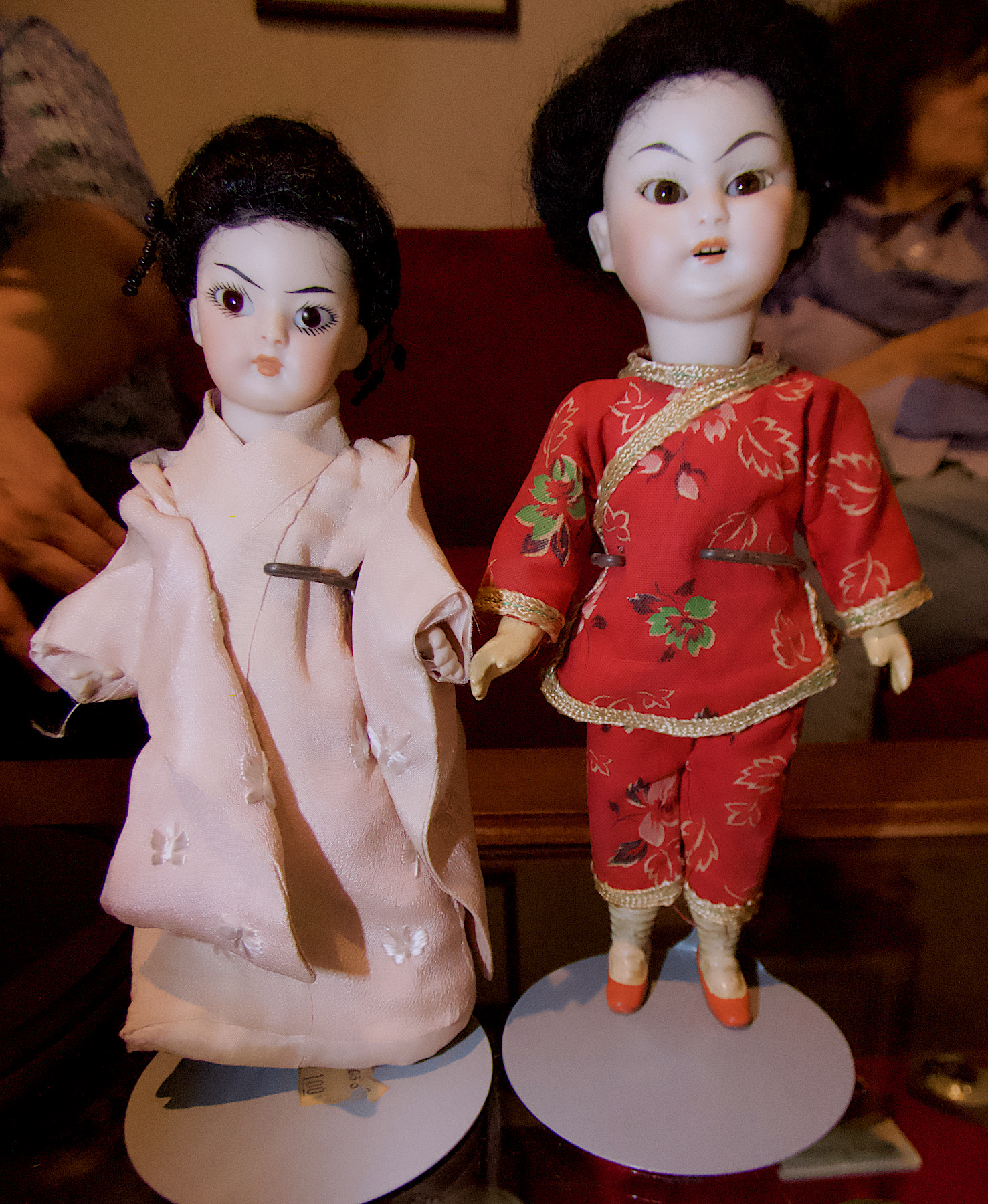
Two more Asian characters by Simon and Halbig. The smaller doll is all-bisque and dressed in an antique embroidered kimono.  She has molded blue slippers with upturned toes.  The other doll is Mold 1129 and is all original.


These 4.5-inch high charming cherubs are Chin-Chin Baby by Gebruder Heubach. Each carries the Heubach square mark faintly incised on the soles of the feet. Made to compete with the popular Kewpie doll, the Chin-Chin Babies came in a variety of headdresses. The girl in the center has her original paper tags.


Another Chin-Chin Baby in a bright orange and blue cap next to a Queue San Baby by Morimura Brothers of Japan.  The two dolls are often confused, as the Queue San is clearly a copy of the Chin-Chin. However the Queue San Baby is larger, with rougher bisque and with less distinct modeling.


All original, this beautiful baby is by Armand Marseille. Incised on the back of the head is the name "Ellar" inside of a six-pointed star. Marseille produced heads for other factories and distributors, but just who "Ellar" is remains a mystery. 


German companies produced a variety of all-bisque Asian dolls. The little lady is the crocheted blue kimono is by Carl Horn and is just 1.75 inches high, including her yarn wig. The minute man in the red cap is by Hertwig and Company. He has a painted dropping mustache and has a little yarn queue inserted in the back of his cap.


French doll makers also produced Asian dolls.  The largest doll is a bit of a mystery. He has a French fashion style shoulder head on a fully jointed twill-covered body with bisque lower arms and lower legs with bare feet. The clothing is old and fragile.  The two tiny dolls are Lilliputiens. Just 2.5 inches tall, these all-bisque dolls were available in a wide variety of costumes, including French regional and historical dress, storybook characters, and ethnic dolls. Like all Lilliputiens, they have swivel necks with a molded loop and painted features.  The pair wear their original costumes and the man has a braided queue inserted into the back of his bald pate.


Elaine Jackson brought her 1950s Kathe Kruse doll to share.


Sunday, September 5, 2021

Baby Beans Comes Home

Member Michele Thelen has this picture of her taken during Christmas at her grandparents' home in 1973, when she was two yers old. She wondered what happened to the bonneted baby doll she is embracing with such joy and started looking for a similar doll. 


Her quest has been met with success! Here is the long-sought doll, part of the Baby Beans line produced by Mattel from 1970 through 1984. They were soft bodied dolls stuffed with polystyrene bean bag balls and had plastic heads with character faces (and in some models, plastic hands as well). The original Baby Beans, three adorable infants, were Bitty Beans, Booful Beans, and Bedsie Beans. The dolls were so popular that the Bean family expanded to include a wide variety of dolls, including storybook characters, mothers and babies, pets, and even babies that came in their own bean cans! Michele's doll is Talking Baby Beans, first introduced in 1972. Activated by a pull-cord on the back of her neck, the doll could say one of eight random phrases (considering that this little doll is nearly 50 years old, Michele says that she is scared try the pull-cord!). Michele states that because of the accompanying childhood photograph, the doll holds special sentimental value.


Friday, June 11, 2021

Countdown to World Doll Day; Friendly Folks

by Kellogg.

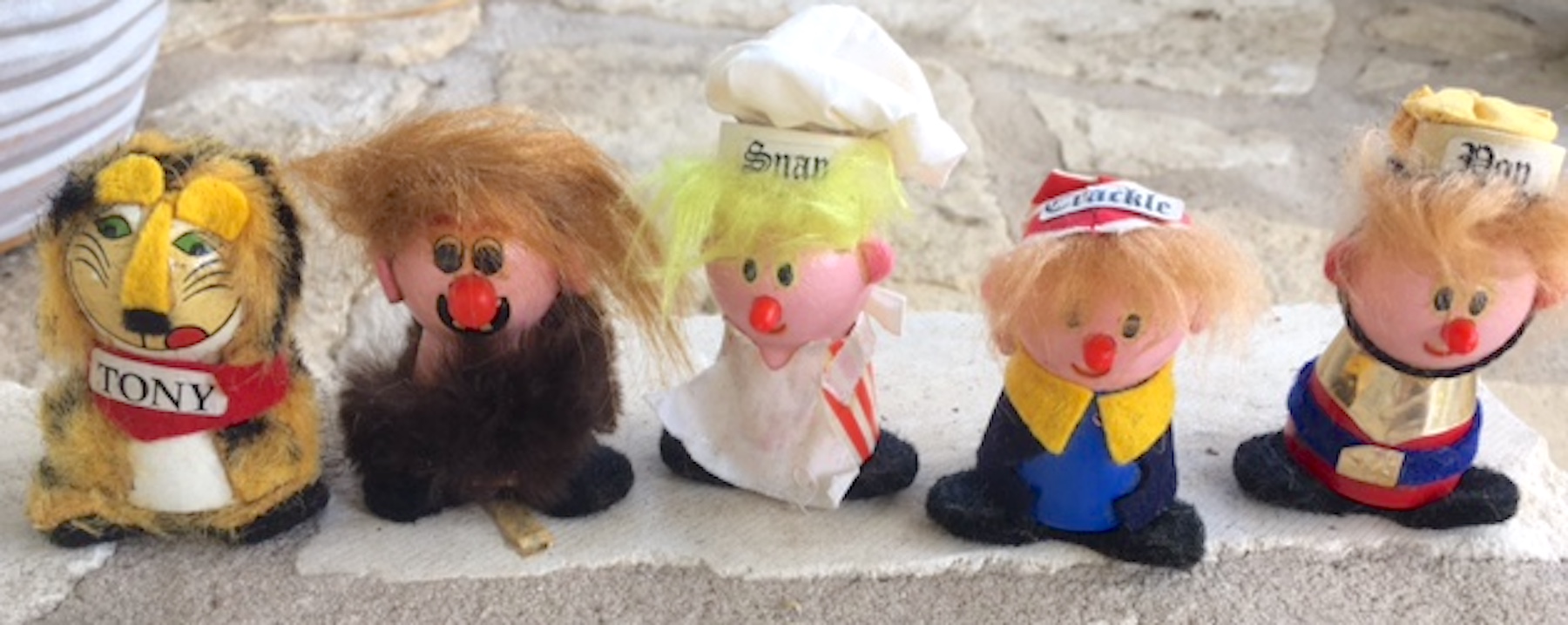
 Dolls throughout history have served many roles, from children's toys to religious or ritualist figures. More recently, they have played a new part--advertising. The 1890s saw the first commercial advertising dolls, printed cloth mascots for products such as cereal, flour, and pancake mix. This cute quintet from member Michele Thelen's collection was issued by the Kellogg Company to promote its breakfast cereals. Each is just 2.5 inches tall and simply constructed out of wood and cloth. They include Tony the Tiger (Frosted Flakes), Ogg the Caveman (Cocoa Crispies) and Snap, Crackle, and Pop (Rice Crispies).

Underneath they carry a 1972 copyright by Kellogg.

This little advertising ambassadors were called "Friendly Folks."  The set of five figures was yours for two Kellogg cereal box tops and $2.00. Friendly Folks were promoted as both "fun to play with" and "conversation pieces to decorate your room or den."


Thursday, June 3, 2021

Countdown to World Doll Day; Kokeshi Dolls

We continue our countdown to World Doll Day with the kokeshi dolls of Japan. These wooden folk dolls originated near the end of the Edo era (1603-1868) in the Tōhoku region of northern Japan, renown for its onsen (hot spring spas). Woodworkers began carving these wooden dolls on lathes to sell to visitors at the onsen. Although the dolls from different regions had their own characteristics, they all shared the same minimalist style of round heads, limbless bodies, and simple colorful decorations. They are typically carved from cherry, dogwood, and maple. Some were created out of one piece of wood, while others had heads that wobbled or turned. The dolls were popular souvenirs and children's toys. At the end of WWII, other regions of Japan began producing their own versions of kokeshi dolls for collectors and the growing tourist trade. Known as "creative" kokeshi dolls, they come in a wide range of styles, often with more detailed decoration and added wooden hair and accessories, representing everything from traditional samurai warriors to contemporary cartoon characters. This charming collection of kokeshi dolls is from member Michele Thelen. They range from 2.5 to 5.5 inches.

This family of kokeshi dolls belongs to member Sharon Weintraub. They were given to her when she first started collecting dolls by family friend who had received them as a gift from her Japanese pen pal in the late 1940s. Each doll contains a tiny bell. The larger dolls are 2.75 inches tall.

This is another gift to Sharon by a friend who taught English in Japan in the 1970s and received this doll as a parting present from her students. The doll is 9 inches high.

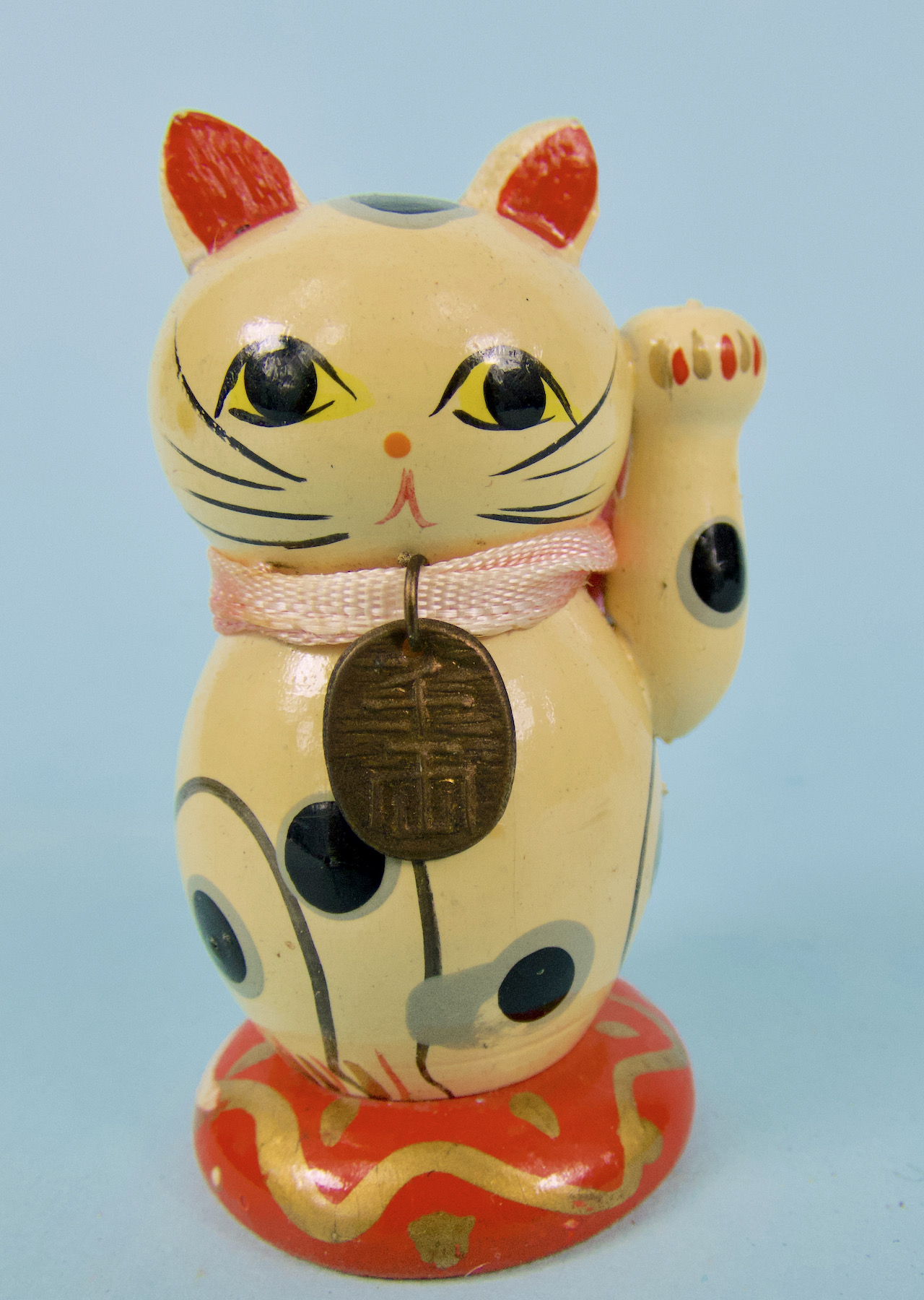
This cute kitty kokeshi is "maneki neko" (beckoning cat).  Known as the "lucky cat" or "welcoming cat," the maneki neko is supposed to bring good fortune into a home or business. The oval medallion around his neck represents a koban, a gold coin used during the Edo period. This mini-maneki is only 2.25 inches tall. 


However, hidden underneath are two even smaller kokeshi dolls, each a mere half an inch tall.