dollshow

dollshow

AUSTIN DOLL COLLECTORS SOCIETY

The Austin Doll Collectors Society is an organization of antique, vintage, and modern doll collectors, dealers, and artisans. We meet on the second Sunday of each month and our meetings are fun and educational. We begin with refreshments and socializing, and, following our brief business meeting, there is a special doll-related program and "show and tell." The Austin Doll Collectors Society is a nonprofit organization and is a member of the United Federation of Doll Clubs.
Showing posts with label Edith Flack Ackley. Show all posts

Monday, March 2, 2026

February 8, 2026, Meeting


Elaine gave a program on cowboy and Indian dolls. She talked about growing up in the 1940s playing cowboys as portrayed in popular culture, but explained that the way the cowboys were depicted in Hollywood is a myth. Elaine said that the cowboy traditional began in Texas after the Texas revolution, when Hispanic ranchers and farmers abandoned their cattle as they were forced to immigrate to Mexico. Hands were hired to round up the stray cattle and drive them to market. However in 1883,  Buffalo Bill Cody's Wild West show created the myth of the cowboy as a noble savior of the wild west. Elaine noted that although 40 percent of the cowboys were Black or Hispanic, on television and in the movies cowboy stars such as Tom Mix, Gene Aubrey, Roy Rogers, and the Lone Ranger portrayed cowboys as a white man protecting civilization from savage Indians. By the 1940s, every American composition doll company had introduced a cowboy doll.


Elaine displayed a number of cowboy dolls from her collection. The composition boy in the back row wearing a red checked shirt and chaps is "Baby Grumpy" by Effanbee. Just to his right in the front is a yellow and white oilcloth doll by the Atlanta Novelty Company and the little tan doll is "Wild Bill," a cloth chew toy. To the far right of the picture, the cloth doll in the front with the checked shirt and red bandana was made from a commercial doll pattern first issued in the 1940s. Just behind him, in the blue shirt and straw hat, is a cloth cowboy made from an Edith Flack Ackley pattern. The tall cowboy in the brown vest and checked shirt behind him has a cloth body also made from an Ackley pattern, but he has a painted wooden head. To the right of the Ackley cowpoke in the blue shirt is a cowboy in brown and tan with a head made from a nut. Behind him, handsome in blue and white, is an all-wooden cowboy carved by Austin artist Nancy Grobe. In front of the pair is a Hitty doll carved by Connie Hardt and dressed as Davy Crockett. One can't play cowboys without Indians, and Elaine shared a number of dolls representing Native Americans. To the far left of the picture are two painted cloth Native American dolls created in the 1930s under the Work Progress Administration, or WPA. In front of the is a tiny bisque nodder doll by the German firm of Hertwig and Company.


 Elaine explained that Native American dolls were often made either as play dolls or tourist souvenirs.  The two cone-shaped dolls on the left of the picture were made by the Seminole tribe out of cloth and palmetto fibers. Elaine said that the older dolls have clothing made from appliqué, while newer versions are decorated with rick-rack. The cloth doll in blue in the center is dressed as a traditional Navajo woman and in front of her is a tiny birch bark canoe. The wooden doll, representing a Native American child, was carved by Connie Hardt.


On the left of the picture are two dolls with carved wooden heads that represent Northeastern tribes. Behind them is a cloth doll that may have been made from an Ackley pattern. The composition baby in yellow felt was from Madame Hendren, a trade name used by the American Averill Manufacturing Company. Next to him, in orange cloth, is a Native American character by the British doll maker, Norah Wellings.


In this picture, the flat colorful cloth doll is actually an oven mitt modeled after a Hopi Kachina. The two seated clay figurines are Pueblo storytellers and the porcelain Indian in the feathered headdress is a bell that was made in Japan. The brown doll captioned "Alice's Baby" was commercially made as an early teething toy for infants.


Members shared some of their Western-themed dolls. Jenell Howell displayed this cute 1955 cowgirl outfit made for Ginny by he Vogue Doll Company, 


as well as this 1952 Ginny in her original Native American outfit.


She also shared this Mary Hoyer hard plastic doll in a hand-knitted outfit representing a South American cowboy known as a "gaucho."


Bette Birdsong brought two Gene dolls in glamorous cowgirl garb.


Sylvia McDonald brought several dolls. The man in the horned headdress in the back represents a Plains Indian doll and dates from the 1930s. The plastic doll in the blue velvet blouse and red skirt was given to Sylvia by her brother in the 1950s and represents a Navajo woman. To her right is another Navajo doll, made out of cloth. In the front is Woody from the "Toy Story" franchise and a Seminole doll that Sylvia told the club is around 75 years old.


David Craig told the club that he didn't have any cowboy or Indian dolls, so he brought two dolls decked out in red and white for Valentine's Day. This blond belle is by JAMIEshow USA and is dressed in an outfit for Gene.


This lady in red is by the Phoenix, Arizona company of D.A.E. Originals.


Lynda Eitel displayed this Navajo woman doll that she had made, 


as well as a number of Western miniatures.


Ann Meier shared these Skookum dolls. Designed by Mary McAboy, these Native American souvenir dolls were from 1913 through the 1960s. They are known for having blanket-wrapped bodies with no arms and molded composition or plastic faces with side-glancing eyes. 


Sharon Weintraub displayed several German bisque examples. This all-bisque cowgirl and her little Indian companion are by Hertwig. 


This all-original Native American character doll is by Bahr and Proschild. The head is incised “244” on the back.


Created by Gebruder Heubach, this doll is based on a real Native American woman, popularly known as "Princess Angeline." Her name was actually Kikisoblu and she was the eldest daughter of Chief Seattle, leader of the Suquamish and Duwamish peoples on the West Coast. In 1855, when the Duwamish Indians were forced to leave their land for reservations, she insisted on remaining in Seattle, living in a small cabin and supporting herself by doing laundry and selling handwoven baskets.


Saturday, September 30, 2023

September 10, 2023, Meeting

 Member Elaine Jackson did a program on Edith Flack Ackley, an author and doll artist. Elaine noted that cloth dolls were often the first dolls given to children. She said that from the 1920s through the 1940s, many stay-at-home mothers began making and selling cloth dolls. This was a thriving industry, but many of these dolls were later discarded after they became worn or dirty from play. During this era, Ackley published books with patterns and instructions for making puppets and dolls. Elaine noted that in 1939, "Woman's Home Companion" magazine published doll patterns and other women's magazines followed suit, as well as offering kits.

Elaine told the club that Ackley was born in 1887 and grew up in an artistic family. Her father owned a paint store and both her mother and sister wrote children's books. Ackley's first husband, Floyd Ackley, was a jewelry designer. Their daughter, Telka, was born in 1918. After Floyd died, Ackley needed a way to support herself and Telka. She had been making marionettes and putting on puppet shows for years, so in 1929 she published her first book, Marionettes. The book included patterns for making cloth puppets in a pocket in the back of the book, as well as plays. Ackley in the 1930s also made marionettes for store displays. In 1938, she published her second book, Dolls to Make for Fun and Profit, and the following year she published A Doll Shop of Your Own. Ackley also created paper dolls and greeting cards, as well as making and selling her own dolls. She created an estimated 3,500 over her career, but except for some very rare examples carrying a ribbon with her name, Ackley's dolls are not marked. Telka became and artist and illustrator, painting still life images that included her mother's dolls, and these paintings were used for creating greeting cards. Ackley died in 1970. 

This is an example of a marionette made from an Ackley pattern.

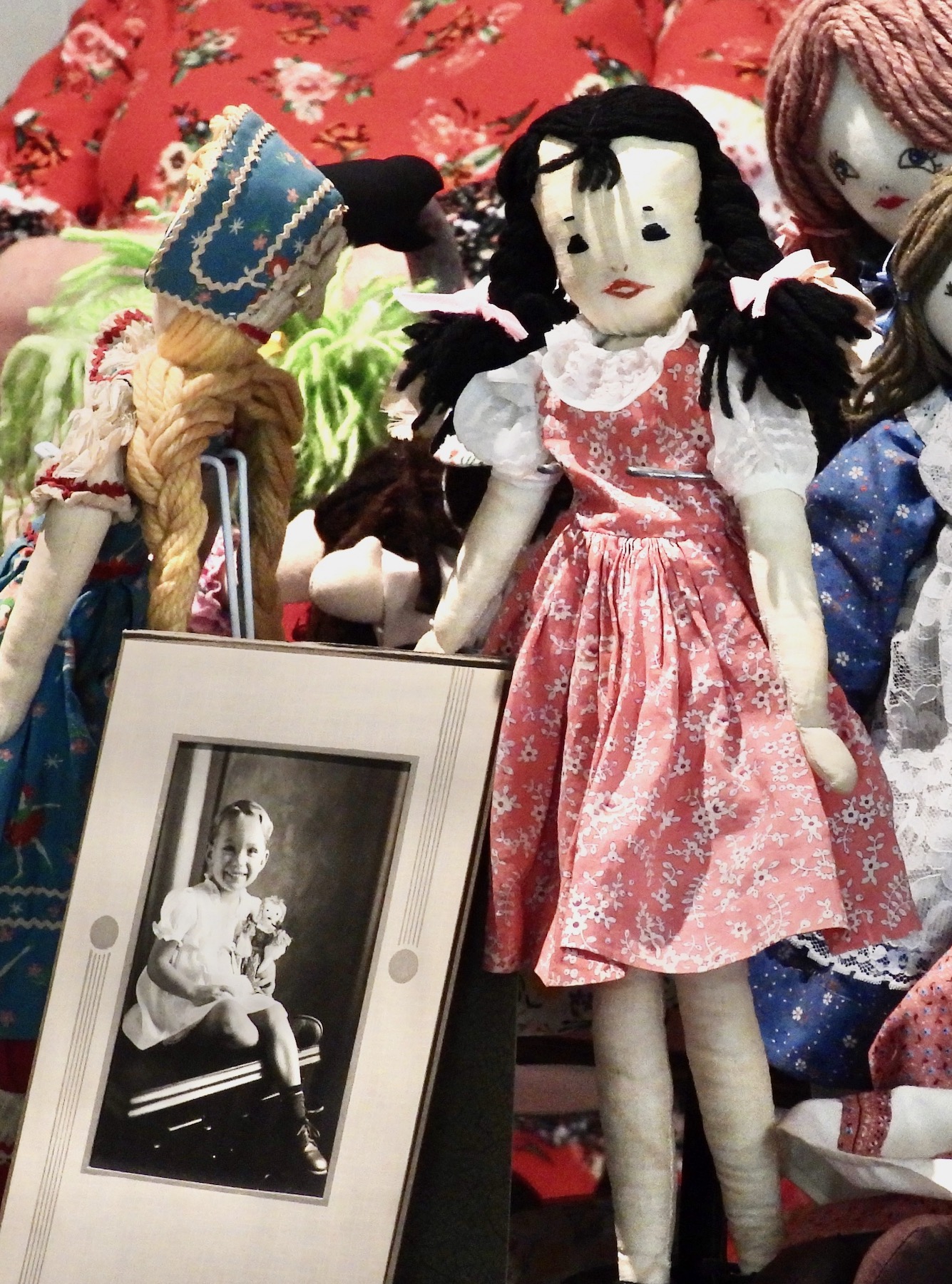
Elaine described some of the characteristics of a doll made using an Ackley pattern. The dolls had side seams and a flat face with embroidered eyes made with horizontal stitches and no nose. The toes of the feet pointed down unless they were stitched up and there were no fingers. The dolls were stuffed through the top of the head and Ackley recommended placing a stick or nail inside the head and neck to keep the head from flopping. The clothes were typically stitched closed, as Ackley did not mention buttons or snaps. Because these dolls were handmade by many different people, there are a lot of charming variations.


This cowboy was created by a woman in Austin.


Elaine found this little Native American doll at member Jenell Howell's house, where it was being used as a cat toy!


Ackley issued a pattern for this clown doll.


This is a version made by Elaine. The circus-print fabric for his outfit is from a 1940s crib pad.


This doll was made by dolly artist Lucy Geist in New York, who used Ackley patterns to create her own dolls. 


Member Sylvia McDonald displayed dolls made by her and her family members. 


This doll was made by her great-aunt.


Jenell shared this cloth doll from the 1940s. She has an expressive face and stitched fingers.


Member Kenneth Reeves displayed this cute cloth doll by the Canadian company of Bamboletta. He said that the Waldorf-style dolls is handmade of natural materials. 


Myrna Loesch brought this cloth doll by doll artist Susan Fosnot that was made as a souvenir doll for the 2014 United Federation of Doll Clubs convention.


Member Nancy Countryman shared a wide variety of cloth dolls from her collection, including two original Cabbage Patch dolls, Bevo, the University of Texas longhorn mascot, and


Miss Piggy of Muppets fame


Sunday, November 28, 2021

November 7, 2021, Meeting

The theme for the November meeting was dolls dressed in fall colors. 


Member Jenell Howell brought her all-original Sasha, made in Germany in the 1970s.


The 1953 Ginny in her pineapple print dress was purchased by member Sylvia McDonald when she was in high school. The Muffy belongs to member Myrna Loesch and dates from 1955.


Myrna also brought this reproduction doll made by former member Mary McKenzie. Another member, Jan Irsfeld, embellished her outfit.

This somber child is by artist Helen Kish and belongs to Sylvia,

Another artist doll, this one created by Sylvia Natterer. Sylvia McDonald added the teddy bear because it matched the doll's original dress.

This doll is entitled "The Frog Prince" and was created by Maggie Iacona. The doll holds a pillow with a fabric frog. Jenell said that this doll was an early attempt by the artist to created a ball-jointed felt doll. 

This quartet belongs to member Elaine Jackson. The two pilgrims have already been featured on our blog. They represent John Alden and Priscilla Mullins and were created circa 1950 by Helen Walker of Just Folks Doll House of Staunton, Virginia.  The cloth doll was made in the 1950s from a pattern created by writer and doll artist Edith Flack Ackley.


This Hitty is cast of resin by artist Sara Cole and was dressed by Elaine in a vintage child's handkerchief. 

Fall also means Thanksgiving with its images of Pilgrims and Native Americans.


The taller doll belongs to member Sharon Weintraub. By Gebruder Heubach, she is a portrait of "Princess Angeline." Born Kikisoblu in 1820, she was the eldest daughter of Chief Seattle, leader of the west coast Suquamish and Duwamish peoples.  In 1855, when the Duwamish Indians were forced to leave their land for reservations, she insisted on remaining in Seattle, living in a small cabin and supporting herself by doing laundry and selling handwoven baskets. 


This Ginny dressed as a Native American dates from 1952-1953 and belongs to Jenell.