

The Austin Doll Collectors Society had its first in-person meeting in over a year, congregating at member Sharon Weintraub's home. Sharon gave a program on Asian character dolls by German and French bisque doll makers. She explained that although the spice trade between Asia and Europe dates back thousands of years, by the 16th century European merchants, often with military support, had seized control of the trade routes, gaining a foothold in the East. The Chinese Qing dynasty losses to Britain and its European allies in the First (1839-42) and Second Opium Wars (1856-1860) forced China to grant Western companies favorable trade concessions and concede territory to their control. In 1853 American Commodore Mathew Perry sailed into Tokyo harbor, beginning the re-establishment of trade and contact with Japanese, who had closed off their country to most foreigners in 1639. By the 1870s, these trading concessions had expanded into colonial control, with Britain, France, and the Netherlands claiming territories throughout Southeast Asia and the Indian subcontinent. The explosion in magazines and newspapers helped bring images and stories of Asian nations and people to the average European. Schoolchildren learned about their countries' colonies and their peoples. Advances in printing made colorful children’s books widely available and affordable and fanciful stories and characters from the East began to appear in the pages of children’s storybooks. All of the interest in the East inspired both French and German doll companies to create dolls representing Chinese, Japanese, Burmese, and other Asian peoples. In some cases, the dolls were little more than colorful stereotypes while other manufacturers strove for more ethnically correct features and clothing.

The cheerful Asian infant doll belongs to member Jenell Howell. He is by J.D. Kestner and is on a ball-jointed toddler body, rather than the more typical bent limb baby body. Next to him is Mold 1329 by Simon and Halbig, dressed in an antique outfit of a Manchu noblewoman, including the unusual platform shoes.
 '
'
Another Asian baby by Kestner, this time in a diminutive all-bisque version. He wears his original, but now fragile, silk outfit. His "slippers" were created by painting the soles of his bare feet black and gluing cord around the edges.

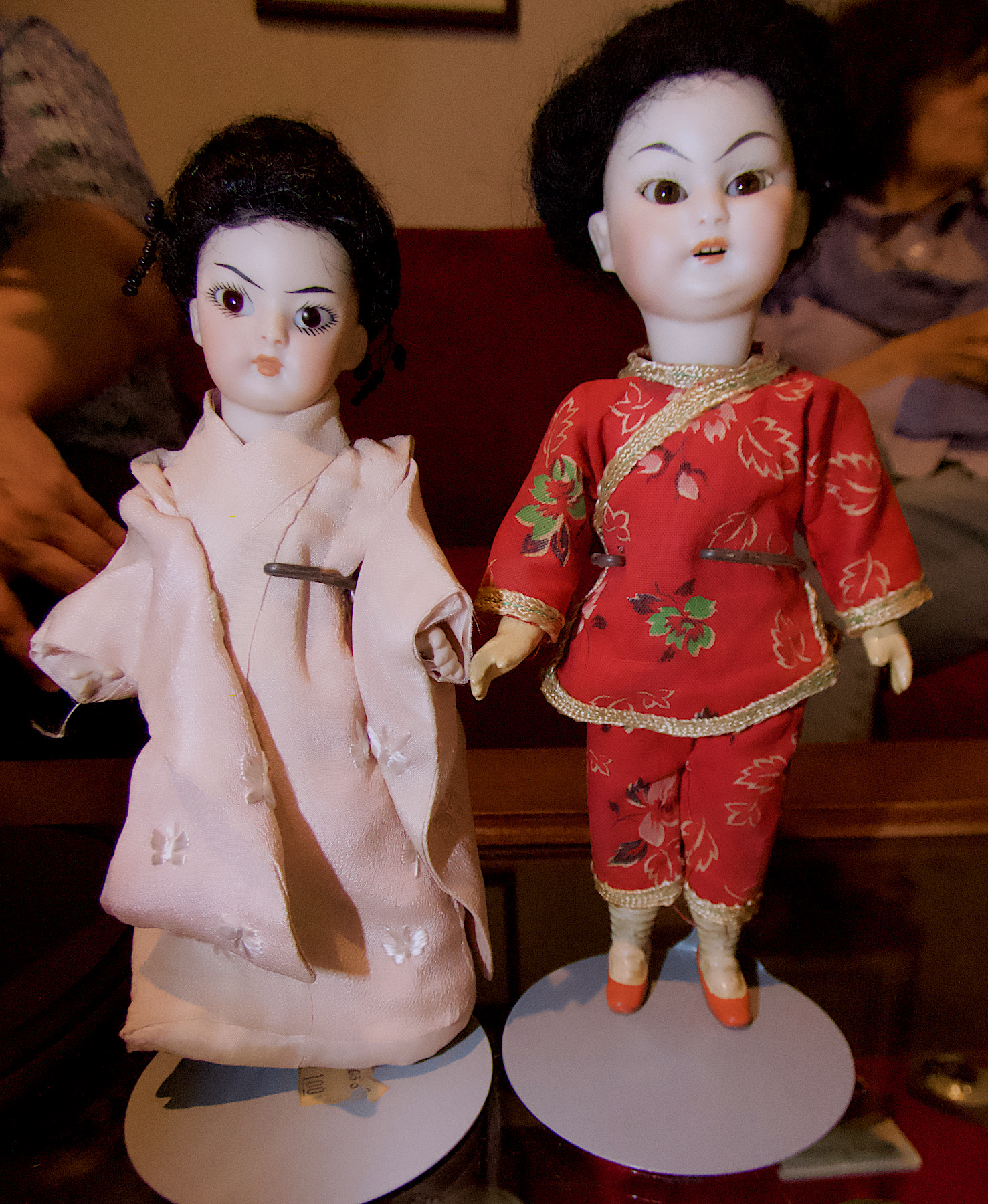
Two more Asian characters by Simon and Halbig. The smaller doll is all-bisque and dressed in an antique embroidered kimono. She has molded blue slippers with upturned toes. The other doll is Mold 1129 and is all original.
These 4.5-inch high charming cherubs are Chin-Chin Baby by Gebruder Heubach. Each carries the Heubach square mark faintly incised on the soles of the feet. Made to compete with the popular Kewpie doll, the Chin-Chin Babies came in a variety of headdresses. The girl in the center has her original paper tags.

Another Chin-Chin Baby in a bright orange and blue cap next to a Queue San Baby by Morimura Brothers of Japan. The two dolls are often confused, as the Queue San is clearly a copy of the Chin-Chin. However the Queue San Baby is larger, with rougher bisque and with less distinct modeling.

All original, this beautiful baby is by Armand Marseille. Incised on the back of the head is the name "Ellar" inside of a six-pointed star. Marseille produced heads for other factories and distributors, but just who "Ellar" is remains a mystery.

German companies produced a variety of all-bisque Asian dolls. The little lady is the crocheted blue kimono is by Carl Horn and is just 1.75 inches high, including her yarn wig. The minute man in the red cap is by Hertwig and Company. He has a painted dropping mustache and has a little yarn queue inserted in the back of his cap.

French doll makers also produced Asian dolls. The largest doll is a bit of a mystery. He has a French fashion style shoulder head on a fully jointed twill-covered body with bisque lower arms and lower legs with bare feet. The clothing is old and fragile. The two tiny dolls are Lilliputiens. Just 2.5 inches tall, these all-bisque dolls were available in a wide variety of costumes, including French regional and historical dress, storybook characters, and ethnic dolls. Like all Lilliputiens, they have swivel necks with a molded loop and painted features. The pair wear their original costumes and the man has a braided queue inserted into the back of his bald pate.

Elaine Jackson brought her 1950s Kathe Kruse doll to share.


