dollshow

dollshow

AUSTIN DOLL COLLECTORS SOCIETY

The Austin Doll Collectors Society is an organization of antique, vintage, and modern doll collectors, dealers, and artisans. We meet on the second Sunday of each month and our meetings are fun and educational. We begin with refreshments and socializing, and, following our brief business meeting, there is a special doll-related program and "show and tell." The Austin Doll Collectors Society is a nonprofit organization and is a member of the United Federation of Doll Clubs.
Showing posts with label Cissette. Show all posts

Saturday, April 5, 2025

March 9, 2025, Meeting

Our club has received a certificate from the United Federation of Doll Clubs congratulating us for 50 years  as a member.


Members Jan Irsfeld and Pam Hardy did a program on Madame Alexander and her dolls.  Her father, Maurice Alexander, was born in Russia, but later emigrated to Germany, where he became interested in toy manufacturing. He arrived in New York City in 1891, founding a doll hospital. His daughter, Bertha, also known as Beatrice, worked at the hospital with her sisters, and dreamed of becoming an artist.  She began making cloth dolls, which were sold at the hospital, In 1923, she started the Alexander Doll Company. With the help of her sisters, she created cloth dolls with the idea that the dolls would be playthings for children. The dolls were inspired by stories and literature, including Alice in Wonderland and Little Women. Scarlett O'Hara from the novel Gone With the Wind was her first licensed character doll, and she would create other dolls based on famous people, such as the Dionne Quintuplets and Queen Elizabeth II. Madame Alexander died in 1990 and the company was sold in 2012 to Kahn Lucas, owner of Dollie & Me.


In 1955, Cissy was introduced as the first American fashion doll, with production ending in 1962. Large, (20 to 21 inches), Cissy was beautifully coifed and dressed. But she was a luxury doll; in 1955, a Cissy just her undergarments cost $12.95, which was a bag of groceries for many families.  Cissy was reintroduced in 1995 and became more modern and often edgier, with outfits sometimes created by renown designers. Cissy appeared as everything from queens to storybook characters to pirates. Jan said, however, that when manufacturing was moved to China, the quality of the dolls declined. Jan told the club that one of her favorite outfits for Cissy is the torso dress, which she has recreated in a variety of fabrics. This is a hand-beaded example is one of her creations.


The Cissy on the left models the original black velvet torso dress and belongs to member Bette Birdsong. Her companion belongs to member Sharon Weintraub and wears the "Ribbons and Roses" ensemble from 1956.


Another iconic outfit for Cissy is this 1957 Toreador outfit.


This example of the reintroduced Cissy belongs to our newest member David Craig. She wears a version of the famous Mondrian cocktail dresses created by designer Yves Saint Laurent in 1965 as a tribute to the artist Piet Mondrian. 


The 10.5-inch tall Cissette, introduced in 1957, was a smaller version of Cissy. In this picture, one Cissette wears the famous toreador outfit. Like Cissy, Cissette was reintroduced. Jan said that the doll in the black velvet gown is a newer version of Cissette dressed after a portrait by famed artist John Singer Sargent. 


This Cissy was issued in 1997 and wears the Gardenia Ball Gown. She belongs to member Nancy Countryman.


This regal Cissy, belonging to Jan, was issued to commemorate the 50th anniversary of Queen Elizabeth II's coronation. 


Nancy brought other examples of Madame Alexander dolls, including this ballerina, 


Winnie Walker with a Cissy-type face, and


Maggie Mixup.


Member Kathie Tovo shared this box of beauties. The smaller dolls are Cissettes, while the other doll is Lissy, issued in 1956 as a more affordable and youthful version of Cissy.


Kathie also shared two larger examples of Alexander dolls. The baby on red and white is a big (and heavy) child, while the other is a scarce Barbara Jane doll issued in 1952 and dressed as Alice in Wonderland. 


Member Jenell Howell displayed this sophisticated Sheri Lewis doll,


as well as this stunning Cynthia. issued in 1952.


The little girl so pretty in pink is a composition McGuffey Ana belonging to member Sylvia McDonald. The sweetie in stripes belongs to Bette. She is a "Quiz-Kin" issued in the early 1950s and has buttons on her back that allow her to nod her head "yes" or "no."


Another composition version of McGuffey Ana belonging to Sylvia.


Myrna shared these Lissy and Elise dots in matching nifty nautical outfits. Myrna told the club that Alexander often offered the same outfit in different sizes.


Member Kenneth Reeves brought  "Tess," a Cissette dressed in an elaborate Victorian ensemble.


He also shared this doll by artist Susan Wakeen representing the storybook character Rapunzel.


Wednesday, September 28, 2022

September 11, 2022, Meeting

Loading

In memory of Queen Elizabeth II, this month's theme was queens. 


Member Sharon Weintraub displayed two doll heads, one of fine bisque and the other of carved wood. Both heads had the hair tucked into a snood, with a scarf draped over on side of the head and a plume on the other.  She explained that this style of head is known to collectors as Empress Eugenie. Empress Eugenie was the consort of Napoleon III, who reigned as the emperor of France from 1852 until 1870. Sharon stated that there is no evidence the head is actually a portrait of the empress, but that this is just a name given this type of head by early doll collectors. The wooden head was found in an antiques market in Barcelona, Spain, and is expertly carved. 


She also shared this French fashion doll by Francois Gaultier on a jointed wooden body. The doll is dressed in an old beautifully tailored and hand sewn outfit, including layers of undergarments. Pinned to the back of her slip is a yellowed note declaring in French "Margueritte of France, Sister of Francis the 1st." This would indicate that the doll represents Margaret of Valois, who became Queen of Navarre upon her marriage to Henry III of Navarre in 1572 and then rose to Queen of France at her husband's 1589 accession to the latter throne as Henry IV. Sharon pointed out that the doll should be more properly dressed in Elizabethan garb rather than a romanticized outfit of the Middle Ages.


Sharon displayed this 9.5-inch tall bisque-headed doll representing Queen Victoria. The doll is part  of the "Femmes Célèbres" ("Great Ladies") series produced by Société Française de Bébé and Jouets (S.F.B.J.) in the 1940s. Her round paper tag reads "Fabrication Jumeau Paris Made in France" on one side and written in ink on back of label is "Victoria I Reine d Angleterre Cirque 1860." 


Member Sylvia McDonald brought this 1992 Madame Alexander doll dressed in a coronation outfit, complete with crown and velvet robe


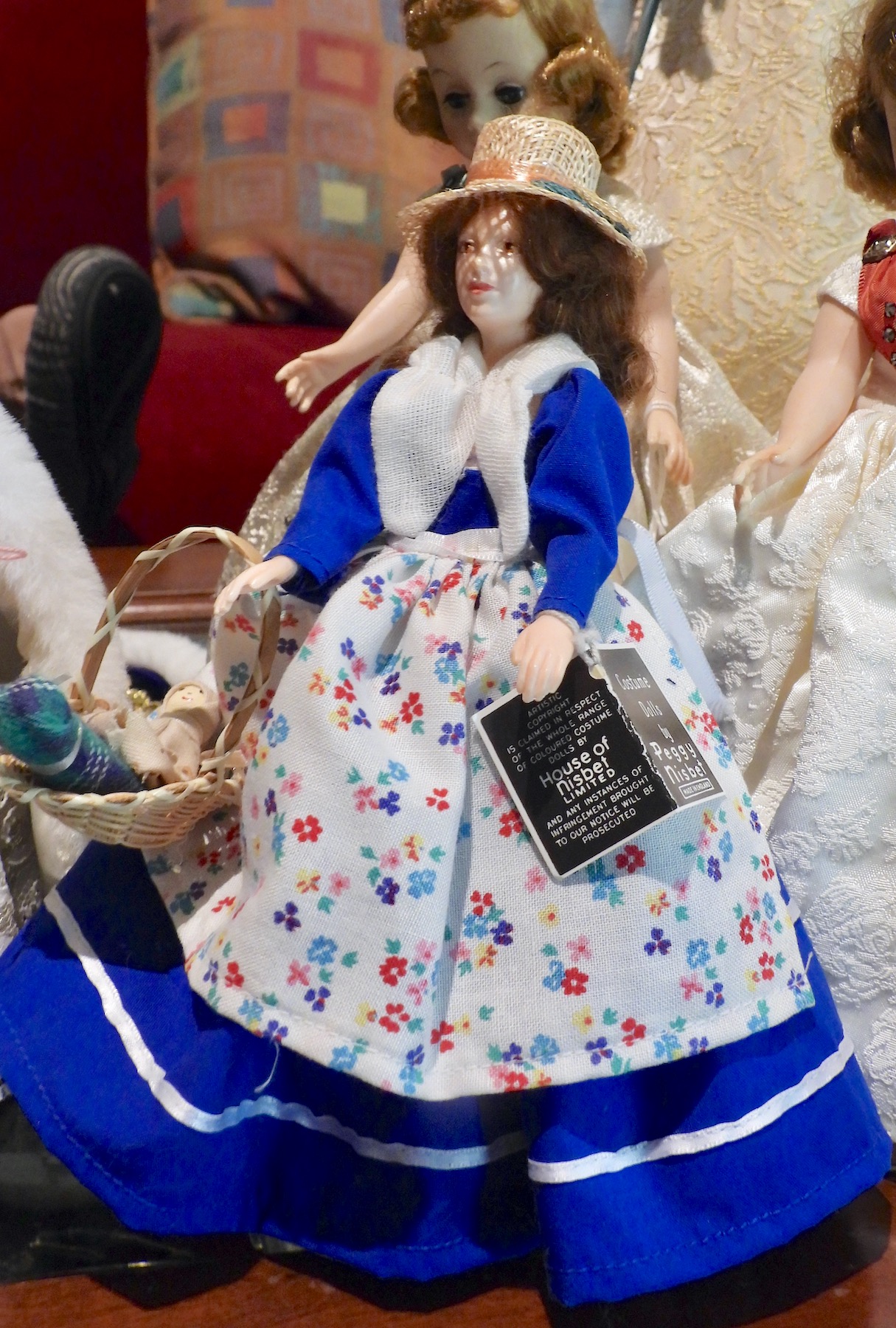
On one side of the doll are dolls in elaborate uniforms by English doll artist Peggy Nesbitt.  The older man represents a yeoman warder, who guards the Tower of London and the crown jewels displayed therein. The other man represents a palace guard wearing his signature "bearskin" helmet. The actual helmets are made of Canadian bear skins and were originally intended to make soldiers look taller and more intimidating in battle. 


A doll peddler, also by Nesbitt, admires the pomp and circumstance.


Member Myrna Loesch brought this collection of Madame Alexander Cissy and Cissette dolls in coronation gowns. The lovely lady in the purple robe dates from 1955. Myrna pointed out the doll's "ruby" and "diamond" bracelets, explaining that the jeweled cuffs worn by Queen Elizabeth during her coronation were a symbol of her sovereignty. The other Cissy dates from 1957 and wears a replacement crown made by Myrna. The purple robe, large golden crown, and specter belong to Member Jan Irsfeld and were made by Alexander to commemorate the 20th anniversary of Elizabeth's coronation.


The Cissette in the golden floral dress is from 1958. The doll with the red sash dates from 1972-73.


Member Elaine Jackson shared this book, first published in 1950, written by Marion Crawford, who was the governess to Princess Elizabeth and her sister, Margaret.


Member Elaine McNally displayed some of her latest wood and cloth creations.


Guest Pam Hardy brought this artist doll to share. She purchased it on a tour of Germany. The doll has a handwritten paper tag that says "matrosen mädchen," or "sailor girl."


Thursday, September 1, 2022

August 14, 2022, Meeting

This month's theme was the souvenir dolls produced for the United Federation of Doll Clubs (UFDC)  conventions.  For every convention a limited edition doll is produced as a souvenir for the convention itself, but special dolls are also designed for luncheons and other events. Member Elaine Jackson brought two examples of UFDC souvenir dolls. This doll is Rosita, the souvenir doll for the 1984 UFDC convention in San Antonio. 


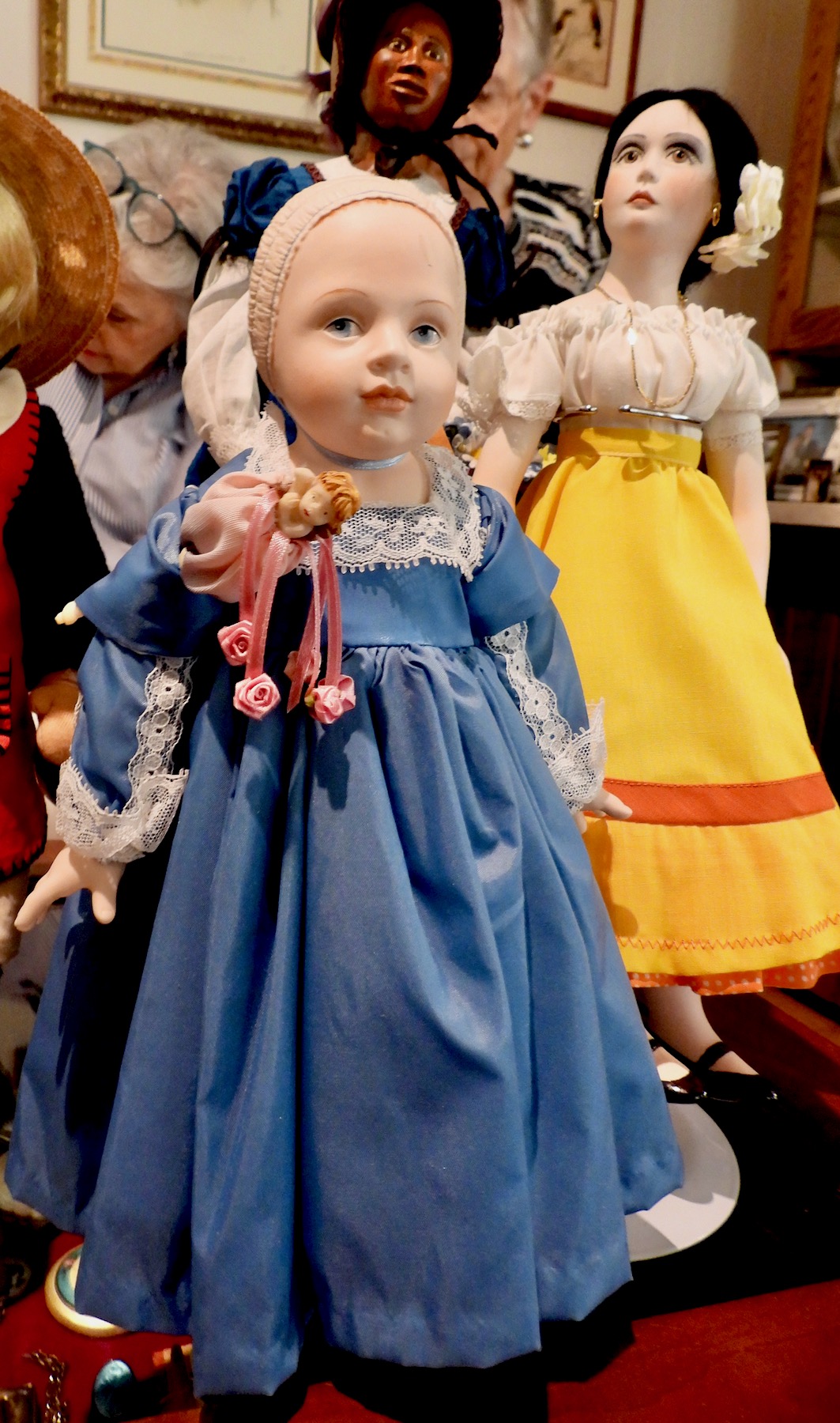
This charming child is Baby Stuart and was the souvenir doll for the 1996 UFDC convention in Dallas.


These are the UFDC souvenir books from these conventions.


Member Sylvia McDonald brought two examples of dolls produced for other events at a UFDC convention. The taller doll is Fritzel, a Child of Fortune, designed by the German doll company of Käthe Kruse. He is 13.5 inches tall and has a soft body and vinyl head with a hand-painted face. Originally he also came with pajamas, bathrobe, slippers, and a blanket. As is typical of these luncheon dolls, there were other accessories, such as a little wooden dog, that were given as table favors. Sylvia received a note from Marion Hohmann at the Käthe Kruse company stating that Fritzel was made in 2000 as a limited edition of 260 dolls.

The smaller girl is Gretel, made exclusively for a Käthe Kruse luncheon at the 2007 UFDC convention. The luncheon theme was "The Sound of Music" and the doll is dressed like the youngest daughter of the Van Trapp family in a traditional Austrian outfit. She is 11 inches tall and stuffed with reindeer hair.


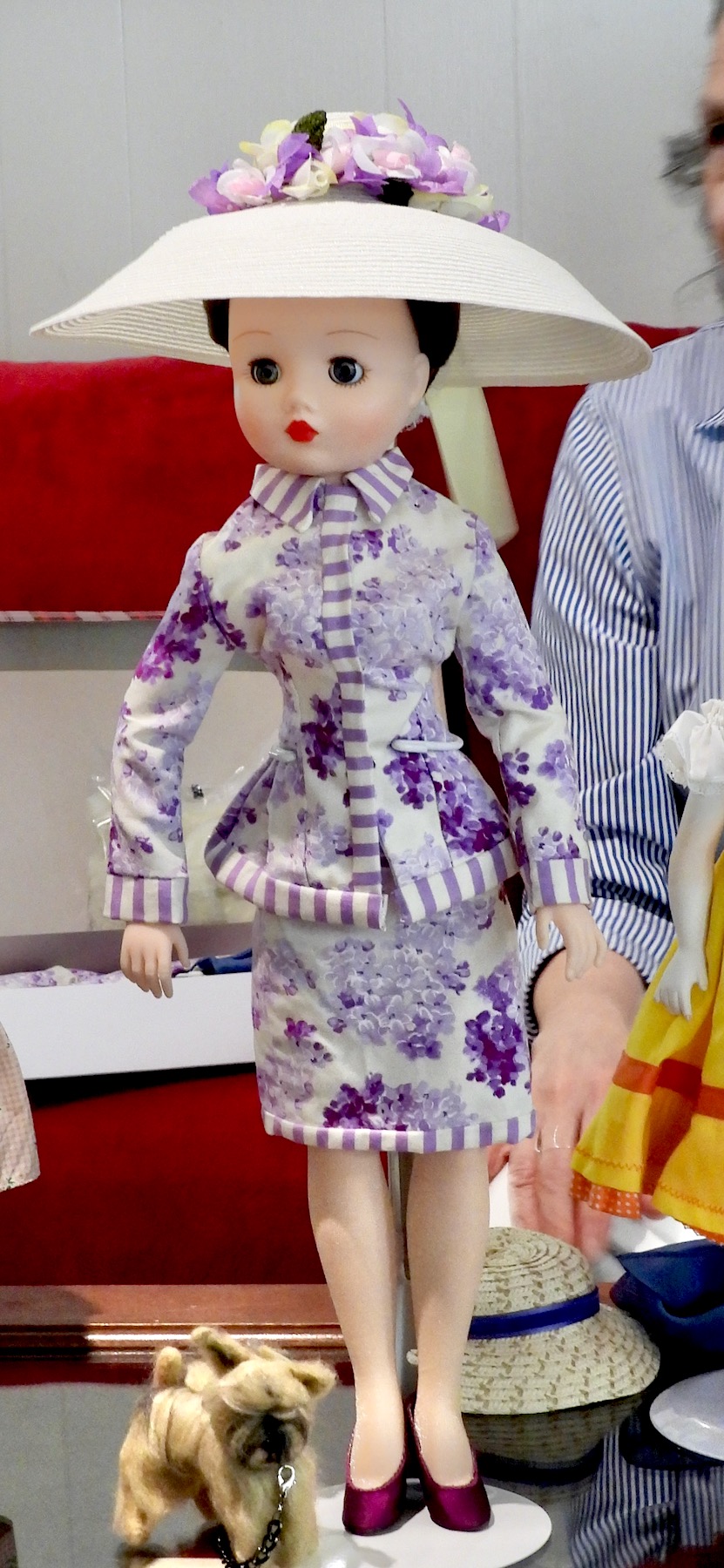
This Cissy by Madame Alexander belongs to member Jan Irsfeld. Jan explained that the doll was a limited edition made for the UFDC in 2001 in a special blue version of an outfit known to collectors as "On the Avenue," inspired by a vintage advertisement for Yardley of London fragrance featuring a Cissy doll.  Jan created this lovely lilac and white outfit for her doll. 


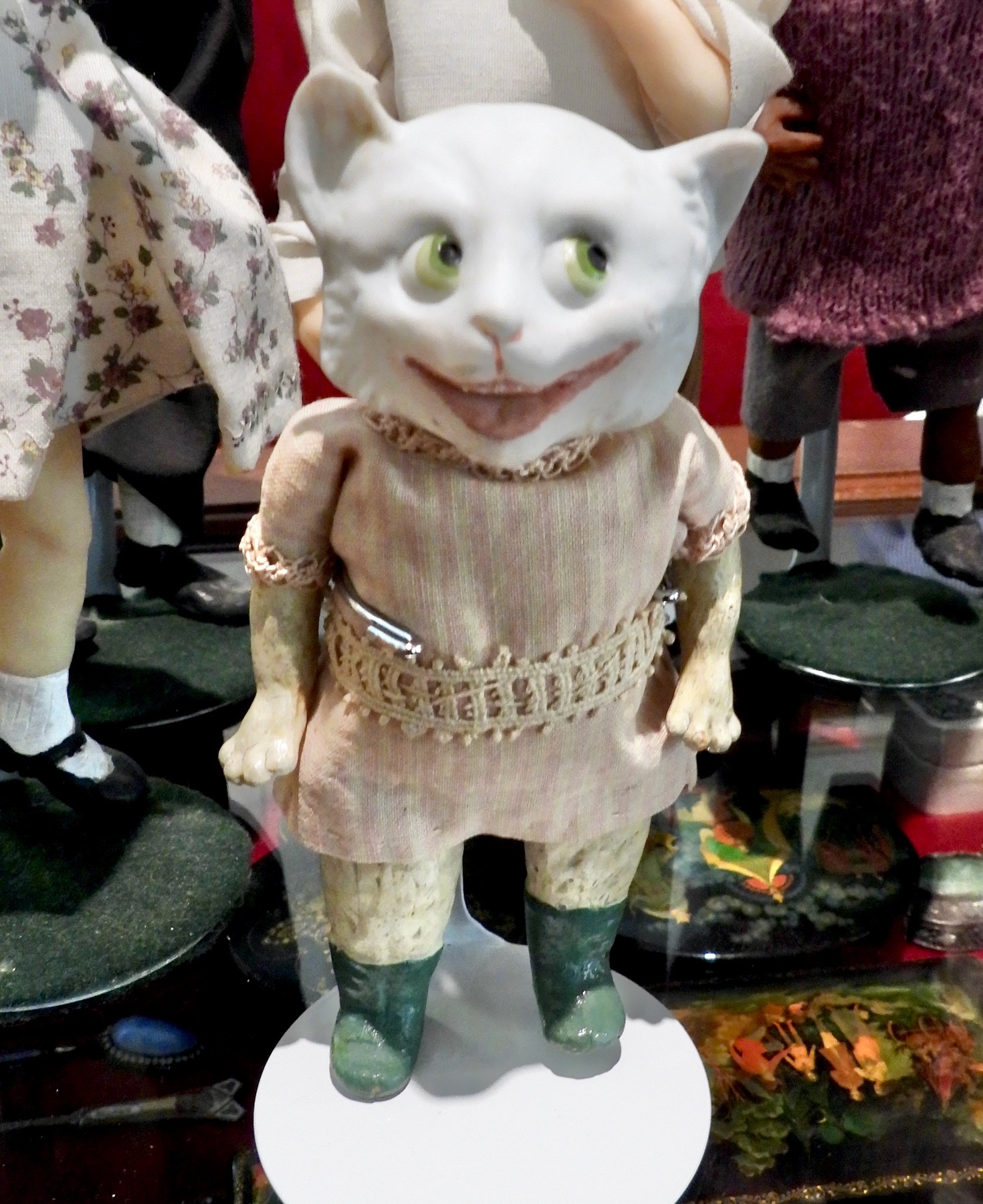
In edition to the various souvenir dolls, a wonderful selection of antique, vintage, and modern dolls is offered for sale at the UFDC sales room, a major attraction at every convention. Member Sharon Weintraub bought this unusual googly-eyed Gebruder Heubach character cat at the 2022 UFDC convention in St. Louis.  


Members also brought dolls to share for show and tell. This doll has head and hands carved from walnut wood by doll artist Floyd Bell and represents Miss Jane Pittman, the heroine of the 1971 novel The Autobiography of Miss Jane Pittman. The doll is beautifully dressed by Charlotte Semple.


Nancy Countryman brought these unique dolls from an unknown artist, dubbing them the ugliest dolls in her collection.


Member Sue Smith shared this handmade doll representing a man from the Native American Sioux tribe in traditional dress. She said that the doll is around 200 years old.


She also brought this doll representing an Apache woman, which Sue said dated from the late 1800s.


Guest Pam Hardy brought this sweet Cissette doll by Madame Alexander. Pam told the members that this is a childhood doll that she received for her birthday in 1956. 


Wednesday, April 27, 2022

April 10, 2022, Meeting

Member Jan Irsfeld gave a program on the history of underwear. Member Myrna Loesch made these adorable and appropriate (and DELICIOUS) iced lingerie sugar cookies, as well as the small round shortbread cookies known as "petticoat tails." To complete the undergarment theme, she also provided a bowl of Ruffles potato chips.


Jan explained that early clothing was unstructured and undergarments were often nothing more than a piece of cloth wrapped around the loins. She holds an example of a Cissy by Madame Alexander that Jan dressed in a recreation of an ancient Egyptian garment.

Jan said that this changed in the era of Elizabeth the First, when clothing became increasingly structured, elaborate, and multilayered. Underwear not only protected the skin from chaffing and helped keep costly clothing clean, it served as a scaffolding to support the clothing, as well as to shape the body underneath. A hooped skirt called a farthingale acted as a frame to extend the skirt, a corset emphasized a lady's waist, and a bumroll accentuated the hips. 

The 1700s introduced the pannier, side hoops that extended the width of a woman's skirts. Jan explained that the name comes from paired baskets that hung on each side of a donkey, typically used to deliver bread. The panniers were sometimes so wide that a woman had to move sideways through doors. Jan displayed a miniature pannier she created, along with the start of hand-beaded skirt that will go over it.  

Jan stated that during the early 1800s, fashion took another turn and women wore high-waisted gowns with straight loosely-draped skirts, requiring very little in undergarments. However, by the 1860s, wide hoop skirts or crinolines were in style, supported by swinging bell-shaped cages of steel and whalebone. Crinoline cages were replaced by the bustle, a descendant of the bumroll. This is a miniature bustle created by Jan.


Starting in the 1900s, as women's clothing became less structured and complex, so did undergarments. The brassiere was introduced as women discarded their corsets and teddies replaced the layers of undergarments. Jan passed around examples of vintage bras and teddies designed by Madame Alexander for the Cissy fashion dolls.


Jan ended her program by sharing this limited edition "Cissy's Secret" by Madame Alexander. Issued in 1997, the set includes not only a Cissy doll, but also a trunk full of her luxurious lingerie.


Member Sharon Weintraub displayed this group of ladies showing the evolution of an undergarment called the combination. Combination underwear was introduced in the 1870s to reduce bulk under the fitted jackets and narrower upper silhouette of the period. The little all-bisque doll with the auburn wig has a molded early version of this undergarment, with short sleeves, a modest neckline, and long legs. Combinations were worn through the 1900s, becoming ever briefer, frothier and sheerer, the cuffs climbing closer to the knees as hemlines began to rise. By the 1920s, the combination was reduced to the flapper's chemise or teddy, as demonstrated by the all-original 1159 Simon and Halbig flapper doll.

Myrna shared these two Madame Alexander Cissettes, one wearing a slip and the other a lace teddy.


Member Sylvia McDonald brought her Käthe Kruse boy in his original undergarment. This doll belonged to her great-aunt and Sylvia thinks that her aunt received the doll around 1912. Sylvia said that Kruse dolls still come in a very similar "onesie."

Member Elaine Jackson shared several examples of vintage doll underwear. . .


. . .as well as this very unusual Madame Alexander doll with a composition head and cloth body. Elaine has redressed her as Alice in Wonderland, but who she was originally is still a mystery.