dollshow

dollshow

AUSTIN DOLL COLLECTORS SOCIETY

The Austin Doll Collectors Society is an organization of antique, vintage, and modern doll collectors, dealers, and artisans. We meet on the second Sunday of each month and our meetings are fun and educational. We begin with refreshments and socializing, and, following our brief business meeting, there is a special doll-related program and "show and tell." The Austin Doll Collectors Society is a nonprofit organization and is a member of the United Federation of Doll Clubs.
Showing posts with label Queen. Show all posts

Sunday, November 2, 2025

October 12, 2025, Meeting

Jan Irsfeld gave a program on goddesses, celestial, movie, and royal, using examples from her collection of Cissy dolls by Madame Alexander. She explained that Madame Alexander was fascinated by powerful and successful women. Peeking out in the far left corner is a Cissy, dressed by Jan, representing  Hatshepsut, a female pharaoh who reigned in the fifteenth century B.C.E.; she qualifies as a goddess because the pharaohs were considering living deities. The dolls on the table represent more modern goddesses of the silver screen. Starting from the left, the luscious lady in white represents Hollywood, while the others are Madame Alexander's  interpretation of actual actresses; Grace Kelly in icy blue, Vivian Leigh as Scarlett O'Hara, Marilyn Monroe, and Elizabeth Taylor.


Elizabeth Taylor models a hand-beaded gown designed by Jan.


Alexander also created many queens. This is an all-original Queen Elizabeth II.


Elizabeth I is represented by a Cissy dressed in authentic Elizabethan garb by Jan. Next to her is "Royal Reception" by Alexander.


French queen Marie Antoinette in her original bejeweled and embroidered gown by Alexander.


In opera, a "diva" is a celebrated female singer, and the word is derived from the Italian for goddess or divine. This Cissy represents Madame Butterfly from the famous opera by Giacomo Puccini.


However, this sassy swashbuckler is more devilish than divine. . . .


Jan shared two more scintillating Cissy dolls, including this flamboyant flapper. . . 


. . . and her favorite Cissy, reduced nude from an Austin doll shop, whom Jan has since restored and elevated to a goddess.


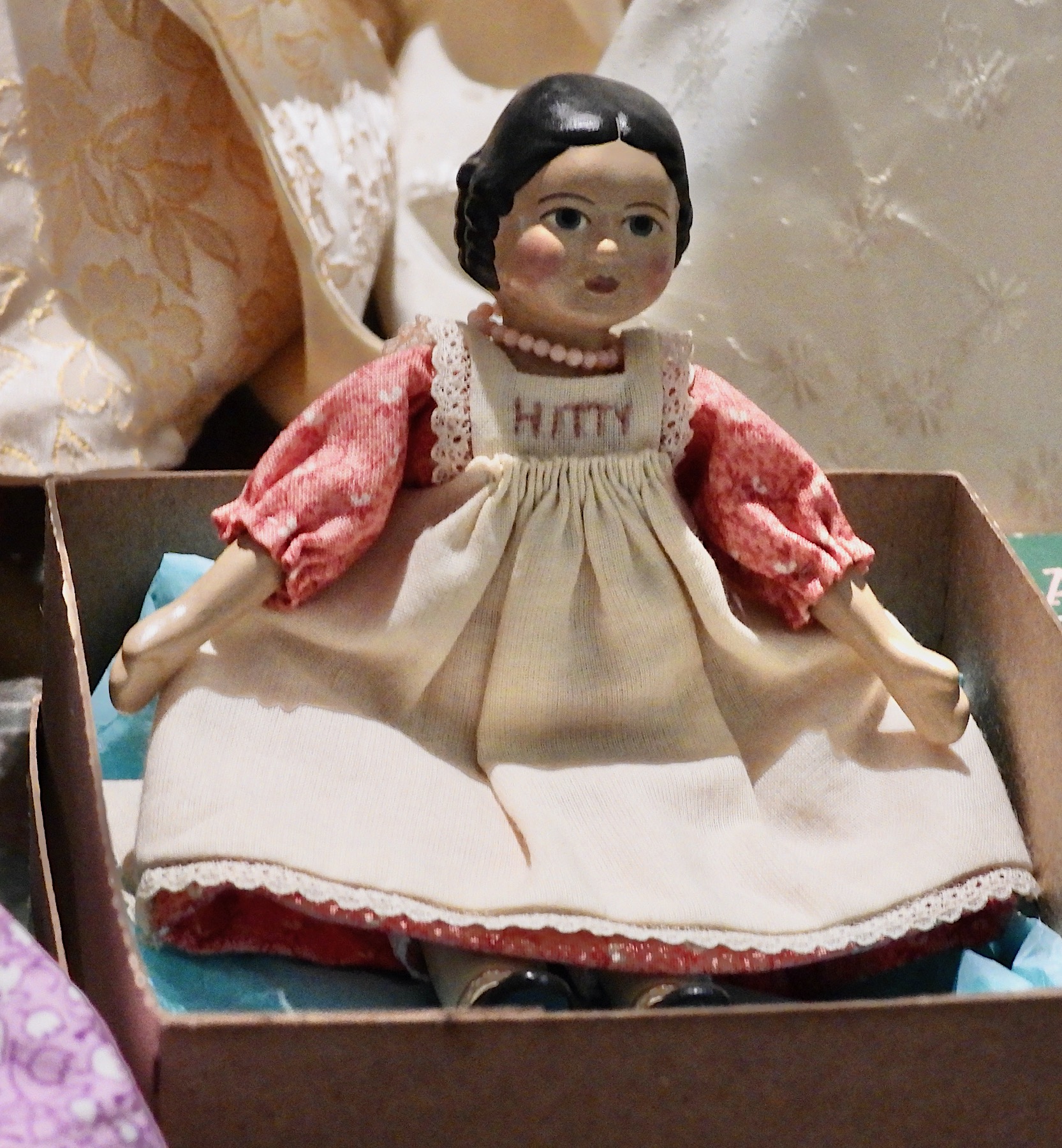
Elaine Jackson shared this wooden Hitty, currently the queen of her Hitty House, carved by member Elaine McNally. 


Jenell Howell brought this goddess of the night, Evangeline Ghastly by Robert Tonner.


David Craig had an earlier example of the eerily beautiful Evangeline. 


Another Tonner doll belonging to David is Ellowyne Wilde, ready for trick or treating in a Halloween outfit made for her by a friend of David's.


Bette Birdsong brought another movie goddess, a Gene doll designed by Mel Odom. In keeping with the season, Jenell shared this Sasha in fall colors.


Sharon Weintraub displayed a trio of little bisque fairies by the German firm of Hertwig and Company, noting that fairies were the subjects the fairy queen and the elfin court.


She also shared this bewitching bisque witch. Witches were thought to worship Hecate. Hecate was originally a Greek goddess, who was the protector of liminal spaces and borders, such as thresholds and doors, and was associated with the night, the moon, and magic. 


Myrna Loesch displayed this doll dress created by the Milwaukee Works Progress Administration (W.P.A.). The W.P.A., which operated from 1939 to 1942, provided work and job training for thousands of unemployed Americans during the Great Depression. While the W.P.A. created large public works such as roads, parks, and schools, it also operated handicraft projects aimed at teaching women skills such as sewing. The Milwaukee W.P.A. handicraft project produced dolls designed to be used as teaching materials in schools, as well as for children in hospitals or as Christmas gifts for children on the relief rolls. This dress was designed to be worn by a cloth doll.


Wednesday, June 15, 2022

June 13, 2022, Meeting

Elaine Jackson and Elaine McNally did a joint program on Hitty and her friends. Hitty is the wooden doll heroine of Rachel Field's 1929 children's novel, Hitty, Her First Hundred Years. In the book, the eponymous Hitty (short for Mehitabel), a simple wooden doll carved by a peddler in the 1820s, narrates her adventures over her century of existence. Jackson explained that Fields was friends with illustrator Dorothy Lathrop and sometime in the 1920s, while strolling together in New York City they saw a small time-worn wooden doll in an antique shop window. All the shop owner could tell them about the doll was that she was at least 100 years old. Neither woman could afford the doll by herself, so they pooled their resources and purchased her jointly. Inspired by the diminutive doll, they created a history for Hitty, written by Fields and illustrated by Lathrop. The book was a success and was awarded the John Newbery Medal of Excellence in 1930. Elaine brought several examples of Hitty, which is still in print. 


The book's charming historical tale has inspired generations of doll artists to carve their own versions of Hitty based on the book's illustrations, as well as Hitty-type dolls referred to as Hitty friends. 


This an early all-wood Hitty was carved by Helen Bullard, one of the founders of the National Institute of American Doll Artists. Jackson explained that because of copyright issues, Bullard called her doll "Holly." People began to wonder what had happened to the original Hitty and Jackson stated that in the 1980s Hitty was discovered in the Stockbridge Library in Massachusetts, where she had been donated by a relative of Lathrop. The original Hitty now resides in a climate-controlled case donated by the Friends of Hitty.


The copyright has since expired and artists now may call their creations "Hitty." Michael Langton persuaded the Stockbridge to permit him to measure the original Hitty and he created Hitty replicas both in wood and resin. This doll, belonging to Elaine McNally, is actually a perfume bottle created by Langton.


Jackson displayed a wide variety of Hitty dolls in wood and resin, showing each artist's own unique interpretation of the beloved doll. 


This doll by Sara Cole is made of resin. Using resin allows an artist to make multiple editions of a doll.


This Hitty by Janet Cordell was a wooden shoulderhead on a cloth body.


Many of Jackson's Hitty dolls are souvenirs from Hitty conventions. This doll by Constance Hardt was the souvenir for a San Antonio convention called "Hitty at the Alamo."


Like many Hitty fans, Jackson has a "Hitty House" to display her Hitty dolls and friends. Jackson explained that Hitty is too large for a standard dollhouse and that her late husband built her a house suitable to Hitty's dimensions. This vintage handmade bed and chair are just the right size for many of Jackson's Hitty dolls. The bed was cleverly created out of an old wooden cigar box with clothespin posts and sewing spool legs.


Another wooden doll from Jackson's collection, this one representing "Miss Unity," the mascot of the United Federation of Doll Clubs. The doll was created by Judy Brown, who has also carved Hitty dolls.


Elaine McNally then displayed her wonderful whimsical dolls inspired by Hitty.


She showed the club the tools she uses to carve her creations.

McNally explained that she may start with a block of wood. . . 

or use a commercially-made blank.

This Hitty holds a wooden whale. In the book, Hitty sails on a whaling ship.

A Hitty-inspired Alice in Wonderland cradling the Cheshire cat. McNally said that she enjoys creating miniature dolls holding an even smaller doll or other object.


This doll is an experiment by McNally to create a fully-jointed wooden doll.


McNally also makes little cloth versions of the rare Izannah Walker dolls, created in the 1840s through the 1880s. 


Another version of Alice and the Cheshire cat.


This is McNally's tiny version of an Edith Flack Ackley doll. A writer and doll artist, in the 1930s Ackley published a book entitled Dolls to Make for Fun and Profit, which included patterns for dolls and their clothing. Many dolls were made using her patterns in the 1930s and 40s.


Guest Joey Gomez shared two of his Hitty dolls. This version is by Gail Wilson.


And this one is by Robert Raikes.


Myrna Loesche brought this little wooden girl carved by Austin artist Nancy Grobe, who was once a member of our club. Nancy eventually had to give up carving because of arthritis and became a skilled painter.


In honor of the Platinum Jubilee celebrating Queen Elizabeth's 75 years on the throne, members shared dolls representing English royalty. The Madame Alexander Cissy dolls and Cissette dolls belong to Myrna and date from the 1950s.


Although these dolls' costumes closely resemble the outfit worn by Queen Elizabeth II at her 1953 coronation, Alexander only referred to them as "Queen" dolls. This doll is all original except for the replacement crown created by Myrna.


This bisque-headed doll represents an earlier English queen, Queen Victoria. She is 9.5 inches tall and is all original. Her round paper tag reads "Fabrication Jumeau Paris Made in France" on one side and written in ink on back of label is "Victoria I Reine d Angleterre Cirque 1860." The head is incised "221 2/0." She is part of the "Femmes Célèbres" ("Great Ladies") series produced by Société Française de Bébé and Jouets (S.F.B.J.) in the 1940s. In 1899, a number of French doll makers, including Jumeau, joined in this alliance in an attempt to ward off German competition. S.F.B.J. (later under the name UNIS) produced dolls until the 1950s and continued to use the Jumeau name for some of its dolls.