dollshow

dollshow

AUSTIN DOLL COLLECTORS SOCIETY

The Austin Doll Collectors Society is an organization of antique, vintage, and modern doll collectors, dealers, and artisans. We meet on the second Sunday of each month and our meetings are fun and educational. We begin with refreshments and socializing, and, following our brief business meeting, there is a special doll-related program and "show and tell." The Austin Doll Collectors Society is a nonprofit organization and is a member of the United Federation of Doll Clubs.

Thursday, July 28, 2022

July 10, 2022, Meeting

Appropriate for Austin's hot July weather, member Sharon Weintraub did a program on antique dolls dressed in bathing suits.  She explained that although sea bathing was long considered to have curative powers, beginning in the Victorian era, with the rise in the middle class and leisure time, trips to the beach became more merry than medicinal. The 40-hour workweek and public transportation brought weekend trips to the beach within the reach of many working class families. Doll companies reflected their era by offering dolls in the latest style of swimwear 

This 17-inch tall French fashion doll models an antique doll-size bathing suit from the 1860s or 70s. Such dolls were the Barbie dolls of their day, and their exquisite and costly wardrobes included every article of accessory or clothing a proper lady would need in her trousseau, including a demure, but fashionable, bathing suit for a visit to the beach. Her two-piece bathing suit, consisting of a long tunic top and full trousers, is beautifully tailored of canvas with wool ribbon trim. Typically, such bathing suits were made from wool, serge, or flannel. All the buttons, even on her cuffs, are fully functional. The snood, stockings, and leather slippers are far newer than the suit itself, but are appropriate for the period. The doll herself has a bisque swivel head on a matching shoulder plate and a kid body. She wears her original mohair wig, which perfectly matches her eyebrows. Although marked only "4" on her shoulder plate, she is attributed to the French manufacturer Masion Jumeau. Her exaggerated elongated almond-shaped eyes, dubbed "wrap around" by collectors, are typical of early Jumeau fashions.

In 1878, Elie Martin, patented a mechanical "poupee nageuse" (swimming doll), marketed as Miss Ondine. The doll must have been popular, as she was produced in some form through the early 1900s. Sharon displayed two versions, an earlier example with a French fashion head and a later version with a Simon and Halbig head, mold #1079. Both dolls wind underneath with a key, moving their arms and legs in a frog-like breaststroke. Sharon told members that their cork bodies were advertised as waterproof and capable of floating in water, but she has never dared to try it. The French Ondine is unusual because she has a bisque breastplate; Sharon explained that typically the head was mounted on a cork and the bathing suit sewn shut around the neck (as is the case with the Halbig version). The plate is not simply a shoulder plate that was cut in half, but was clearly molded this way, as all the edges are finished. The lady has a cork pate and is only marked "2" on the back of her head. The Halbig swimming doll wears her original silk swimsuit, once blue, but now faded to ecru. Later or cheaper models had bisque heads from lesser German companies or celluloid heads.


Sharon shared a number of little German all-bisque dolls in molded bathing suits. She explained that although many collectors think that these dolls are dressed in their undergarments, they are actually outfitted for a day at the beach.


The Black girl in her original striped bathing suit is an early all-bisque doll by Simon and Halbig. The little girl in the pink swim attire by her side is an all-original character doll by Gebruder Heubach on a composition slender body. She is incised on back of head “8192 Germany Gebruder Heubach 11/0.” 

In front of her is a little all-bisque girl seated in her beach chair; jointed only at the shoulders, this little girl is molded into a sitting position. She is made from pre-colored bisque, meaning that the slip already has a pink or skin tone. Originally, the slip used for bisque dolls was white and the complexion coat had to be padded on and refired. Beginning around WWI, some German companies began using a precolored slip. Incised on the back "771 Germany,” she is from the German firm of Hertwig and Company. Not only did this firm extensively use precolored bisque for its all-bisque dolls, bathing beauties, and similar novelties, Hertwig was a whiz at using inexpensive materials to make an attractive presentations. There was a lot of competition between German doll companies, each trying to come up with cost-effective ways to make their items more eye-catching to the consumer. Hertwig often cleverly clad its dolls in a few scraps of cheap material to make them more appealing. The molded hair loop holding a miniature rayon ribbon bow is typical of Hertwig, as is the little mesh bathing suit. The chair, which actually folds, is another example of Hertwig's imaginative use of inexpensive material to make its merchandise more marketable. A few slats of lightweight wood and a thin strip of colorful material create a cunning toy chair that certainly would appeal to little girls, yet be inexpensive enough so that most parents could afford to be indulgent. The chair is faintly stamped “Germany.” Typically, Hertwig produced boy and girl pairs, so perhaps she has a male counterpart in his own little lounge.


Also of precolored bisque from Hertwig is this pair of all-bisque chubby toddlers are dressed in their original net bathing suits, trimmed with matching ribbon. 


Inside her original box labeled "Bathing Girl,” the doll in the striped attire doll wears in her original  bathing suit and matching cap, trimmed with silky bows. Marked "Heubach Kopplesdorf 250-17/0 Germany," and 6.5 inches tall, in her day, she was a rather inexpensive play doll, but sweet and pretty enough to catch a little girl's eye and win her heart. Sharon said that dolls such as this may have been sold in seaside souvenir shops, alongside the lithographed tin sand pails and wood-handled fish nets. This little blond beach babe is also still tied into her original box and wears her original pale blue mesh bathing suit and matching cap. Her painted eyes and closed mouth suggest that she was an even less expensive souvenir than the Kopplesdorf doll. The back of doll's head is incised with an intertwined "W&S," the mark of the German firm of Walther and Sohn, and "Made in Germany."


Members brought a wide variety of darling dolls in sun or swim attire to share.


Jenell Howell brought this vintage Vogue Ginny in a green polka dot sunsuit and her little playmate, an Alexander-kin by Madame Alexander. An all-original Number 1 Barbie, complete with her stand, babysits while an all-composition Scootles by Rose O'Neill wants to join in the fun.


Member Bette Birdsong shared this trio of Ginny dolls,  all dressed for a day of fun in the sun.


The Terri Lee doll with her personalized inner tube also belongs to Bette. Standing next to her is a porcelain Shirley Temple doll by Danbury Mint belonging to member Sylvia McDonald and in front of Shirley is another doll from Sylvia, designed by Helen Kish. The sophisticated sun worshipper in the striking aqua and navy ensemble is a vintage Dollikin belonging to member Myrna Loesch. 


The Cabbage Patch doll dressed as an Olympics swimmer for Team USA also belongs to Myrna. The other two dolls were shared by guest Joey Gomez. The doll in the lilac bathing suit is Fanfan, a contemporary fashion doll from France. The seated doll in bright blue is a Neo Blythe.


Ann Meier shared this sweet little Betsy McCall.


Monday, June 20, 2022

All Kitted Out

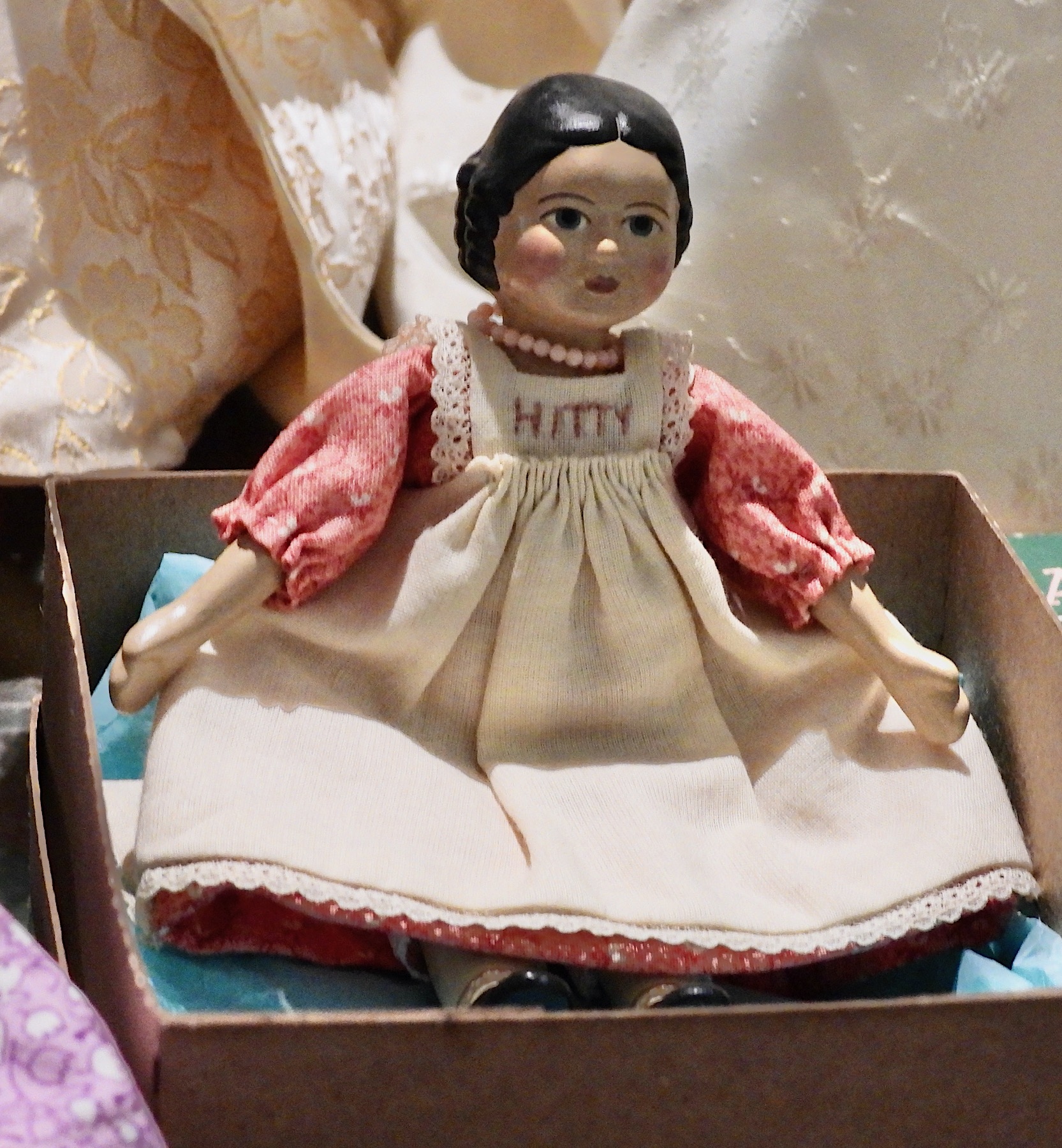
Following up on the Hitty program at out last club meeting, Member Gail Simpler shares her Hitty doll, which came from the American Kit Company by Robert Raikes. The kit included a 6.5 inch tall wooden Hitty doll, a storage bag with her name stitched on it, fabric, and patterns for making her a dress.


Wednesday, June 15, 2022

June 13, 2022, Meeting

Elaine Jackson and Elaine McNally did a joint program on Hitty and her friends. Hitty is the wooden doll heroine of Rachel Field's 1929 children's novel, Hitty, Her First Hundred Years. In the book, the eponymous Hitty (short for Mehitabel), a simple wooden doll carved by a peddler in the 1820s, narrates her adventures over her century of existence. Jackson explained that Fields was friends with illustrator Dorothy Lathrop and sometime in the 1920s, while strolling together in New York City they saw a small time-worn wooden doll in an antique shop window. All the shop owner could tell them about the doll was that she was at least 100 years old. Neither woman could afford the doll by herself, so they pooled their resources and purchased her jointly. Inspired by the diminutive doll, they created a history for Hitty, written by Fields and illustrated by Lathrop. The book was a success and was awarded the John Newbery Medal of Excellence in 1930. Elaine brought several examples of Hitty, which is still in print. 


The book's charming historical tale has inspired generations of doll artists to carve their own versions of Hitty based on the book's illustrations, as well as Hitty-type dolls referred to as Hitty friends. 


This an early all-wood Hitty was carved by Helen Bullard, one of the founders of the National Institute of American Doll Artists. Jackson explained that because of copyright issues, Bullard called her doll "Holly." People began to wonder what had happened to the original Hitty and Jackson stated that in the 1980s Hitty was discovered in the Stockbridge Library in Massachusetts, where she had been donated by a relative of Lathrop. The original Hitty now resides in a climate-controlled case donated by the Friends of Hitty.


The copyright has since expired and artists now may call their creations "Hitty." Michael Langton persuaded the Stockbridge to permit him to measure the original Hitty and he created Hitty replicas both in wood and resin. This doll, belonging to Elaine McNally, is actually a perfume bottle created by Langton.


Jackson displayed a wide variety of Hitty dolls in wood and resin, showing each artist's own unique interpretation of the beloved doll. 


This doll by Sara Cole is made of resin. Using resin allows an artist to make multiple editions of a doll.


This Hitty by Janet Cordell was a wooden shoulderhead on a cloth body.


Many of Jackson's Hitty dolls are souvenirs from Hitty conventions. This doll by Constance Hardt was the souvenir for a San Antonio convention called "Hitty at the Alamo."


Like many Hitty fans, Jackson has a "Hitty House" to display her Hitty dolls and friends. Jackson explained that Hitty is too large for a standard dollhouse and that her late husband built her a house suitable to Hitty's dimensions. This vintage handmade bed and chair are just the right size for many of Jackson's Hitty dolls. The bed was cleverly created out of an old wooden cigar box with clothespin posts and sewing spool legs.


Another wooden doll from Jackson's collection, this one representing "Miss Unity," the mascot of the United Federation of Doll Clubs. The doll was created by Judy Brown, who has also carved Hitty dolls.


Elaine McNally then displayed her wonderful whimsical dolls inspired by Hitty.


She showed the club the tools she uses to carve her creations.

McNally explained that she may start with a block of wood. . . 

or use a commercially-made blank.

This Hitty holds a wooden whale. In the book, Hitty sails on a whaling ship.

A Hitty-inspired Alice in Wonderland cradling the Cheshire cat. McNally said that she enjoys creating miniature dolls holding an even smaller doll or other object.


This doll is an experiment by McNally to create a fully-jointed wooden doll.


McNally also makes little cloth versions of the rare Izannah Walker dolls, created in the 1840s through the 1880s. 


Another version of Alice and the Cheshire cat.


This is McNally's tiny version of an Edith Flack Ackley doll. A writer and doll artist, in the 1930s Ackley published a book entitled Dolls to Make for Fun and Profit, which included patterns for dolls and their clothing. Many dolls were made using her patterns in the 1930s and 40s.


Guest Joey Gomez shared two of his Hitty dolls. This version is by Gail Wilson.


And this one is by Robert Raikes.


Myrna Loesche brought this little wooden girl carved by Austin artist Nancy Grobe, who was once a member of our club. Nancy eventually had to give up carving because of arthritis and became a skilled painter.


In honor of the Platinum Jubilee celebrating Queen Elizabeth's 75 years on the throne, members shared dolls representing English royalty. The Madame Alexander Cissy dolls and Cissette dolls belong to Myrna and date from the 1950s.


Although these dolls' costumes closely resemble the outfit worn by Queen Elizabeth II at her 1953 coronation, Alexander only referred to them as "Queen" dolls. This doll is all original except for the replacement crown created by Myrna.


This bisque-headed doll represents an earlier English queen, Queen Victoria. She is 9.5 inches tall and is all original. Her round paper tag reads "Fabrication Jumeau Paris Made in France" on one side and written in ink on back of label is "Victoria I Reine d Angleterre Cirque 1860." The head is incised "221 2/0." She is part of the "Femmes Célèbres" ("Great Ladies") series produced by Société Française de Bébé and Jouets (S.F.B.J.) in the 1940s. In 1899, a number of French doll makers, including Jumeau, joined in this alliance in an attempt to ward off German competition. S.F.B.J. (later under the name UNIS) produced dolls until the 1950s and continued to use the Jumeau name for some of its dolls.


Wednesday, April 27, 2022

April 10, 2022, Meeting

Member Jan Irsfeld gave a program on the history of underwear. Member Myrna Loesch made these adorable and appropriate (and DELICIOUS) iced lingerie sugar cookies, as well as the small round shortbread cookies known as "petticoat tails." To complete the undergarment theme, she also provided a bowl of Ruffles potato chips.


Jan explained that early clothing was unstructured and undergarments were often nothing more than a piece of cloth wrapped around the loins. She holds an example of a Cissy by Madame Alexander that Jan dressed in a recreation of an ancient Egyptian garment.

Jan said that this changed in the era of Elizabeth the First, when clothing became increasingly structured, elaborate, and multilayered. Underwear not only protected the skin from chaffing and helped keep costly clothing clean, it served as a scaffolding to support the clothing, as well as to shape the body underneath. A hooped skirt called a farthingale acted as a frame to extend the skirt, a corset emphasized a lady's waist, and a bumroll accentuated the hips. 

The 1700s introduced the pannier, side hoops that extended the width of a woman's skirts. Jan explained that the name comes from paired baskets that hung on each side of a donkey, typically used to deliver bread. The panniers were sometimes so wide that a woman had to move sideways through doors. Jan displayed a miniature pannier she created, along with the start of hand-beaded skirt that will go over it.  

Jan stated that during the early 1800s, fashion took another turn and women wore high-waisted gowns with straight loosely-draped skirts, requiring very little in undergarments. However, by the 1860s, wide hoop skirts or crinolines were in style, supported by swinging bell-shaped cages of steel and whalebone. Crinoline cages were replaced by the bustle, a descendant of the bumroll. This is a miniature bustle created by Jan.


Starting in the 1900s, as women's clothing became less structured and complex, so did undergarments. The brassiere was introduced as women discarded their corsets and teddies replaced the layers of undergarments. Jan passed around examples of vintage bras and teddies designed by Madame Alexander for the Cissy fashion dolls.


Jan ended her program by sharing this limited edition "Cissy's Secret" by Madame Alexander. Issued in 1997, the set includes not only a Cissy doll, but also a trunk full of her luxurious lingerie.


Member Sharon Weintraub displayed this group of ladies showing the evolution of an undergarment called the combination. Combination underwear was introduced in the 1870s to reduce bulk under the fitted jackets and narrower upper silhouette of the period. The little all-bisque doll with the auburn wig has a molded early version of this undergarment, with short sleeves, a modest neckline, and long legs. Combinations were worn through the 1900s, becoming ever briefer, frothier and sheerer, the cuffs climbing closer to the knees as hemlines began to rise. By the 1920s, the combination was reduced to the flapper's chemise or teddy, as demonstrated by the all-original 1159 Simon and Halbig flapper doll.

Myrna shared these two Madame Alexander Cissettes, one wearing a slip and the other a lace teddy.


Member Sylvia McDonald brought her Käthe Kruse boy in his original undergarment. This doll belonged to her great-aunt and Sylvia thinks that her aunt received the doll around 1912. Sylvia said that Kruse dolls still come in a very similar "onesie."

Member Elaine Jackson shared several examples of vintage doll underwear. . .


. . .as well as this very unusual Madame Alexander doll with a composition head and cloth body. Elaine has redressed her as Alice in Wonderland, but who she was originally is still a mystery.