dollshow

dollshow

AUSTIN DOLL COLLECTORS SOCIETY

The Austin Doll Collectors Society is an organization of antique, vintage, and modern doll collectors, dealers, and artisans. We meet on the second Sunday of each month and our meetings are fun and educational. We begin with refreshments and socializing, and, following our brief business meeting, there is a special doll-related program and "show and tell." The Austin Doll Collectors Society is a nonprofit organization and is a member of the United Federation of Doll Clubs.
Showing posts with label Davy Crockett. Show all posts

Friday, April 3, 2026

March 8, 2026, Meeting

Member Myrna Loesch did a program on dolls modeled after celebrities and famous people. She explained that "celebrity" refers to someone who is a recognized public figure in the media, often in the entertainment industry, while a famous person is generally known for an achievement, skill, or historical importance.  As early as the 1830s paper dolls were created in the images of famous performers, such as the renown ballerina, Marie Taglioni, as well as historical figures and royalty With the advent of silent films, companies such as Louis Amberg began producing celebrity dolls based on movie stars like Charlie Chaplin. Dolls were also made of sports figures, such as the early doll produced by the Ideal Toy Company modeled after the baseball player Ty Cobb. Movies inspired ever more celebrity dolls, as did the coming of television. 


Myrna said that from 1934 through 1938, Ideal produced composition Shirley Temple dolls. The child actress was so popular that almost a third of the dolls produced in the United States were Shirley Temple dolls. Numerous companies also made Shirley knock-offs. This vinyl Shirley by Ideal is from Myrna's childhood and dates from the late 1950s to 1960s.


The doll in the blue dress, Myrna said, is a composition Shirley knock-off.  The doll in pink next to her is another vinyl Shirley. Behind them is a hard plastic doll based on the actress and model Roxanne from the television show, "Beat the Clock;" the dolls was issued in 1952 by Mona Lisa Dolls, a subsidiary of Valentine Doll, Inc.


Another television personality, this cheerful child represents actress Angela Cartwright from the show "Make Room for Daddy" and was introduced in 1960. 


This trio of lovely ladies represent the skating and movie star Sonja Henie. An Olympic medal winner and a world champion, Henie retired from competition in 1936 to star in movies and ice shows. She transformed figure skating by incorporating dance moves intro her routines and wearing short skirts and white figure skates. These composition dolls were made by Madame Alexander in the 1930s and 40s.


Puppeteer and ventriloquist Shari Louis had her own show on television from 1960 through 1963, performing with puppets such as "Lamb Chop." The show was a hit and Madame Alexander made a number of dolls based on Lewis. 


Myrna ended her presentation with a more contemporary example of celebrity dolls, five male dolls modeled on the boy band "New Kids on the Block," introduced by Hasbro in 1990. 


Jenell Howell brought this  doll by Peggy Nesbit representing actor Bob Hope from the movie, "The Road to Morocco."


Jenell also displayed this Jane Withers doll by Madame Alexander. Withers was a child star in the 1930s and 40s, and in her adult life collected dolls. Jenell purchased this doll when Wither's collection was auctioned off and discovered that it has a note from Withers pinned under her clothing.


Produced by Ideal as part of its bendable Flexy line, this doll represents singer and comedienne Fanny Brice as her character "Baby Snooks."


Visitor Pam Matthews shared this example of a celebrity doll based on a cartoon character, in this case, Betty Boop. All original, this composition cutie is "Baby Betty Boop," made by the Cameo Doll Company in the 1930s.


She also brought this all-original doll representing the child actress Margaret O'Brien by Madame Alexander.


Elaine Jackson shared this Davy Crockett doll carved by Helen Bullard. Crockett was the star of a 1950s television series by Disney and was played by the actor Fess Parker. Elaine told the club that Bullard made only 40 of these dolls. 


Davis Craig displayed this Madame Alexander doll from the 1990s representing the television actresses Lucille Ball. He said that he had bought the doll for his mother, who was a big fan of the red-headed comedienne, but that it was given away. David later found the doll on eBay and was able to repurchase her; he said that his mother's initial's were on the doll's box.


Bette Birdsong told the club that in 1952 she saw a Madame Alexander doll representing Queen Elizabeth in a store. She asked for the doll for Christmas, but Santa failed to deliver.  Bette was able to purchase this example years later from Jenell.


Sylvia McDonald shared her childhood Shirley Temple doll in a dress made by her mother.


She also brought these Madame Alexander dolls dressed as Christopher Columbus and Queen Isabela.


Sharon Weintraub displayed this all-bisque doll based on the famous English clown, Joseph Grimaldi. Grimaldi is considered the father of the modern clown, as in the early 1800s, he performed in white face, dressed in colorful costumes, and was known for his acrobatics and exaggerated facial expressions. Today, in England, clowns are still known as "Joeys."


Wednesday, June 18, 2025

June 8, 2025, Meeting

Member Myrna Loesch did a program on dolls made by Michele-ette, a Mexican doll company.

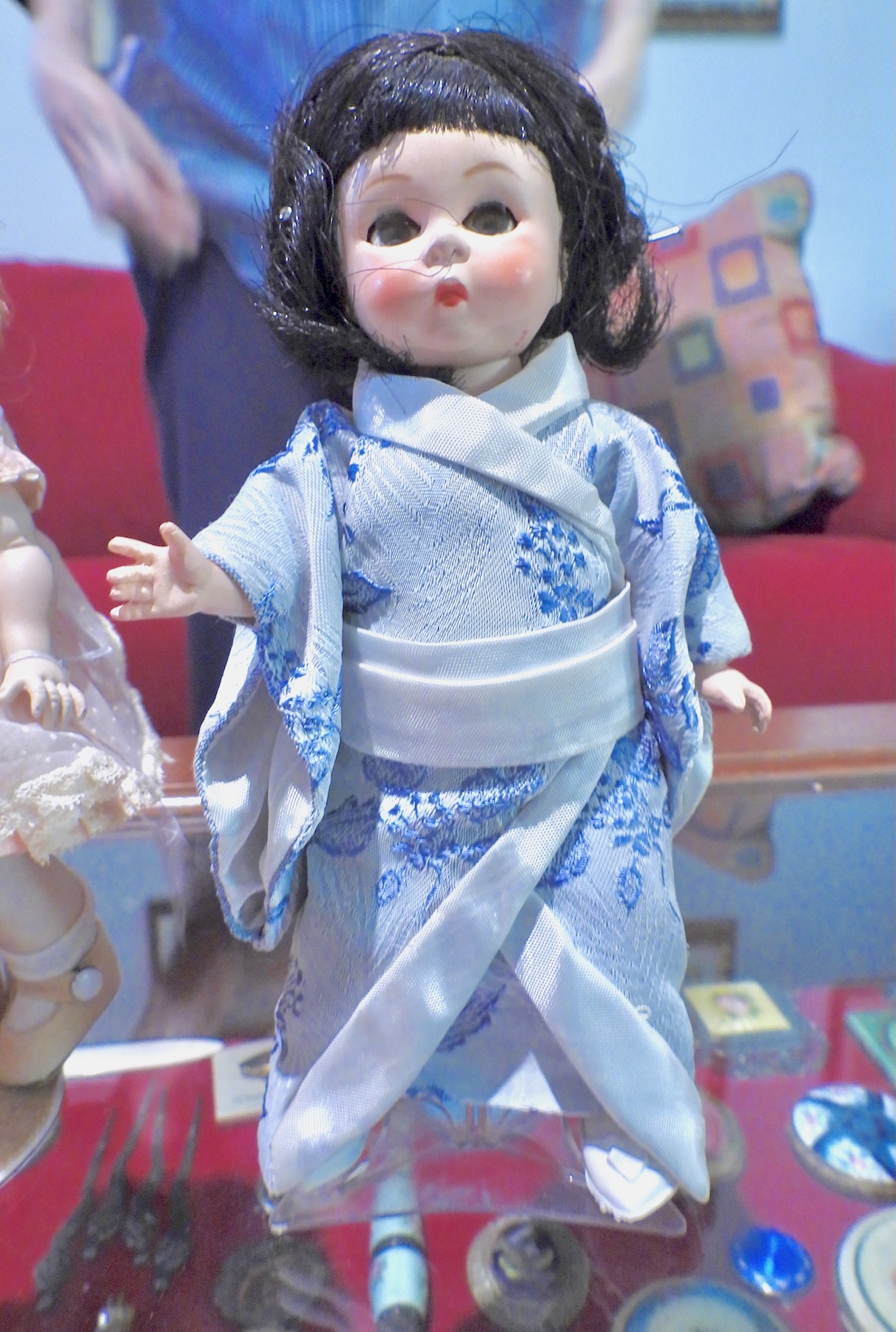
She told the club that she found this doll at an estate sale labeled as by Madame Alexander. Myrna said that although the doll did resemble the eight-inch Alexanderkins/Wendykins, her facial painting, such as the eyebrows, was different, she had a coarse black wig styled with two long pins, and she was unmarked. 


Some time later, Myrna found this doll on eBay, also dressed in a kimono, with the same facial painting, a coarse wig styled with pins, and no mark. 


Shortly afterwards, Myrna acquired these two similar dolls on eBay, but dressed in Mexican outfits. The dolls still carried their original tags, stating "Michele-ette Hecho en Mexico."


Myrna said that a doll collecting friend in San Antonio also had a pair of Michele-ette dolls, a girl in a traditional Mexican outfit and a boy dressed as a matador. She gave Myrna a copy of a newspaper article from the September 19, 1958, edition of the "Arizona Republic" about Mrs. Philip (Michele) Fauerso, the owner of the Michele-ette doll company in Mexico City. According to the article, Fauerso, at the time the owner of the Barbizon modeling agency and its associated schools, was vacationing in Mexico City, but could not find any canned dogfood for her dog. She started making her own dogfood and soon her neighbors were asking whether they could try some for their pets. Fauerso began selling the dogfood and at the end of her vacation sold the company for $10,000. In 1953, Fauerso was again vacationing in Mexico City with her husband and daughter. She told the newspaper that she dreaded returning to the rush of New York City and was looking for an excuse to stay in Mexico. Fauerso and her daughter noted while shopping that all the dolls they saw were ugly. Inspired, Fauerso took a small doll her daughter had brought with her and repainted and redressed it. Using a horse tail she bought at a slaughter house, she braided a new wig for the doll. Fauerso then took the doll to various shop owners and returned with $16,000 worth of orders. She persuaded her husband to stay in Mexico City and started her doll company.

According to the article, the business got off to a rough start with a single sewing machine and three  employees. They had to fulfill the first order for 24 dolls, but were having difficulty assembling the plastic dolls. Fauerso made a quick trip to the United States and returned with 24 plastic dolls, which were repainted, redressed, and re-wigged. In order to meet other order deadlines, Fauerso had her employees  purchase the dolls and used them the fill subsequent orders. This bought the company time to develop its manufacturing techniques. Another problem was with their employees, but over two years the company developed a trustworthy workforce of women. Fauerso told the reporter that hers was the only factory in Mexico with women bosses. The company had grown from a home business to a factory with 150 employees, 35 sewing machines, and ten injection machines. The article reported that over 200,000 Michele-ette dolls, all dressed in hand made fashions, had been produced.

Myrna speculated that the American dolls first used by Michele-ette may have been Alexanderkins/Wendykins and that the company may have later purchased molds from Madame Alexander, which could explain the resemblance between the Michele-ette dolls and the Alexanders. She noted that Fauerso and Alexander were both woman entrepreneurs from New York City and it may have been possible that they knew each other.

Myrna told the club that articles she found on the Internet in 2019 and 2020 reported that the Museo del Juguete MX  (Museum of Toys Mexico) had an exhibit of Michele-ette dolls from the 1970s. She said that it appears that the dolls are no longer being made.

Member Sylvia McDonald shared this example of an American-made hard plastic eight-inch doll, Muffy created by Nancy Ann Storybook Dolls. 


This is a Ginny doll, which started the trend for eight-inch girl dolls. She belongs to member Jenell Howell and is dressed as Davy Crockett, complete with coonskin cap and rifle.


Jenell also shared her newest BJD creation.


Member Elaine Jackson brought this hand-carved wooden Hitty doll by TC Vollum.


Another wooden doll, belonging to member Sharon Weintraub. She is a vintage "peg wooden" or Grodnertal doll dressed as a pearly queen.  Sharon explained that the "pearlies" are charity groups associated with England's working classes. They are famous for their velvet costumes covered in elaborate designs made from mother-of-pearl buttons. The doll's hand-stitched velvet dress and bonnet are covered in small mother-of-pearl buttons and tiny faux pearl beads.