
dollshow

dollshow

AUSTIN DOLL COLLECTORS SOCIETY

The Austin Doll Collectors Society is an organization of antique, vintage, and modern doll collectors, dealers, and artisans. We meet on the second Sunday of each month and our meetings are fun and educational. We begin with refreshments and socializing, and, following our brief business meeting, there is a special doll-related program and "show and tell." The Austin Doll Collectors Society is a nonprofit organization and is a member of the United Federation of Doll Clubs.

Saturday, January 28, 2023

January 8, 2023, Meeting

Member Sharon Weintraub did a program on "Weird, Wacky, and Ugly Dolls." She explained that while we tend to think of dolls as beautiful, with phrases such as "dolly face" or "she's a real doll," doll companies also created dolls that many would consider odd or ugly.  She shared a number of examples from her collection. This automaton is by Leopold Lambert and entitled "Bébé et Polichinelle." Made in the 1890s, when the automaton is wound, the little girl lifts and lowers her broken polichinelle doll as she turns her head and raises her left hand to "wipe" tears from her eyes. The character head, with squinting eyes and wide-open wailing mouth, is Mold 211 by Jumeau. 


This wicked witch, complete with many molded warts, is "Hexe," created for Cuno Otto and Dressel by Simon and Halbig as part of Dressel’s portrait doll series from 1898 through 1903. Other dolls in this series include the Farmer, Rip Van Winkle, and Uncle Sam, as well as historical figures from the period, such as Admiral George Dewey and Admiral William Thomas Sampson.


Another witch doll, with a hooked nose, wrinkled face, and painted fangs, made by the German firm of Hertwig and Company. She is dressed in her original outfit. Hertwig also offered this doll as part of a set, with two all-bisque children representing Hansel and Gretel. The little china boy is front of her is a mysterious oddity. He is molded into his chair and when a metal lever is moved in the back of the chair, he jiggles his head and arms.


This peddler doll with her basket full of tiny antique items has a German papier mache head of the type made from the 1870s through the 1890s. The head represents an elderly woman with a large hooked nose, a wide grin exposing two teeth, and wire eyeglasses. Such heads were also used for characters such as witches and Mother Goose.


The taller monkey is of early composition covered with brown mohair and his smaller companion is an all-bisque monkey. Although unmarked, Sharon stated that they were no doubt of German origin


This early all-bisque doll is two toys in one, as his hat is also a whistle.


Another unusual male all-bisque doll, this man appears to be dressed as a character from the traditional commedia dell'arte. His hands are pierced, there are loops on each foot, and another hole in the brim of his hat, suggesting that he could be strung as a simple marionette. Sharon thinks that he may have been intended to be part of a child's toy theatre.


This pair of unusual early bisque nodders features a naughty boy in a dunce cap sticking out his tongue at his primly dressed sister.


The popularity of Rose O'Neill's Kewpie doll introduced in 1913 sent German companies scrambling to create their own Kewpie-inspired dolls to try to cash in on the Kewp craze. This well-fed trio are "Happifats" dolls designed by Kate Jordan and produced by George Borgfeldt in Germany from 1913 to 1921. They were produced in three sizes of all-bisque dolls as well as a version with a composition head. Happifats were also produced in Japan and companies like Shackman made reproductions as well. The German dolls have the finest bisque and decoration and often carry a stamped “C” for “copyrighted” on the sole of one foot. 


 The little horned imp was no doubt another German company's creative answer to the rather angelic Kewpies. He has cloven hoof feet and even a tiny goat tail. The other doll is HEbee SHEbee designed by Charles Twelvetrees, a prominent illustrator of the 1920s who specialized in drawings of cute children, often with humorous captions. E.I Horsman introduced HEbee SHEbee in 1925 both in bisque and composition. The boy and girl dolls are identical, except that SHEbee has pink shoes and while HEbee wears blue ones. 


These grinning or grimacing girls were designed by Jeanne I. Orsini in 1920. The all-bisque dolls were made in Germany and distributed by George Borgfeldt. The unusual right hand with the extended pointing finger is unique to these dolls.


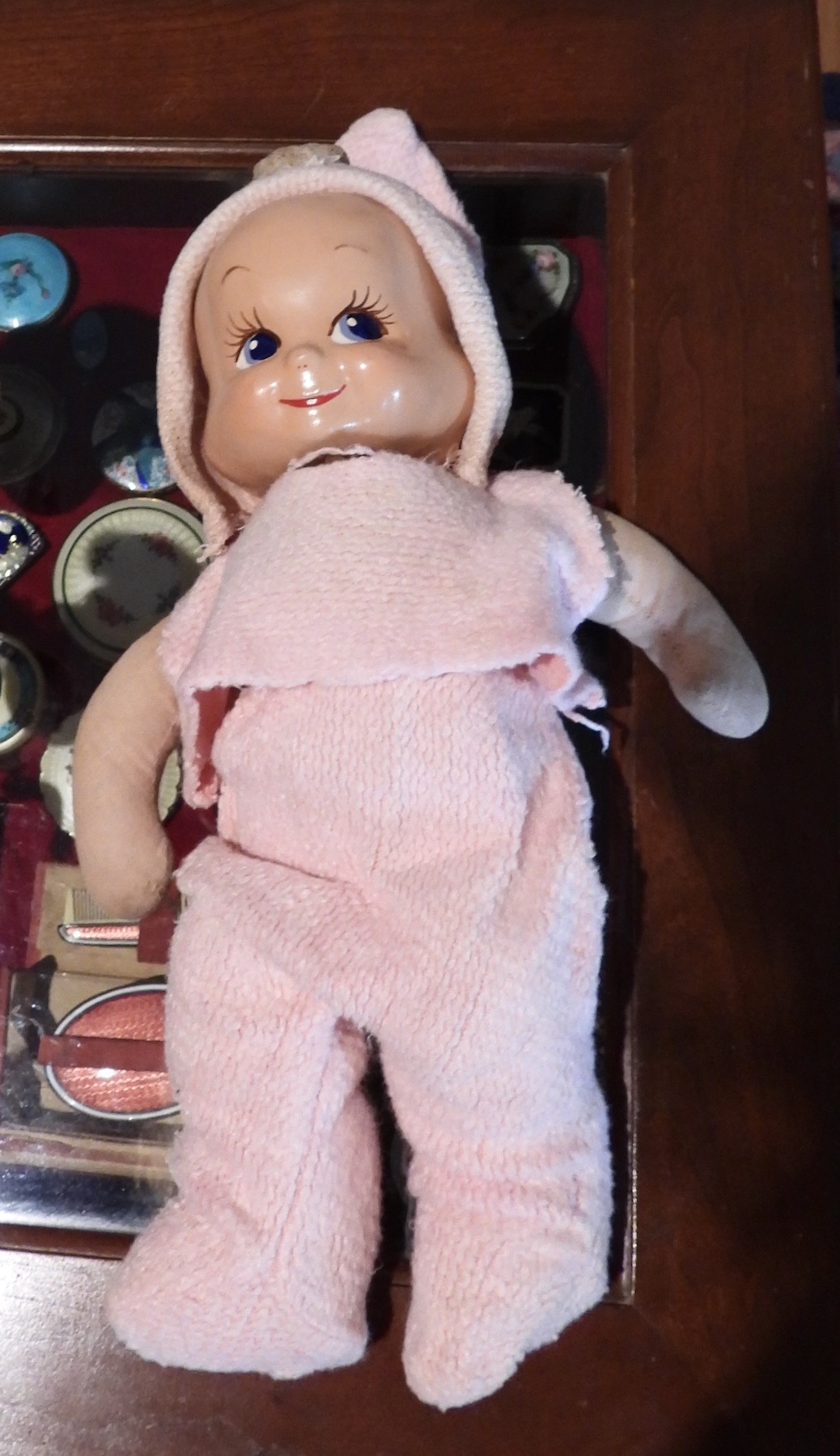
Jenell Howell shared her recent find, a Trudy doll with three faces. Trudy was introduced in 1946 by the Three-in-One-Doll Corporation and was designed by Elsie Gilbert. She has a composition head and a cloth body.

Elaine McNally brought this German doll dressed in its original Shaker costume.  Founded in the 1740s in England, the United Society of Believers in Christ's Second was a Christian sect that became known as the "Shaking Quakers" because of the dances and movements they made during worship services. A number of Shaker settlements were established in the United States beginning in the 1780s. The Shakers were known not only for their unique dress, but also for their fine arts and crafts. Shaker woman and girls dressed dolls in traditional Shaker costumes to sell to the public as souvenirs. 


Inspired by her find, Elaine created her own version of Shaker dolls. The larger doll she calls "Sister Flora." The dolls are cloth with paper clay faces. 


Elaine Jackson brought this trio of dolls created by Jane C. Furbee (1891 -1978). Little is known about this doll artist other than she started making and dressing dolls in the 1940s. The two taller dolls are wood and cloth and the one in the violet dress has a cloth tag stating that she is a "JanFer Woodee Doll."  The little girl is carved completely from wood and dates from 1970.


Kenneth Reeves shared this picture of his three R & B (Arranbee) Littlest Angels. He stated that the girl in the white dress with tiny pink flowers was made by R & B in the mid 1950s. The redhead in the center is Li'l Imp made by Vogue in 1959 and 1960 using the old R & B molds. The one in pink on the right was made by Vogue in 1963, again using the old R & B molds. He said that 1963 was the last year of production of Littlest Angel using the old R & B molds.


Monday, January 2, 2023

Holiday Party, December 11, 2022

The club celebrated its annual holiday party at the beautiful home of member Jan Irsfeld, all decked out for the holidays.


Members shared not only a delicious pot luck lunch but dolls with links to the season. Sylvia McDonald brought this "Precious Moments" doll. She is from the series "Garden of Friends" and represents December.


Myrna Loesch set up this endearing tableau of two Alexander-kins dolls by Madame Alexander celebrating the holiday of Chanukah. 


Both dolls are from the international series and represent Israel. The earlier doll from the 1960s wears earrings as well as a Star of David necklace.


The later version has only the necklace.


Jenell Howell brought this delightful wooden Santa, beautifully hand carved by the husband of former member Ann Campbell.


Sharon Weintraub brought this crocheted miniature snowman she attributed to the German company of Carol Horn.


Also by Horn are these diminutive dolls, each only about 1.5 inches high. The bearded dolls at the ends Sharon said could represent either gnomes or the traditional Father Christmas and they each have a tiny metal lantern hanging by their sides.


Sharon also shared this all-bisque Kewpie doll in its original Christmas crepe paper costume.


Nancy Countryman brought these two well-loved dolls from her childhood.


Jam Irsfeld displayed this outstanding Cissy representing representing Madame 
Pompadour in the court of King Louis XV of France. Jan created the doll's lavish and ornate winter outfit.


Under her lush cloak, Madame's gown is elaborately adorned with intricate hand beading. Jan said it took her a year and a half to complete the dress.


Another creation by Jan is her interpretation of a Cissy trunk and trousseau once offered by FAO Schwarz.  Jan made the trunk out of wooden boxes.


Saturday, November 26, 2022

November 13, 2022, Meeting

Member Sylvia McDonald gave a program on dolls designed by artist Sylvia Natterer. She began with a short history of the artist. Natterer was born in Switzerland in 1949. As a child she made her own dolls and dollhouse and later won awards in drawing and painting. She became a creative design teacher and taught students how to make puppets. Natterer became a member of the Munich puppet theater and made puppets to sell. However, Sylvia said that Natterer decided to cut the strings off her puppets and began selling dolls both as children's playthings and collectibles. In 1972 Natterer began creating dolls from wood composition or resin.


Sylvia discussed the doll artists who inspired Natterer, with examples of their dolls. These included Käthe Kruse (the tallest boy in the back in the green hat and the little girl in front of him in the red and white dress and pinafore), Elizabeth Pongratz (the girl in the navy blue knit dress with blond pigtails), and Sasha Morgenthaler (the remaining dolls pictured). Sylvia stated that Natterer was impressed by the design of the Sasha dolls and how their neutral expressions allowed children to project a wide range of emotions on to their dolls. She noted that in 1979 Natterer met Kruse's daughter Hanne Alder-Kruse and a friendship developed that led to Natterer designing two dolls for the Kruse company. Natterer was also close friends with Pongratz. 


Sylvia told the club that Natterer moved to Munich in 1975 and began creating her own molds and porcelain dolls. In 1982, she collaborated with the German company Zapf. Inspired by her own infant children, Natterer designed a large baby doll. In 1989, Natterer partnered with the German company Götz for the production of the Fanouche and Friends line. Sylvia stated that just prior to this, Natterer created an exclusive line of vinyl dolls, hand painted and dressed by her, for The Toy Shoppe in Richmond, Virginia. She explained that Götz agreed to this arrangement because it was seen as free publicity for the upcoming Götz collection. Natterer moved again in 1991 to a historical old schoolhouse in Tyrol, Austria, where she lives and works. 

Sylvia stated that Fanouche and her twelve friends were an immediate success when they hit the market in 1990. Natterer also produced other dolls for Götz. She said that the dolls are of the highest quality, with rooted hair or wigs, hand-painted features, and finely-made clothing designed by Natterer. The dolls carry the Götz mark and Natterer's "SN" signature, and came with a certificate of authenticity. In addition to her work with Götz, Natterer designed special collectible dolls with Franklin Heirloom Dolls as well as for an Italian and a Japanese company. From 1999 to 2003, Natterer designed a line of dolls for the Spanish company White Balloon as well.

Sylvia explained that Natterer's partnership with Götz ended December 31, 2003, and the artist began working with Zwergnase to continue the Fanouche line. However, because Götz would not release the doll molds to Natterer, she had to recreate the dolls, so that the two lines look very different from each other. From 2006 to 2014, Natterer collaborated with Kruse on the Minouche line of dolls. When the Kruse company was sold in 2014, the French company Petitcollin took over production of this line. 

Sylvia displayed her collection of winsome Natterer dolls.

Member Jenell Howell shared several of her Natterer dolls as well, with examples by Götz, White Balloon, and Petitcollin.


Jenell also shared this beautiful brown-eyed girl designed by Dewees Cochran. She said that this is one of the dolls she has been dreaming of adding to her collection.


Another doll from Jenell, a little Madame Alexander Alexander-kin found at the recent Settlement Home Garage and Estate Sale.


Member Bette Birdsong showed off two of her recent finds from local antique malls, a pretty-in-pink Toni doll by Ideal and a Honey walker doll by Effanbee.


Guest Jeremy Jones shared these two more contemporary porcelain clown dolls.


Member Jan Irsfeld brought this Cissette by Madame Alexander dressed as "Madame X" from the famous 1884 portrait by artist John Singer Sargent.


Sunday, October 30, 2022

October 9, 2022, Meeting

Member Jenell Howell did a program on Arranbee dolls, which she referred to as a mystery company. She explained that very few collectors are familiar with the company and that many of its dolls were not marked and can be difficult to identify. When the dolls are marked, she said that they may be branded "Arranbee,” “R&B,” or with the doll’s name. 


Jenell stated that the company was founded in 1919 by Bill Rothstein and Berman, hence the name Arranbee. By the 1930s, Rothstein was the sole owner. The company’s motto was “The dolls that sell on sight.”  The company started by importing dolls from Germany. Its most popular import was “Dream Baby’ by Armand Marseille, such as this tiny example, as well as Simon and Halbig dolls. Jenell said that sometimes the Arranbee name appears on these dolls. Arranbee also sold doll hospital supplies and doll parts. 


Around 1925 the company began manufacturing composition dolls, both under its own name and for other companies. It sold a “mama doll” named Nannette. Jenell noted that Arranbee often reused names like “Dream Baby” and “Nannette” for other dolls in its line. The company was known for quality dolls at reasonable prices. Ruby Hopf, the sister of George Averill, designed clothing for the the company’s doll line. In 1927, Arranbee formed a partnership with Vogue. This little doll in blue is an example of this partnership. 


This cute 9-inch tall cowgirl belongs to member Elaine Jackson and is an example of the company’s storybook series. 


Jenell told the club that Arranbee created the Nancy doll to compete with the ever-popular Patsy doll. The doll was made in a wide variety of sizes with painted eyes, sleep eyes, molded hair, or wigged. This example belongs to member Elaine McNally and is marked “Nancy. 


Another example of Nancy with molded hair, belonging to member Nancy Countryman. The doll is marked “Arranbee. 


Debuteen was another popular doll offered by Arranbee. This example belongs to member Myrna Loesch. Jenell stated that the doll may have been made by Vogue for Arranbee. 


Jenell shared several variations of hard plastic Nancy Lee or Nannette. She said that these dolls have pointed chins and lips painted with the right side very slightly higher than the left. Several of the dolls have floss wigs.


The ice skater has a walker mechanism. Her striped dress is
not original.


This adorable redhead is Littlest Angel, which Jenell noted is similar to “Wee Imp” by Vogue. She said that Arranbee introduced the small bent-knee toddler doll. 


Jenell stated that Rothstein died in 1957 and the following year the company was bought out by Vogue. Vogue kept Arranbee as a separate company for three years, then merged the two companies. Jenell noted that Arranbee clothing uses lots of bias tape and square snaps, and that a fichu is often part of the outfit. 

Member Sylvia McDonald brought one of her childhood dolls, this charming child in her original outfit. The doll has been purchased for her in 1946 or 1947 from White’s Auto Store and put away for her as a Christmas present. However, Sylvia came across the doll before the holiday and that is how she learned that Santa was in fact her father! 


New member Pam Hardy shared this beautiful Toni doll in its original box. She said that it was given to her by a neighbor who learned that she collected dolls. The doll belonged to the neighbor’s daughter, who had never played with it. 


Jan Irsfeld displayed this Dollikin, which she said replaced one she had in childhood. Jan also created her striking outfit.