dollshow

dollshow

AUSTIN DOLL COLLECTORS SOCIETY

The Austin Doll Collectors Society is an organization of antique, vintage, and modern doll collectors, dealers, and artisans. We meet on the second Sunday of each month and our meetings are fun and educational. We begin with refreshments and socializing, and, following our brief business meeting, there is a special doll-related program and "show and tell." The Austin Doll Collectors Society is a nonprofit organization and is a member of the United Federation of Doll Clubs.
Showing posts with label china. Show all posts

Tuesday, October 31, 2023

Rare Taufling Restored

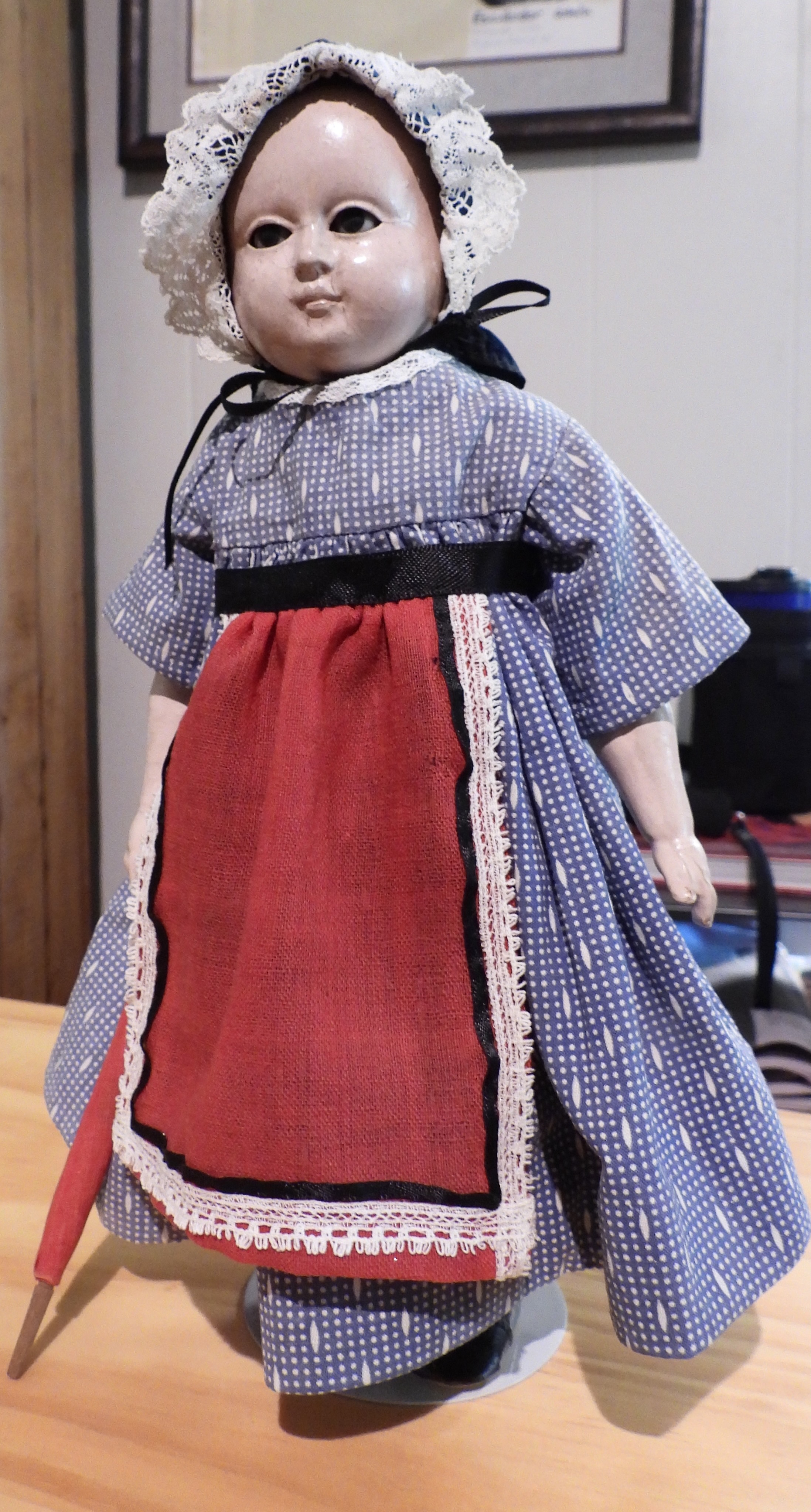
 At the our July 9, 2023, meeting, member Elaine McNally gave a wonderful program on so-called Motschmann or taufling dolls.  One of the dolls shared at the meeting was this scarce china version with inset glass eyes belonging to member Sharon Weintraub. This poor little guy was waiting to be restored, but the squeak box in his torso still worked. 


At the 2023 United Federation of Doll Clubs convention in Bellevue, Washington, Sharon found a damaged antique taufling body that was missing the head, but had intact arms and pelvis. Even more serendipitous, the parts were a perfect match to her doll. Here is the now fully restored doll.


Although unmarked, the head resembles the rare glass-eyed china head dolls made by the German company of Kloster Veilsdorf. 


Monday, July 31, 2023

July 9, 2023, Meeting

Member Elaine McNally did a program on so-called Motschmann or taufling dolls. She explained that although they are called different names by collectors and come in a variety of materials and styles, what the dolls have in common are a solid chest and pelvis connected by fabric, often covering a squeaker or voice box, and cloth inserts at the shoulders and thighs, giving the dolls the floppiness of an infant. Some dolls may also have swivel necks and jointed wrists and ankles. Elaine said that these dolls were inspired by a type of Japanese play doll called ichimatsu, which has the same "floating" limbs. In 1853, American Commodore Mathew Perry sailed into Tokyo harbor to re-establish  trade and contact with Japanese, who had closed off their country to most foreigners. Among the artifacts brought back by Perry were Japanese dolls. German companies began manufacturing dolls with similar bodies in papier mache, sometimes with a wax coating, and china. The dolls often resembled babies with round bald heads, sometimes with little tufts of hair painted by their ears, hence the name "taufling," meaning a very young infant. However, dolls also were made with hairstyles or features associated with older children. Christoph Motschmann patented a voice box that was used in many of these dolls; an early collector seeing the Motschmann name on one such doll mistakenly thought Motchmann had made the doll, when in fact he had simply designed the voice box. The tallest standing doll is an antique, while the two other standing dolls are creations by Elaine.


This doll with molded hair was a gift to Elaine from a friend. It is papier mache with a wax coating.

'

The tallest doll with a curly mohair wig has a voice box operated by a pull string and clearly cries "Papa." Standing in front of this doll is a traditional Japanese ichimatsu doll. The little doll next to her is wax over papier mache and wears her original clothing. 


Member Sharon Weintraub displayed these two Japanese ichimatsu dolls. The lady doll is unusual because most ichmatsu resemble young boys or girls and the child doll has a bisque head, rather than the traditional head with a complexion made of gofun, a smooth white coating made from crushed oyster shells. 


Sharon also shared this scarce china version with inset glass eyes. Although unmarked, the head resembles the rare glass-eyed china head dolls made by the German company of Kloster Veilsdorf. This poor little guy is waiting to be restored, but the squeak box in his torso still works. 


Member Elaine Jackson brought this example with sleeping eyes. She has a squeaker, but lacks floating hands or feet.


Member Pam Harding displayed this beautiful Bye-lo baby. She said that she had wanted one for a long time. 


She also shared this stockinette doll with large painted eyes made in 1976. The doll is supposed to represent Betsy Ross.


Member Jan Irsfeld told the club how she found, restored, and dressed this lovely Cissy doll by Madame Alexander. 


Wednesday, February 14, 2018

February 5, 2018, Meeting

For our February meeting, the refreshment able was decked out in a festive Mardi Gras theme. 


Member Sharon Weintraub did a program on frozen Charlottes and Charlies. These unjointed bisque and china children are typically frozen into a standing position. Early doll collectors dubbed these dolls "Frozen Charlottes" after the the old American folk ballad called “Fair (or sometimes Young) Charlotte,” which tells the sad tale of a beautiful young woman who foolishly refuses her mother's advice to dress warmly and subsequently freezes to death on a sleigh ride to a Christmas Eve ball. However, these figurines are actually German in origin, where they were called badekinder (bathing children). Produced in Germany beginning in the 1860s, they were offered as children’s playthings and bath toys (some, like the little boy at the top left in yellow and white striped bathing trunks will actually float when placed in water).


The little girl on the left is a bank with a slot on her back for coins.  Not too many seem to have survived, because the only way to reclaim your savings is the literally break the bank!


Although many badekinder are nude, they also can be found in molded clothing. 


Some frozen Charlottes wore wigs.


Frozen Charlottes also appear in novelty items, such as this the badekinder in a bottle.


This early china Charlotte is beautifully dressed an antique bridal gown of silk and net.  Sometimes a doll would be dressed a scraps left over from making the bridal gown to commemorate the happy occasion.


Other members brought Frozen Charlottes to share.  This diminutive doll belongs to Beverly Evans.


This tiny child is a family heirloom belonging to Elaine Jackson.


Sylvia McDonald brought this bisque-headed baby character by the Japanese firm of Morimura for show and tell.  


Saturday, July 22, 2017

July 3, 2017, Meeting

In honor of the upcoming Fourth of July, the refreshments were as American as apple pie. 


Member Beverly Evans gave a program on the history of boy dolls.  In the 1800s there were few male dolls, most simply a doll dressed as a man or boy and often serving as the groom for a bride doll or dressed as a soldier or sailor.  The introduction of character dolls by German manufacturers resulted in dolls modeled to be specifically boys. 


Beverly brought many examples of antique and contemporary boy dolls from her collection.


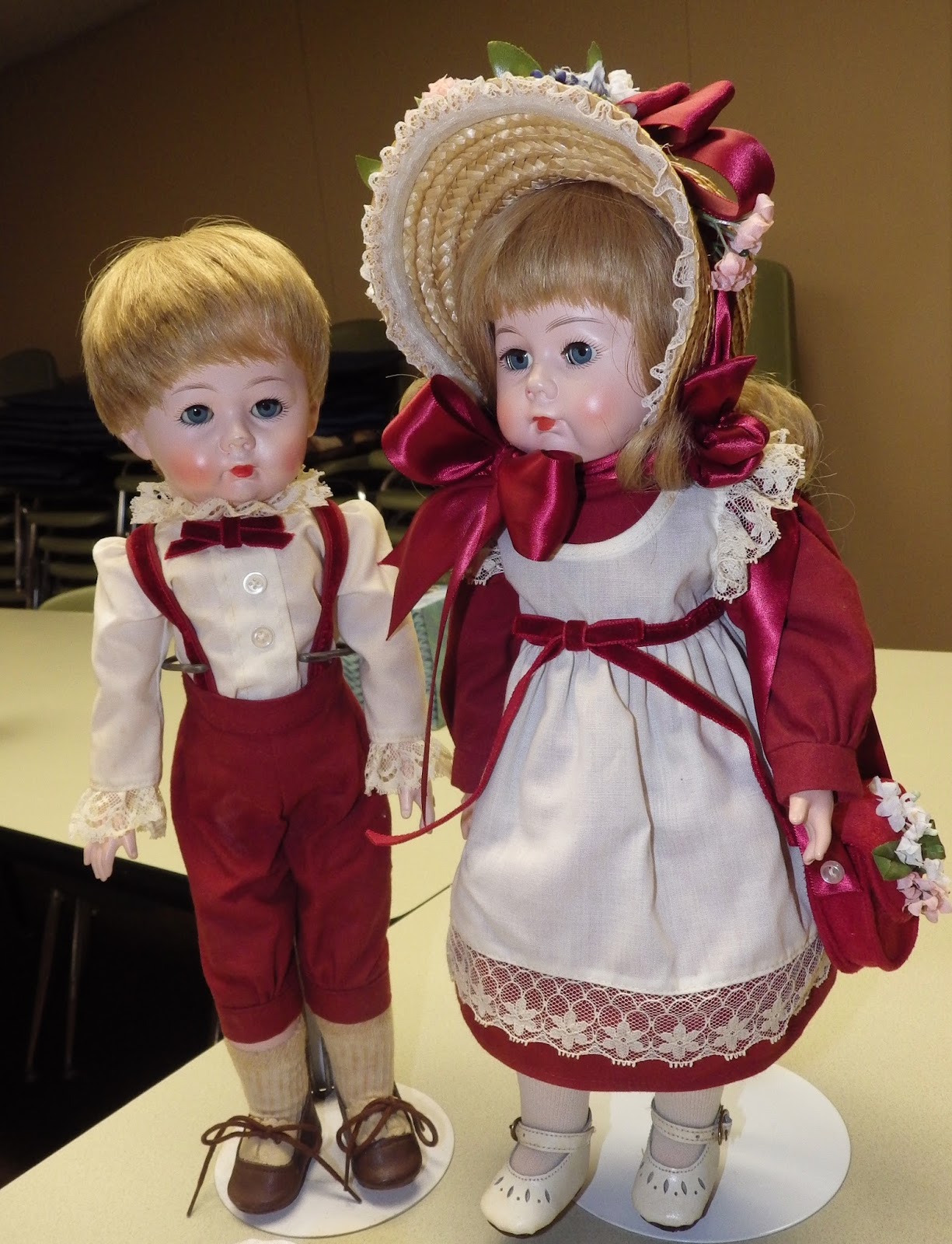
Dolls dressed as brother and sister pairs have long been popular.


Members also brought boy dolls to share.


Brenda Kaye White introduces Logan, the first boy doll created by American Girl.


Sallie Howard displays two boy dolls from Mattel.


Elaine Jackson brought this boy doll by pioneering doll artist Emma Clear.   Clear operated the Humpty Dumpty Doll Clinic in Los Angeles, where she repaired and restored dolls.  Unable to find parts for antique dolls, she began to reproducing her own, and started in the 1930s offering a variety of reproduction bisque and china dolls.  Although Clear is best known for her reproduction dolls, she also created her own character dolls, like this handsome boy.


Myrna Loesch shares Cotton Joe, an early Black character doll by Horsman.


Jennell Howell told us about Buddy Lee, an advertising doll manufactured  for the H. D. Lee Company, the maker of Lee Jeans from the 1920s though the early 1960s.  Buddy Lee dolls came dressed in detailed miniatures of Lee garments representing a variety of occupations.