dollshow

dollshow

AUSTIN DOLL COLLECTORS SOCIETY

The Austin Doll Collectors Society is an organization of antique, vintage, and modern doll collectors, dealers, and artisans. We meet on the second Sunday of each month and our meetings are fun and educational. We begin with refreshments and socializing, and, following our brief business meeting, there is a special doll-related program and "show and tell." The Austin Doll Collectors Society is a nonprofit organization and is a member of the United Federation of Doll Clubs.

Monday, March 30, 2020

Home Sweet Home

With so many of us staying close to home these days, this is a good time to explore Kara Lee Bell's delightful dollhouse.  She created the lighting using are $1 headlamps from Walmart, held in place by velcro.


She already had this itty-bitty baby doll, who fit perfectly into the wee walker.


The other residents are dolls inspired by the computer-animated series Spirit Riding Free, produced by DreamWorks Animation Television.  Not only are the dolls the right scale, they have jointed knees and can even hold things! 


Tuesday, March 24, 2020

Oh Baby!

A second entry in the Austin Doll Collectors Society's virtual doll meeting challenge.  With events and meetings cancelled, social distancing, and many people staying close to home, our members are urged to engage in a virtual meeting by sharing their dolls and doll-related activities on-line.

This bevy of beautiful bisque-headed baby dolls belongs to member Sylvia McDonald.  The first doll on the left is from the Japanese firm of Morimura Brothers.  When German doll exports were interrupted during WWI, the Japanese entered the doll market, often directly copying popular German bisque dolls.  The doll next to him was painted by Rebecca Clay Stewart and has a Real Seeley body.   The next two babies are German.  The one with a cap covering his bald dome head is by Hertel Schwab and the brunette baby is Mold 750 by Armand Marseille.  Sylvia says that the sweater worn by the Armand Marseille doll was made for her childhood dolls by her grandmother and is probably 70 to 75 years old! 


Saturday, March 21, 2020

Wee Wooden Doll

With events and meetings cancelled, social distancing, and many people staying close to home, the Austin Doll Collectors Society has challenged its members to engage in a virtual doll meeting by sharing their doll activities on-line, from rearranging their collections, showing off their repair or redressing projects, or simply displaying their latest treasure.  We start off with this marvelous miniature belonging to member Sharon Weintraub.

Just 2.75 inches high, this diminutive wooden doll is jointed at the hips, shoulder, elbows, and knees.  The little guy came in an old New Haven watch box with the fragile fragments of his original suit of aqua silk trimmed with tiny tarnished golden cord; all that remains intact is a cream silk shirt front, lace underpants, and his delightful hat. This type of antique jointed wood doll is most likely from the Grodnertal region of Germany and dates from the early to mid-1800s.  Collectors sometimes refer to these dolls as "peg woodens" because of the wooden pegs allowing their joints to move.  He is what some collectors call an "alien head," as his head appears to be molded papier mache or composition instead of carved wood. 


Friday, March 13, 2020

March 2, 2020, Meeting


Member Myrna Loesch did a program on vintage Elise dolls by Madame Alexander.  Her source of information was The Elise Files by Kiley Ruwe Shaw.  Myrna told the club that in 1955, Madame Alexander introduced Cissy,  the first American fashion doll with an adult figure. Two years later, in 1957, Madame Alexander introduced Cissette, a miniature 10-inch tall version of the 20-inch Cissy, and the 16-inch Elise.  Elise was a softer, more youthful version of Cissy with a teenage body. Madame Alexander knew that the popular dolls of the day were brides and ballerinas. Elise was the first doll produced by Madame Alexander that had jointed ankles, which allowed the doll to pose in numerous ballet positions.  At FAO Schwartz, an Elise dressed as a ballerina retailed for $12.95 and as a bride for $15.95.  By comparison, a Sweet Sue 14-inch walker with jointed ankles like Elise sold for $8.97 to $11.97 at Sears.  A trunk set at FAO Schwartz for Elise sold for $42.50 while a trunk set for a comparable doll at Sears sold for $17.95.  A basic Elise doll in a chemise sold for $8.50 in 1957.

Elise was sold from 1957 to 1964. The early Elise dolls had wide or saddle hips as they were walkers. Later Elise dolls had narrow hips and were completely strung with elastic. Madame Alexander used several different molds. All of the vintage Elise dolls had the multi-jointed bodies. The earliest version of Elise had a painted head with a softer blush.  In 1957, the company transitioned away from painted heads to infused plastic heads with the skin tone mixed into the plastic and a “high color” blush. In 1959, a new face was introduced for the Sleeping Beauty doll, which was made for only one year. Around 1960, the infused plastic heads appeared a bit more translucent, almost waxy, and had a softer chin. The 1961 infused plastic head had a more mature look, but as the company was using up their stockpile of heads, many of the previous variations can be found with the “1961 look”. The Maggie Mixup doll used the 1961 Elise face, but came with a red wig with straight bangs and always had freckles. In 1962, the vinyl “Marybel head," a smaller version of the Kelly doll head, was introduced. The 1963 to 1964 vinyl head Elise was the last head produced for the vintage Elise doll. 

The vintage Elise dolls had saran wigs with a cloth wig cap. The early dolls largely had a curled bob or hair from the sides pulled back and held in place with a metal spanner bar in blonde (tosca), brunette, or redhead.  In 1961, a short-styled  bubblecut wig was used.   The 1962 Marybel head had a blonde or brunette wig styled in the manner of Jackie Kennedy’s hairstyle. 

As Elise was a teenager, her wardrobe contained fewer evening gowns and focused more on a wide range of day wear.  Elise’s clothing was beautifully constructed of the high-quality materials that Madame Alexander is known for.  The wardrobe included bridal, evening, and garden gowns, ballerina outfits, an assortment of dresses, and various lingerie items as well as an assortment of separates. Elise portrait dolls included Sleeping Beauty, Godey, Queen Elizabeth II, Renoir, and Scarlett.  Elise’s clothing is identified by a label sewn into the clothing; however, not all pieces are tagged. The printing on the tags is red, yellow, or blue, with “Elise” in script. It is not known if the color of the tag was random or if it was tied to distribution. The type of script used in the last tags from 1960 is different and Elise is followed by an asterisk with no quotation marks. 

Original shoes for Elise came with spike heels for when her feet were arched and kitten heels for when her feet were not. The spike heels were used under formal and bridal gowns, as well as with some dolls sold in day dresses.  Shoes are hard to find for Elise as she was often sold as a ballerina wearing dancing slippers; however, reproductions are available on eBay and Etsy.  Elise also had a wide variety of hats which either came with an outfit on the doll or were sold separately.  Madame Alexander’s hats were largely made of synthetic straw with flowers and ribbons attached with small staples instead of glue.  Hats for Elise are approximately 6 inches across with the crown opening measuring 3 inches or less; the outer brim measures 17 inches around. 

Elise’s size of 16-inches made her a tricky sell in the doll market as most inexpensive clothes were designed for the 14-inch or 18-inch tall dolls. The 20-inch Cissy could wear clothes that fit Sweet Sue, Miss Revlon, and numerous other dolls.  Patterns were also readily available for 20-inch  dolls. Ultimately, it was the entrance of the 11-inch Barbie fashion doll with a price tag of $3.50 that was the demise of Cissy, Cissette, and Elise.   1964 was the last production year for the vintage Elise.


(Thanks to Ann Meier for the photographs!)

Wednesday, February 19, 2020

February 3, 2020, Meeting


The refreshment table was decked out in red and covered with sweet treats in honor of upcoming Valentine's Day.


Beautiful vintage Madame Alexander Cissy dolls from member Myrna Loesch, each offering a heart-shaped candy box, decorated the tables.


Member Sharon Weintraub did a program on Gebruder Heubach character dolls.  She told the club that Brothers Christopher and Phillip Heubach purchased an established porcelain factory in1840 in Lichte, Thüringia, Germany (Gebruder means brothers).   In 1882, the company registered its mark of a sunrise symbol with "GH" inside.  The factory produced porcelain figurines and other decorative objects, with the first mention of the production of doll heads occurring in 1910.  The factor produced bisque character heads and all-bisque dolls, often using sculptors from nearby art school.  In 1910, the company registered another mark of Heubach in a square. The company declared bankruptcy in 1938.

Heubach supplied bisque doll heads to other factories, which helps explain why the heads are found on a wide variety of bodies and why some heads may be found with no marks.  The bodies range from very cheap crude composition or cloth to higher quality kid and ball-jointed bodies. High production at the factory lead to worn molds, so mold numbers were blurred or lost.   This causes confusion among modern collectors trying to authenticate a doll. However, Sharon said, even with missing mold numbers, there is no mistaking Heubach’s style.  For its painted-eye characters, Heubach used intaglio eyes, in which the iris is indented, giving the eyes depth.  The all-bisque dolls have starfish hands with the middle and ring fingers jointed. 


These three Asian character dolls are called Chin-Chin.  They are each 4.5 inches tall and faintly incised under their feet with the Heubach square mark.  The girl has her original paper labels


This 7.75 inch tall Heubach smiling girl is called "Coquette."  She has pillar legs.


This 8-inch tall version of Coquette has jointed legs.  There are no visible marks.


Wearing her original ethnic costume, this 8.25-inch tall girl is incised on her back "9558" and "3." 


Known among collectors as the "three-bow girl," this charming child is 9 inches tall and incised "10490//3" on the small of her back. 


Heubach used precolored slip for some of its bisque heads, the slip already having a pink or skin tone.  This 3.75-inch tall Coquette shoulderhead is made of a pale pink precolored bisque.  The head is incised on the back with square Heubach mark and “1” over “Germany” and “7856.”   There is also a small green artist’s mark; these green marks are often found on Heubach heads.


These two googly-eyed kitties each carry the Heubach square mark on the back of their necks.  They are 6 inches tall, have composition bodies textured to look like fur, and wear their original outfits.


Heubach also made dolls with glass eyes.  This 9-inch tall Gebruder Heubach 6971 character head is on a good quality composition and wood ball-jointed body. 


This 11-inch tall doll has a bisque head on a 5-piece flapper body and wears her original dress. The head is incised “8192 Germany Gebruder Heubach G 5/0 H.” 


The 8192 flapper mold was made in a variety of sizes.  This petite example belongs to member Sylvia McDonald.


This 11.5-inch tall bisque pouty child is on a good quality ball-jointed composition body.  The bisque head carries the Gebruder Heubach sunburst mark and there is a blurred "Holtz-Masse" red stamp on the body, indicating that this head was supplied to the German firm of Cuno and Otto Dressel.


These lovely ladies have bisque shoulder heads on crude fabric bodies with composition limbs. Early collectors mistakingly thought the bodies were replacements and put the heads on what they thought were more appropriate fashion leather bodies. The lady in white is incised "7926 " and has a closed mouth.  Her sister is 12.25 inches tall and has an open mouth with four tiny teeth. She is mostly likely mold 7925.


Sharon warned members that after the fall of the Berlin, high quality reproduction Heubach characters suddenly started appearing on the market. Originally, they were offered as “reissues,” but soon some German dealers began offering rare "all original" Gebruder Heubach characters, often in what was claimed to be their original boxes. The heads also began appearing on elaborate candy boxes and other fantasy items.  Many are offered on eBay or appear at auctions. Some of these dealers seem to have an endless supply of rare all-original dolls, especially when one considers that the Berlin Wall fell in 1989 and by this time every nook and cranny of every old factory and warehouse in the former East Germany has been thoroughly searched. Yet these sellers appear to have warehouses of them, all looking suspiciously fresh for something that is supposed to be around a century old. Sometimes the boxes are a bit battered, but the dolls look as clean and bright as the day they left the factory (which was most likely last month). Although the clothing is supposed to be nearly a century old, there is no fading, surface dust, or melting.  The Heubach character heads are also appearing on crank automatons attributed to the German company of Zinner and Sohne.  Zinner made inexpensive toys and used dolly-faced heads on its creations.  Sharon said authentic Heubach heads were used on rather crudely made dancing or toddling automatons.  This example has a cardboard and wood cone-shaped body on wheels and when wound, spins in little circles.  The head is incised with he Heubach sunburst and ""7604."  On the bottom of cone, written in a childish scrawl with pencil, is "Altis 1912."  In another version, the doll actually "walks" by rocking back and forth on unsteady legs.


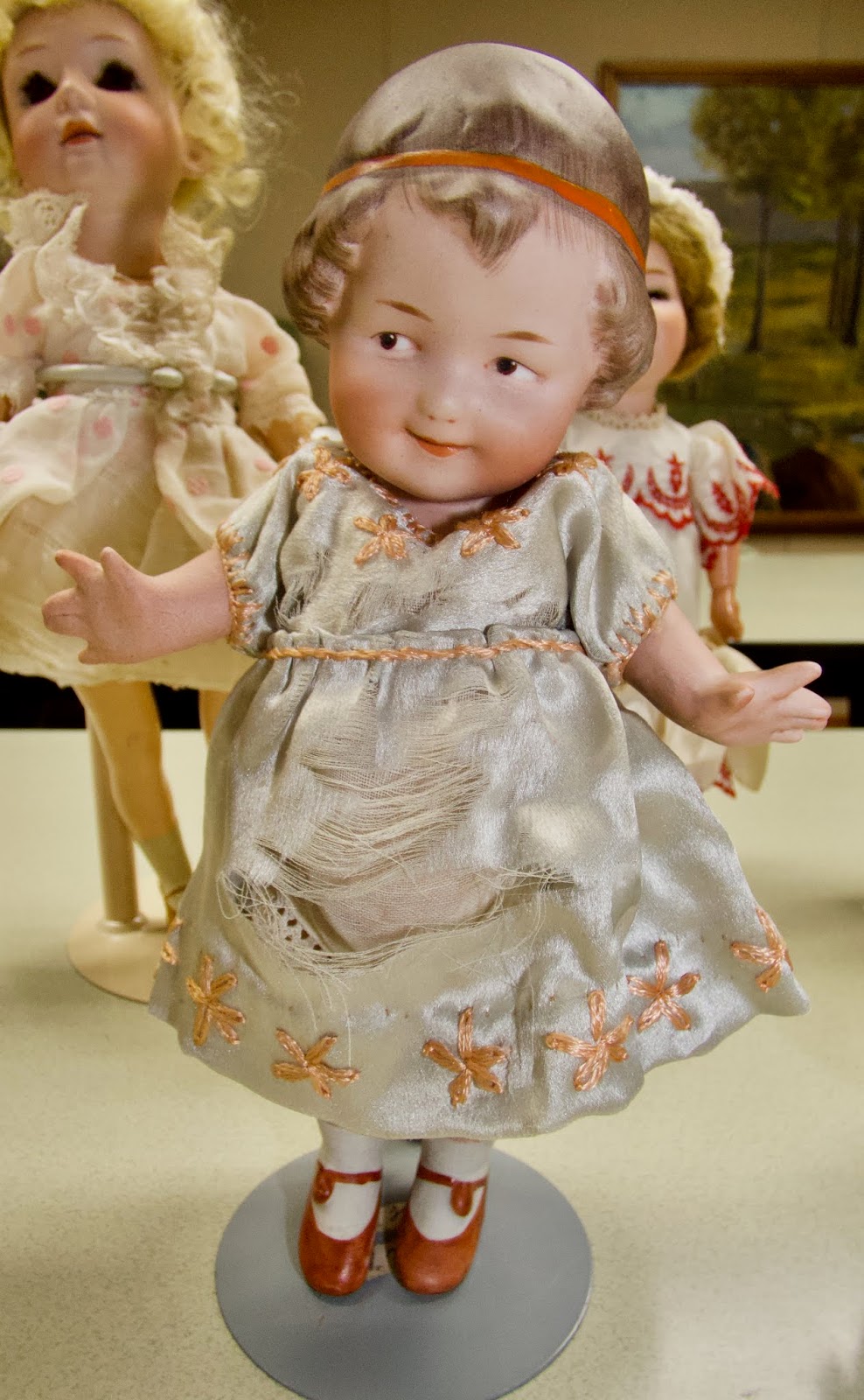
This Heubach character boy  belongs member Elaine Jackson.  His mold was worn when he was cast, so his features are not as sharp and some of the details lost.  There is no mold number.  She also brought the little all-bisque girls to share.


\


Wednesday, January 15, 2020

January 6, 2020, Meeting

Member Beverly Evans did a program on the history of Madame Alexander dolls.


These dolls belong to Beverly.   Just 5 inches tall, they are part of the Alexander Madame miniature porcelain collection, produced only in 2000.


Member Bette Birdsong brought this composition Princess Margaret.  Pretty in pink, this doll dates from the 1940s.


Member Myrna Loesch  shared this vintage lady in a lacy peignoir.  The doll is Cissy, introduced in 1955.  A sophisticated fashion doll, her shapely female figure caused some consternation.  Member Jan Irsfeld made this sultry sleepwear.  


This is Cissette, a miniature version of Cissy introduced by Madame Alexander in 1957.


Myrna also brought this example of a more contemporary Cissy.  Called "Coquette Cissy," she is 10 inches tall and has painted eyes.


Member Sylvia McDonald brought these Madame Alexander dolls from her childhood.   The doll in yellow is Wendy Ann and Sylvia received her for Christmas in 1949.  Although the doll is wearing the dress she originally came in when she was purchased, the dress is labeled "Polly Pigtails," another Madame Alexander creation.  Sylvia thinks that either there was an error at the factory or the dresses were switched at the store.  The following Christmas brought Sylvia the smaller doll, Beth from the Little Women series. She has the Maggie face mold.  The toddler in green is Little Genius, a gift from Sylvia's parents in 1961.  Sylvia said that her parents told her that this would be her "last doll."  Sylvia has gone on to acquire many dolls since then.


Member Jenell Howell brought this doll, Elise, from the mid-1960s.


This all original vintage 20-inch tall Cissy is one of the dolls in the banner of the club's Facebook page.  She wears Style 2082 from 1956, also known as "pink ribbons and roses."