
dollshow

dollshow

AUSTIN DOLL COLLECTORS SOCIETY

The Austin Doll Collectors Society is an organization of antique, vintage, and modern doll collectors, dealers, and artisans. We meet on the second Sunday of each month and our meetings are fun and educational. We begin with refreshments and socializing, and, following our brief business meeting, there is a special doll-related program and "show and tell." The Austin Doll Collectors Society is a nonprofit organization and is a member of the United Federation of Doll Clubs.

Tuesday, May 7, 2024

April 14, 2024, Meeting

Member Jan Irsfeld gave a program regarding how she became interested in courture fashion and was inspired to create versions for Cissy by Madame Alexander. Jan said that in her late teens she began pulling out pictures from fashion magazines of dresses she found interesting. After meeting with a Neiman Marcus employee, Jan said that she was inspired to start creating her own doll-sized fashions. At first she used regular patterns, but changed them to make them unique. When Madame Alexander came out with a catalog of Cissy fashions, Jan tried copying them. While living in Las Vegas, Jan discovered a specialty fabric store that provided fabric for Las Vegas shows and she also began learning how to hand bead dresses, as well as how to create her own patterns. She displayed several examples of her exquisite hand-beaded fashions.


This is Jan's version of the famous beaded dress Marilyn Monroe wore when she sang "Happy Birthday" to President John F. Kennedy.


Jan also displayed several gowns made with fabric she found at the Las Vegas store, demonstrating how the fabric can be used to design a dress. This gorgeous gown was created from fabric made of woven ribbons. She said the dress reflects the more polished look of fashion from the 1990s through the 2000s.


Jan also displayed detailed dresses that she had copied from fashion magazines.


Jan told the club that this doll was inspired by a 15-year-old Spanish fashion model who uses a wheelchair.


Jan brought this Cissy wearing an example of the couture ensembles created by Madame Alexander.


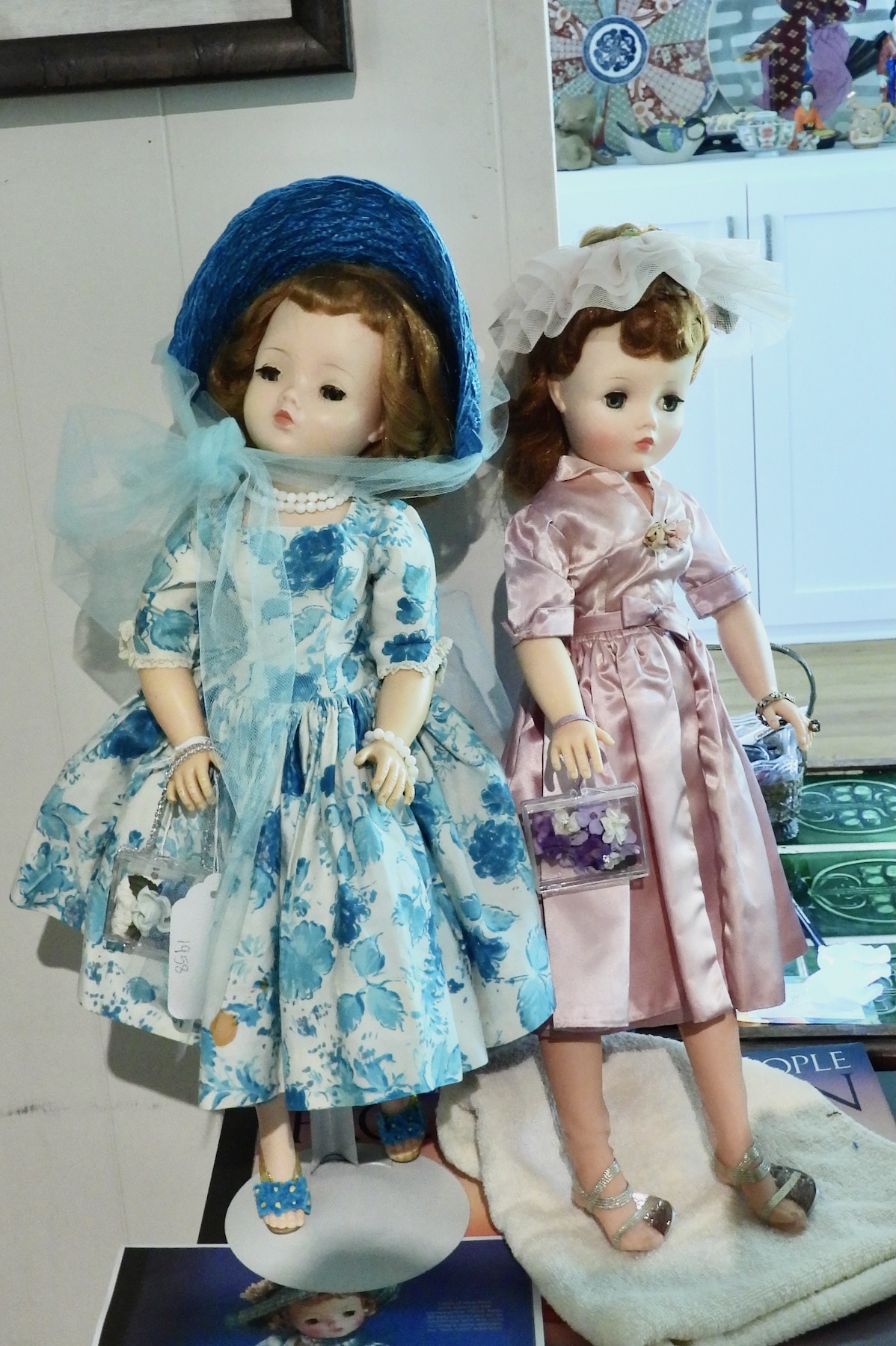
Other members also shared examples of dolls outfitted in high fashion. The vintage Cissy doll in blue is the childhood doll of member Myrna Loesch. While the dress is original, the hat and shoes are replacements. The Cissy in pink belongs to member Sylvia McDonald. She told the club that the outfit, which dates from 1957, was originally blue!

Another vintage Cissy, belonging to member Sharon Weintraub.  Her all-original outfit is Style 2082 from 1956. 


Member Elaine Jackson shared two beautifully dressed ladies. The one in blue was carved by doll artist Floyd Bell and represents Miss Jane Pittman, the heroine of the 1971 novel The Autobiography of Miss Jane Pittman and was dressed by Charlotte Semple. The other doll is an antique German fashion lady dressed by a woman who also designed costumes for the Austin opera company.


Member Nancy Countryman brought this Barbie from the couture collection called "Portrait in Taffeta" from 1996.


She also shared this other Barbie which she believes is dressed in a hand-made outfit.


Member Jenell Howell displayed several dolls from Integrity Toys, which makes several different lines of 12-inch collectible fashion dolls dressed in haute couture.


Jenell stated that she is attracted to the attention to detail, from zippers to jewelry.


Member Pam Hardy shared this all-original Cissette doll from her childhood. She told the club that a friend's mother took her to a toy store for her birthday in 1956 so that she could choose her own doll.


Monday, April 1, 2024

March 10, 2024, Meeting

Members were asked to bring a new doll or a doll that has special meaning for them. Pam Hardy brought this cute porcelain doll by artist Donna Rupert. She told the club that she had bought the doll when her granddaughter was born. Her granddaughter is now 18 years old. 


Jan Irsfeld shared this stunning Cissy. She said that when she first moved to Austin, her doll collection was packed away. Jan visited a local doll shop and found this Cissy. She created the gorgeous hand-beaded gown for her,


Bette Birdsong received this charming child from Jenell Howell as a thank you gift for helping Jenell sort out a doll collection. The vinyl doll is by the Spanish company Famosa and winks when you squeeze her tummy (Bette calls her "Winky").


Jenell brought this Elise by Madame Alexander that she is currently restoring. 


Elaine McNally shared this comic wooden German character. 


She also brought this Hitty doll that she carved and dressed. Elaine said that she tried to make the doll resemble the illustrations in the book. Also, her dolls were recently featured in "Doll Castle News" in an article entitled  "Tiny Texas Treasures." 


Sylvia McDonald brought this doll by German artist Elisabeth Pongratz. The wooden doll is hand-carved  and has spring joints that allow her to pose without a stand. Her wig is real hair and her dress is crocheted by hand.


Myrna Loesch rescued this early composition baby doll from an estate sale. She said that it reminded her of a childhood doll.


She also brought this very well loved carved-hair Schoenhut, which dates from 1912 to 1918.


Myrna told the club that this antique papier mache head doll has special meaning for her because the doll was given in 1883 by a grandfather to his granddaughter with the last name of Bader. Myrna said that Bader was also her grandmother's name. 


Sharon Weintraub brought two dolls she recently added to her collection. This bisque-headed clown doll was purchased at a local antiques mall. It is by the French company Jules Steiner and appears to be all-original.


She also has shared this unusual Black German all-bisque doll.


Elaine Jackson brought this collection of carved wooden dolls created by Austin artist Nancy Grobe, who was once a member of our club. Nancy eventually had to give up carving because of arthritis and became a skilled painter.


Friday, March 1, 2024

February 11, 2024, Meeting

Member Elaine Jackson lead the program, which was on books and dolls. She started out with one of the most famous books featuring a doll, Hitty. Hitty is the wooden doll heroine of Rachel Field's 1929 children's novel, Hitty, Her First Hundred Years. In the book, the eponymous Hitty (short for Mehitabel), a simple wooden doll carved by a peddler in the 1820s, narrates her adventures over her century of existence. Jackson explained that Fields was friends with illustrator Dorothy Lathrop and sometime in the 1920s, while strolling together in New York City they saw a small time-worn wooden doll in an antique shop window. All the shop owner could tell them about the doll was that she was at least 100 years old. Neither woman could afford the doll by herself, so they pooled their resources and purchased her jointly. Inspired by the diminutive doll, they created a history for Hitty, written by Fields and illustrated by Lathrop. The book was a success and was awarded the John Newbery Medal of Excellence in 1930.

Elaine discussed several other books with dolls as protagonists, including the famous Raggedy Ann series, the first book published in 1918 by Johnny Gruelle, a cartoonist and illustrator, and The Legend of the Bluebonnet by Tomie dePaola, in which a young Comanche girl sacrifices her beloved doll in order to bring much needed rain and is rewarded with the creation of the bluebonnet flowers. Another doll whose book won the Newberry Medal was Miss Hickory. Published in 1946, the main character is a doll made out of twigs with a hickory nut head.


Elaine shared two artists' interpretations of Miss Hickory and Hitty. 

Member Elaine McNally displayed her latest creation, this cloth frog doll she made using one of the original molds from artist Martha Chase for her series of dolls based on the book Alice in Wonderland. This mold was originally used for the frog footman.


Member Myrna Loesch shared the book, The Lonely Doll by photographer and author Dare Wright. Her version of Edith, the lonely doll of the book, is by Madame Alexander, but Myrna noted that the original Edith was actually a cloth doll by Lenci.

Member Kenneth Reeves discussed several books featuring dolls, including Little Mommy by Little Golden Book which features a little girl learning how to be a mommy by playing with her dolls, and The Doll's House by Rumer Godden about two little girls repairing a doll house they find in an attic. He also brought this Madame Alexander doll based on the story of Rapunzel. . . 

and this Effanbee doll portraying Sleeping Beauty. 

And finally, he presented a doll reading a book. This is Emma by Richard Simmons, but Kenneth replaced the mirror she once held with a book.

Member Sylvia McDonald brought the little girl in brunette braids who represents Pollyanna. The little wooden Pinocchio is a doll she inherited from a relative.  The other two little girl dolls are Muffie dolls by the Nancy Ann Storybook Doll Company belonging to member Pam Hardy.


Sylvia brought this book, Mimi, based on the famous painting "Doctor and the Doll" by Norman Rockwell. . . .


as well as these dolls based on the same painting by Rumbleseat Press.


She also discussed several doll related books, including the book Madeline by Ludwig Bemelmans about a little French schoolgirl, with the cloth doll it inspired.


Jan Irsfeld shared this Cissette doll by Madame Alexander representing Morgan Le Fay from the King Arthur legends.


Member Kathie Tovo brought a Raggedy Ann book that belonged to her mother and two cloth Raggedy Ann dolls. The larger doll is homemade while the smaller may be by P. F. Volland Company, which made the first commercially produced Raggedy Ann dolls beginning in 1918.


She also displayed doll related books from her collection, including the Racketty-Packetty House by H. Burnett, first published in 1906.


Kathie said that this German peg-wooden doll reminded her of the wooden dolls who lived in the Racketty-Packetty house.


Member Sharon Weintraub shared several books. The Better Homes and Gardens Story Book belonged to her as a child and includes "The Story of Live Dolls" by Josephine Scribner Gates. The tiny green book was published in 1863 and the full title is The Dolls' Surprise Party. The blue book is entitled The Story of the Little White Teddy Bear Who Didn't Want to Go to Bed.


Saturday, February 3, 2024

January 14, 2024, Meeting

Member Jenell Howell did a program on doll designer Joseph Kallus. 


She said that she was inspired by member Elaine Jackson's collection of segmented composition and wood character dolls. Jenell explained that George Borgfeldt and Company in 1912 contracted with Rose O'Neill to produce dolls and figurines based on her Kewpie characters and the company advertised for a sculptor to make a model. Kallus, a 17-year-old student at the Fine Arts College of Pratt Institute in Brooklyn, submitted a plaster model and was hired to design the dolls. This began Kallus' long and creative career in doll design. When WWI disrupted the import of German bisque dolls, he founded the Rex Doll Company in 1916 to produce composition Kewpie dolls that were distributed by Borgfeldt. Rex Doll also made composition carnival dolls that were distributed by the Tip Top Company. Two years later Kallus received his first copyright for his design of Baby Bundie. 

Kallus became president of the Mutual Doll Company in 1919, which produced not only composition Kewpies and Baby Bundie dolls, but also Bo- Fair, Dollie and Vanitie, which had specially designed joints. He resigned from Mutual in 1921 and the next year established the Cameo Doll Company, which existed until 1982 when Kallus assigned all his properties to Jesco, Incorporated. Cameo produced Kewpies for Borgfeldt, as well as Baby Bo Kaye and the comic strip character Little Annie Rooney.  Many of the dolls and toys created by Cameo through the late 1940s had composition heads and segmented wood jointed bodies. Examples of these unusual and creative dolls include Joy, Pinkie, and Margie. Kallus also designed dolls for other companies, such as Felix the Cat for Schoenhut and Pinocchio for the Ideal Novelty Toy Company, cartoon characters such as Popeye and Betty Boop, and even company advertising mascots, such as the Hotpoint Man.

In 1944, Rose O'Neill died and Kallus was assigned the rights to Kewpie, and later to Scootles and Ho- Ho. Over the years Kallus would license, or attempt to license, Rose O'Neill designs with companies such as Strombecker of Chicago, Milton-Bradley, Incorporated, and American Character Doll Company, but Kallus was difficult to work with, demanding and litigious.

 In 1976, thieves broke into Kallus' home and stole his original models for Kewpie and other dolls, as well as other materials. By the 1980s, Kallus was struggling to protect his Kewpie patent from companies and individuals making unauthorized copies. In 1982, he started negotiations to sell the rights to Kewpie to Jesco, but on June 26th, he was fatally struck by a vehicle while crossing the street. Kallus' daughter completed the transfer. The following year, Jesco started making Kewpie dolls. 

Jenell brought this bisque Kewpie. The Kewpie started Kallus' long career in dolls. 


This example of a composition Kewpie by Cameo was the childhood doll of member Sylvia McDonald. The doll is wearing a dress crocheted by Sylvia's grandmother. Sylvia members her parents struggling to restring her beloved doll with a strip of rubber from an old tire inner tube.


Two all composition examples of Scootles, another Rose O'Neill character, made by Cameo. These dolls belong to Jenell.


Examples of Felix designed by Kallus for Schoenhut. One belongs to member Bette Birdsong and the other to Sharon Weintraub.


Kallus designed this Pinocchio, as well as other Disney characters, for Ideal, as well as Knickerbocker. This example belongs to Jenell. 


Two examples of the Margie with segmented wood joints. The doll in blue belongs to member Myrna Loesch and the red clad doll was shared by Elaine Jackson.


This is Pinkie, who belongs to Elaine.


Elaine also brought this example of "Sunny Sam," a "Flexy" doll designed by Kallus for Ideal. His arms and legs are bendable springs. 


This "Kewpie Gal" also belongs to Elaine. She was issued by Milton Bradley under contract with Cameo in the 1970s.