dollshow

dollshow

AUSTIN DOLL COLLECTORS SOCIETY

The Austin Doll Collectors Society is an organization of antique, vintage, and modern doll collectors, dealers, and artisans. We meet on the second Sunday of each month and our meetings are fun and educational. We begin with refreshments and socializing, and, following our brief business meeting, there is a special doll-related program and "show and tell." The Austin Doll Collectors Society is a nonprofit organization and is a member of the United Federation of Doll Clubs.

Monday, January 27, 2025

January 12, 2025, Meeting

Member Sharon Weintraub did a program on German male bathing beauty figurines, whom she called "beach beaus." She told the club that German companies did make male bathing beauties, but in far fewer numbers than their female counterparts.

Sharon said that many beach beaus appeared as comic figurines. Posing proudly by a small vase or match holder, this male bather stands over the caption “Gaze on me Girls.” He is from the firm of Schäfer and Vater, founded in 1890. Underneath he is incised underneath with Schäfer's crowned sunburst mark and "9593," as well as stamped "Made in Germany.”


Also by Schäfer is this pair of real swingers. Sharon told the club that  their legs are hinged with wire, so that they can swing back and forth. 

Sharon called these two mature beach beaus nodding acquaintances, as their bisque heads bob up and down. The man in blue stripes is incised on the back edge of both his head and robe “9273," while his companion is similarly marked “9274."


Sharon noted that not all beach beaus were comic characters. This pair of bisque vases feature a man and a woman dressed in matching red and white bathing attire. She had the bathing beauty preparing to dive in her collection for many years, but later came across the male mate at a local estate sale.


Sharon told the club that in 1879, Italian artist Odoardo Tabbachi created a marble sculpture entitled "La Tuffolina" (the diver), featuring a voluptuous bathing beauty in a graceful diving pose. The statue was so popular that many German porcelain companies produced their own adaptations of Tuffolina in both bisque and china and in a wide variety of sizes. The metal stature is a bronze copy of the original Tuffolina. Next to her is a very scarce male version of La Tuffolina (Sharon suggested that he could be called "Il Tuffolino"). He is 22 inches tall and incised under his base "No. 302" and “3."


Sharon told the club that these two handsome beach beaus are by the German firm of Hertwig and Company. The company, founded in 1864, produced a wide variety of products in "portzellan und feinsteingut" (porcelain and earthenware), from utilitarian household wares to artistic figurines, dolls, and novelties. The beau in black and red is of china  and is stamped "Germany" and incised "544, " while his brother is of light-weight earthenware, and, in addition to the "544" mark, is incised underneath "16." 


This standing beach beau is of precolored bisque with loop jointed arms. There are holes in the soles of his feet for the supporting rods of a stand and "Foreign" is stamped in black on the sole of his left foot.  Sharon explained that in 1890, the United States Congress enacted the McKinley Tariff Act, which required that items imported to the United States be marked with their country of origin. The use of "Foreign" was initiated as a way to comply with the Act, as well as subsequent laws enacted by other countries. The "Foreign" mark not only indicated that an item was manufactured for export, it could be used to avoid marking the originating country's name on a product when there might be some tension between it and receiving country. Sharon attributed the figure to the German firm of Hertwig and Company, which made extensive use of precolored bisque. She said that she suspected that with the jointed arms and the holes in the feet for a supporting stand, he was intended to be dressed and displayed, most likely as a groom. However, she has dressed him in swim attire created from a scrap from an antique wool bathing suit.


Sharon said that this beach beau was created by the German company of Galluba and Hofmann, founded by Hugo Galluba and Georg Hofmann in 1891. She noted that while this firm is renown among collectors for its beautiful bathing beauty ladies, Galluba made at least one male counterpart. He is superbly sculpted with detailed musculature and has a golden tan. Under his left thigh he is incised with "80423 P.P." 


Member Myrna Loesch shared this mustached man doll with a bisque head and articulated wooden body. He appears to be stamped "SS" on his back and resembles dolls made by artist Sherman Smith.


Member Jan Irsfeld brought a bowling beauty instead of a bathing beauty. This felt and cloth character doll may be by either Klumpe or Roldan, two Spanish doll makers who produced a wide variety of souvenir and comic caricature dolls beginning in the 1950s.


Guest David Craig shared this ball-jointed doll by the Phoenix, Arizona company of D.A.E. Originals.  David told the club that he really likes the fashions of the 1950s and 60s. 


Member Pam Hardy brought this French S.F.B.J. doll. In 1899, French doll makers, including Jumeau,  formed an alliance named Société Française de Fabrication de Bébé and Jouets, using the mark "S.F.B.J." SFBJ used Jumeau molds for some of its dolls.  


Sunday, December 29, 2024

December 8, 2024, Meeting

Our last meeting of 2024 was our annual holiday party, held at member Jan Irsfeld's beautiful home. She had decked the halls with all sorts of merry and bright holiday cheer.


Members brought a number of darling dolls to share. 

Member Myrna Loesch shared this cute composition Santa doll made by Ralph A. Freundlich in the 1930s. She had replaced his original faded cloth outfit and he certainly seems pleased with his new gay apparel. 

Member Jenell Howell displayed this petite Pukipuki BJD she dressed in festive holiday attire.


Member Sylvia McDonald shared this wistful all-bisque baby by doll artist Rebecca Clay Stewart, a gift from Jenell. Stewart was a preschool teacher who also not only made dolls, but also taught doll-making in her studio, for some 20 years. A skilled seamstress, Stewart also dressed her creation. Sylvia named the doll "Becky" after her maker. 


Member Pan Hardy brought this pretty porcelain angel garbed in white and gold. She said that she has had this angel for some 10 to 15 years.


Her Santa was a later acquisition. Pam said that she bought this nifty St. Nick because he matched the angel. 


Member Elaine Jackson shared this interesting ethnic doll in a wooden sleigh. The doll may represent a member of the Sami, an indigenous people found spread across Scandinavia and Russia. Traditionally, the Sami were a nomadic people, surviving by hunting, fishing, and herding reindeer. 


At the last holiday party, Jan had introduced this Madame Alexander Cissy she was dressing in an outfit inspired by the fashions of the early 1900s. The doll's elaborate ensemble is now complete.


Jan also shared these bedazzling bead-encrusted Christmas creations she had made.


Wednesday, December 25, 2024

Happy Holidays!

Today some lucky little girl may have found one of these adorable dolls under her Christmas tree or tucked into a stocking. These dolls and stuffed animals were collected by members throughout the year and donated to Austin's Blue Santa charity, which provides toys and gifts to children and families in need during this holiday season. 


Monday, November 25, 2024

November 10, 2024, Meeting

In keeping with the upcoming Thanksgiving holiday, many members brought dolls representing Native Americans. This papoose in a pink felt cradleboard belongs to member Myrna Loesch. The cold-painted bisque baby was dressed by Madame Hendren, which was part of the part of the Averill Manufacturing Corporation, and dates from 1916 through the 1920s. Myrna said that a handwritten note found with the doll read, "In Lucy Brown's keepsake box packed up in Pittsburgh 1927."


Member Elaine Jackson brought two pairs of cloth dolls to illustrate the myth of the First Thanksgiving at Plymouth Massachusetts in 1621. The first pair, representing Priscilla Mullins and John Standish, appeared earlier on this blog. The dolls, dating around 1950, have pressed and painted faces and are from Just Folks Doll House by Helen Walker of Staunton, Virginia.

The second pair were a Native American boy and girl, made by the Michigan WPA Toy Project, sponsored by Michigan State College. Dating around 1939, the dolls were made using the Edith Flack Ackley cloth doll pattern. They are have painted features, rather than the embroidered features used for the Ackley pattern and are all original. Elaine noted that the dolls' costumes are not representative of the Wampanoag Tribe (who also called themselves the People of the First Light), who were the indigenous people who greeted the Pilgrims.


Member Sylvia McDonald, who was the hostess for the meeting, shared several Native American dolls. The man in the elaborately beaded buckskin outfit represents a Plains Indian. Sylvia said that he appears to be of either carved wood or treated cloth and came with a tag denoting him as, “Circa 1930’s.”  The woman doll was purchased for her by her brothers, John and Larry, in Taos at a shop in 1954 or 1955. Of hard plastic, she is dressed in a traditional Navajo costume.


This homemade cloth Indian family were sewn made by a friend’s niece when Sylvia was around eight or nine years old.  She said that they were some of the first dolls that she considered a part of her collection.


This trio belongs to Member Bette Birdsong. The woman wearing a navy wool dress, which was typical of her tribe, and the man on the right, are reproductions of dolls made by the Crow. The doll with the heavily beaded bodice, which was characteristic of the Sioux, is an antique. The beadwork includes tiny images of American flags. 


Member Jenell Howell brought a complete set of composition Snow White and the Seven Dwarfs dolls in what appears to be their original presentation box. These dolls were issued by the Knickerbocker Toy Company to coincide with the 1937 release of Disney's first animated feature. All of the dolls are in excellent condition and Jenell said that there was speculation is that this set might have been a salesman's sample.


Returning to a seasonal theme, Member Jan Irsfeld displayed two Madame Alexander Cissy dolls from a series issued over four years, starting 2005. The dolls were inspired by the Pompadour period, when French fashion was an its height, and the dolls were dressed in clothing representing the four seasons. This pair represents Fall and Jan made the man's knee-high suede hunting boots.


Another example of Jan's terrific tailoring and dazzling beading skills.


Member Nancy Countryman shared this 17-inch tall composition doll. The doll has sleeping blue eyes and two teeth, but no markings.           


She also brought a homemade cloth gray mouse dressed in fall colors. A clear glass mason jar serves as this doll's body. 


Member Pam Hardy brought these miniature porcelain Yolanda Bello dolls from the Picture Perfect Babies Collection by The Ashton Drake Galleries.  The boy dressed in a baseball outfit is Matthew and the girl’s name is Jennifer. 


A big thank you to Member Ann Meier and Sylvia for providing the pictures and information!


Sunday, October 20, 2024

October 13, 2024, Meeting

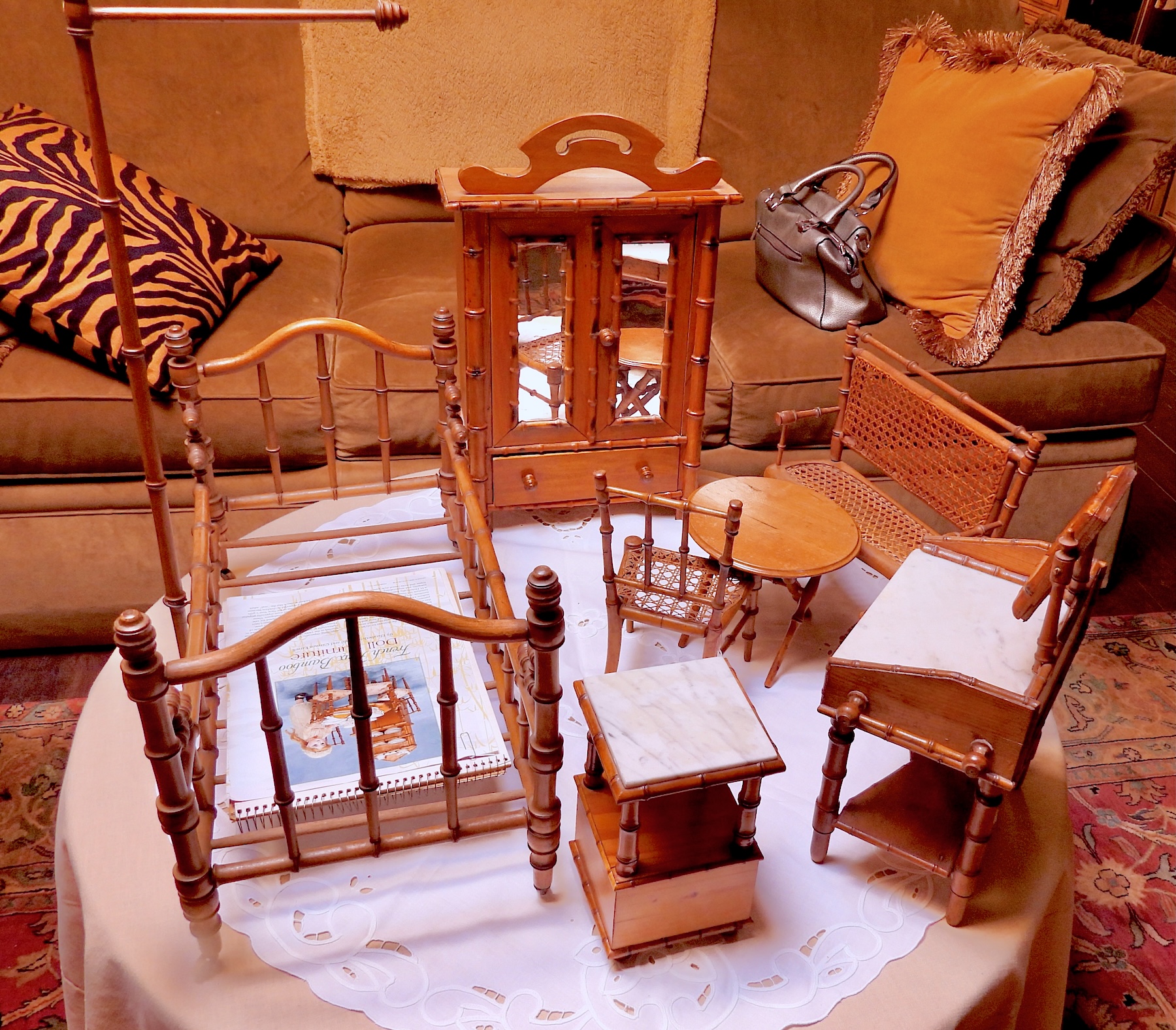
The club met at member Bette Birdsong's home, where she gave a program on French faux bamboo doll furniture. She explained that after trade opened with China and Japan in the 1860s, a style of furniture called “chinoiserie” that incorporated Asian motifs became popular in Europe. However, bamboo was too fragile for heavier European furniture, so companies began creating faux bamboo furniture using hardwoods. Doll furniture reflected this popular style throughout the 1800s. 

Bette said that the early faux bamboo doll furniture was high-end and often associated with French fashion 
dolls. Toy armoires, like this one, featured mirrored doors, as well as shelves for storing doll clothing and linen.

Night tables and dressing tables sometimes had marble tops. The night stand has a cabinet for secreting the chamberpot, while the dressing table features racks on the sides for holding towels.


The settee and chair have woven cane seats and the table folds up for storage,


Bette told the club that beds were the most expensive of such furniture, often outfitted with feather pillows and mattresses, as well as lace canopies. Lynda's bed has tiny metal casters and an arm for supporting a delicate canopy of lace or net. 

Sometimes pieces can be found with the maker’s label. Choumer and Collet began making making doll furniture in 1867 and later contracted with the American toy store FAO Schwarz. Faux bamboo doll furniture was exhibited at the 1900 Paris Exposition. 

Member Sharon Weintraub shared this French all-bisque doll by Fernand Sustrac, with ball-jointed elbows. Sustrac patented this doll in 1877. Sharon got the doll from a woman who had inherited the doll from her grandmother. The family spent time in France in the late 1800s and the woman assumed that the doll was probably purchased then. 


Bette displayed this Black character doll, attributed to the German firm of Bahr and Proschild. She said that the doll is on "permanent loan" from her sister, Lynda.


In honor of Halloween, member Elaine Jackson brought this cloth "gypsy" doll made in the 1970s by a local doll artist, Ann Lind. Elaine told the club that as a child she sometimes dressed up for Halloween as a gypsy woman wearing skirts, scarves, and jewelry borrowed from her mother's wardrobe.